Labradorite
Plagioclase feldspar (sodium calcium aluminum silicate), Mohs 6 to 6.5, perfect cleavage. The flash (labradorescence) is light reflecting off thin twin layers inside a gray to black body. Bead rough is mostly Madagascan.
At a glance
| Hardness (Mohs) | 6 to 6.5 |
|---|---|
| Family | Feldspar |
| Where it is mined | See description |
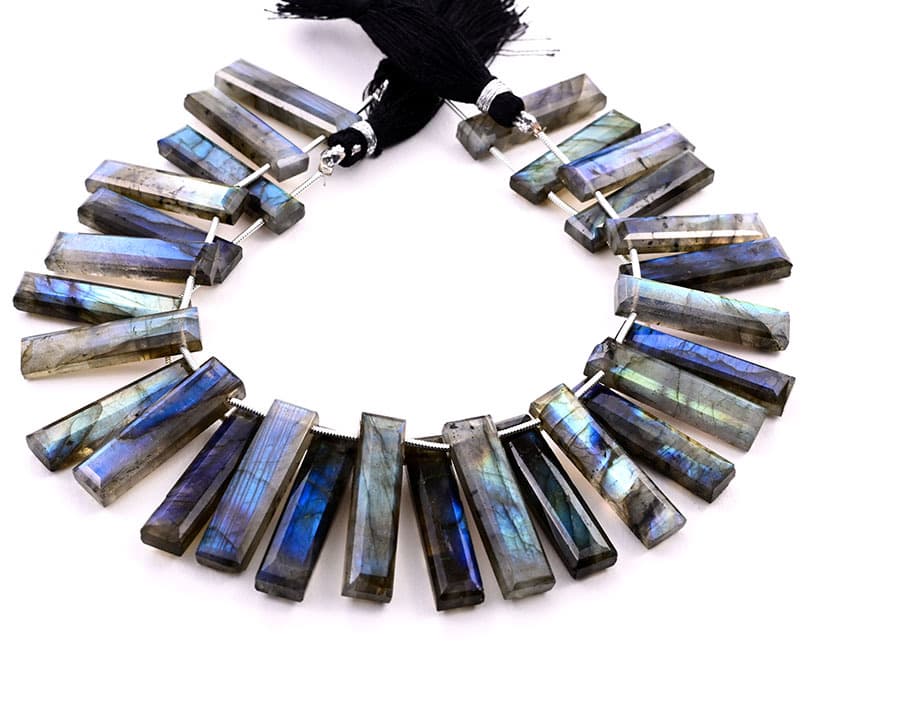
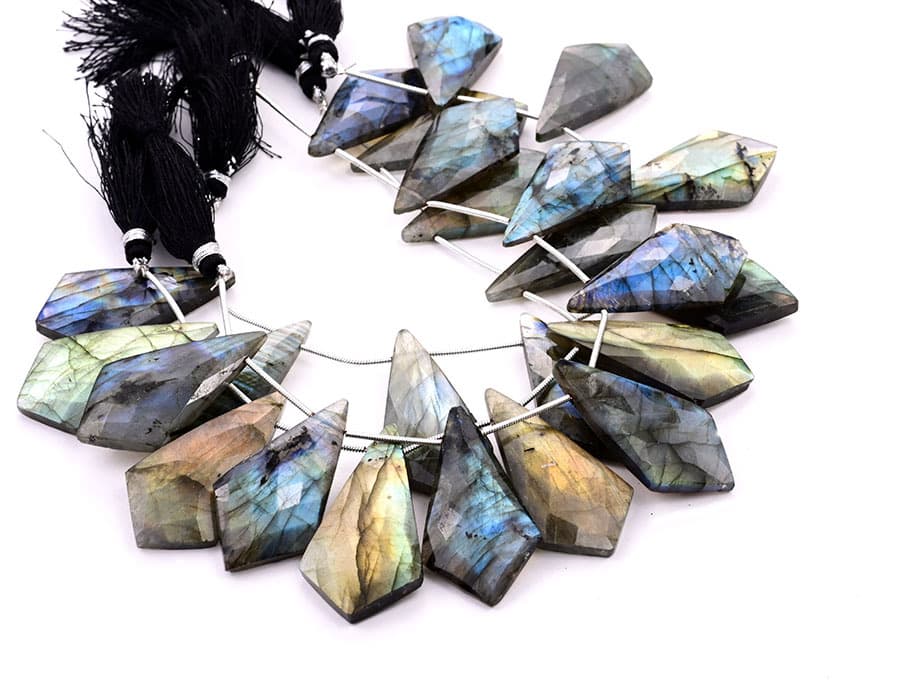
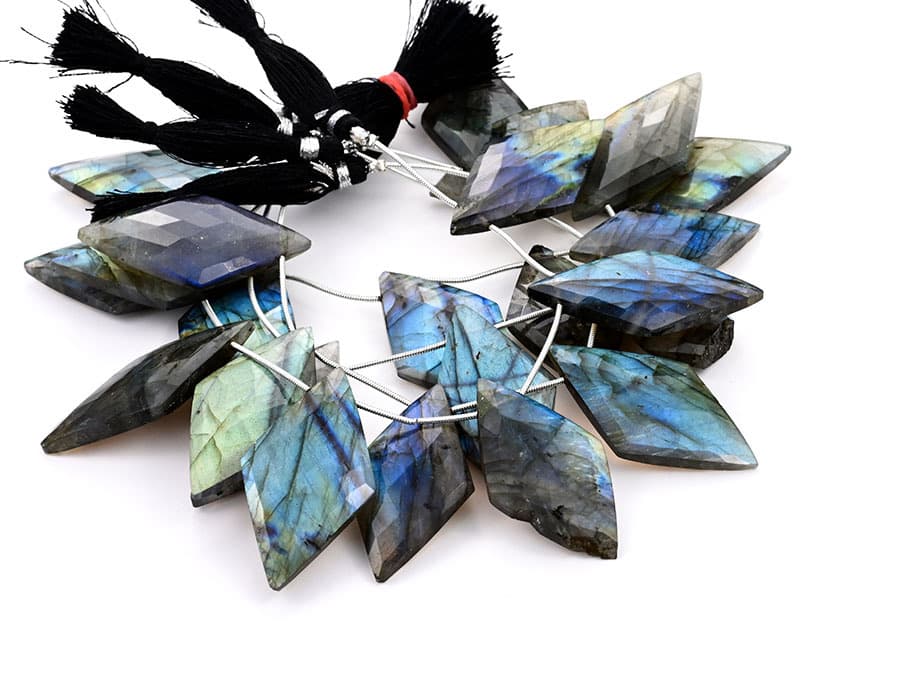
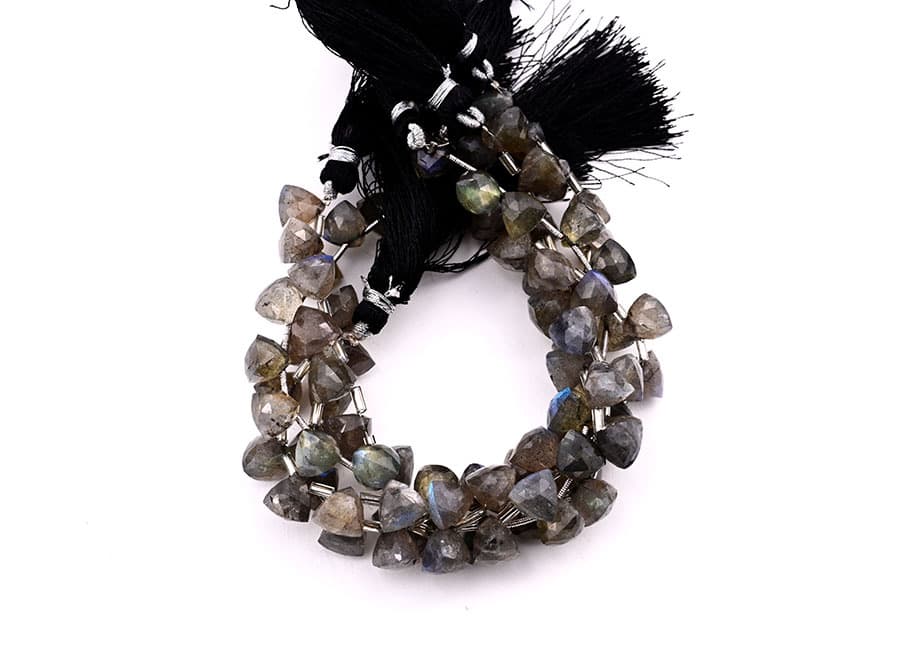
| Shapes we carry | Arrowheads, Diamond cuts, Hearts, Marquise, Pears, Pyramids, Rectangles, Trilliants |
| Strands listed | 10 |
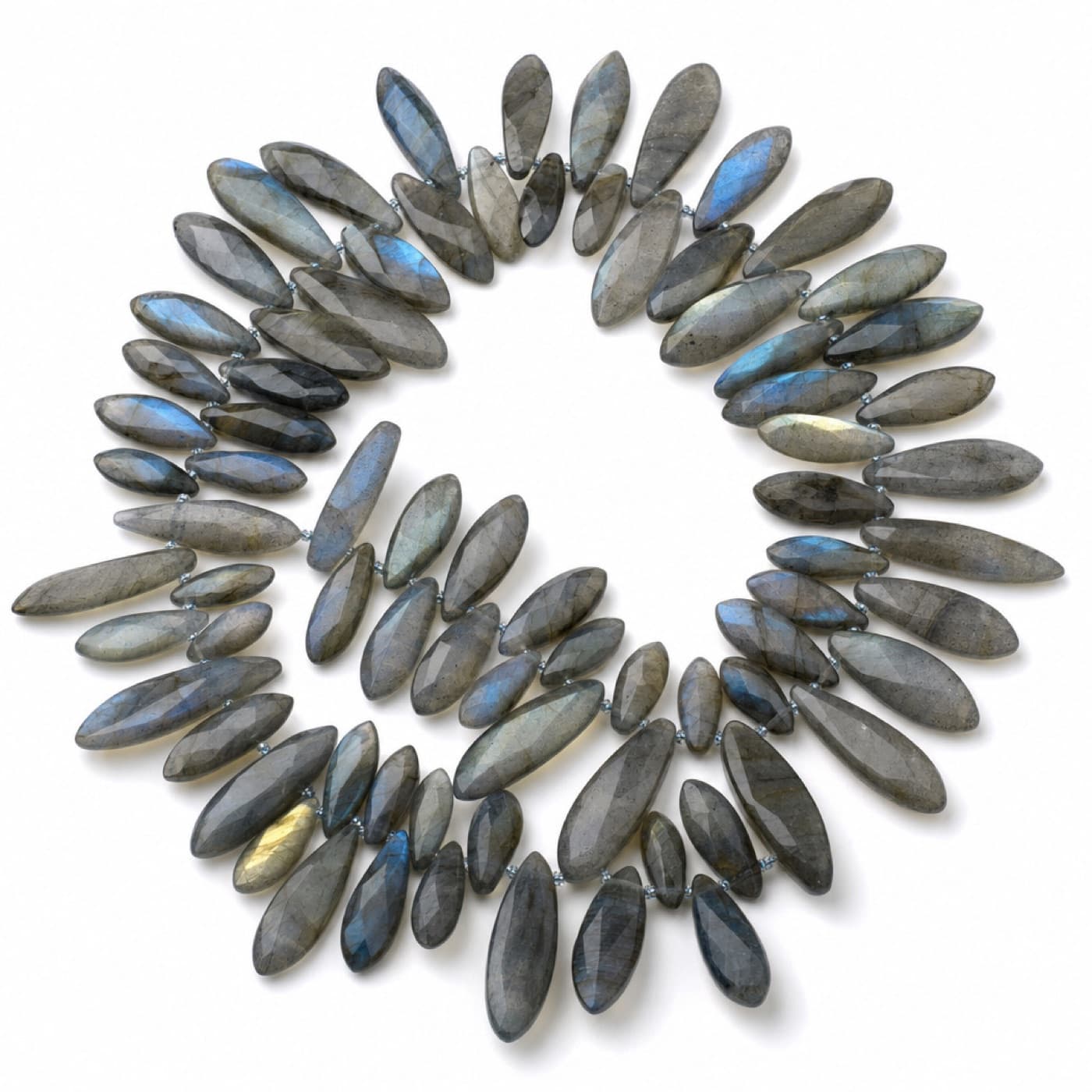
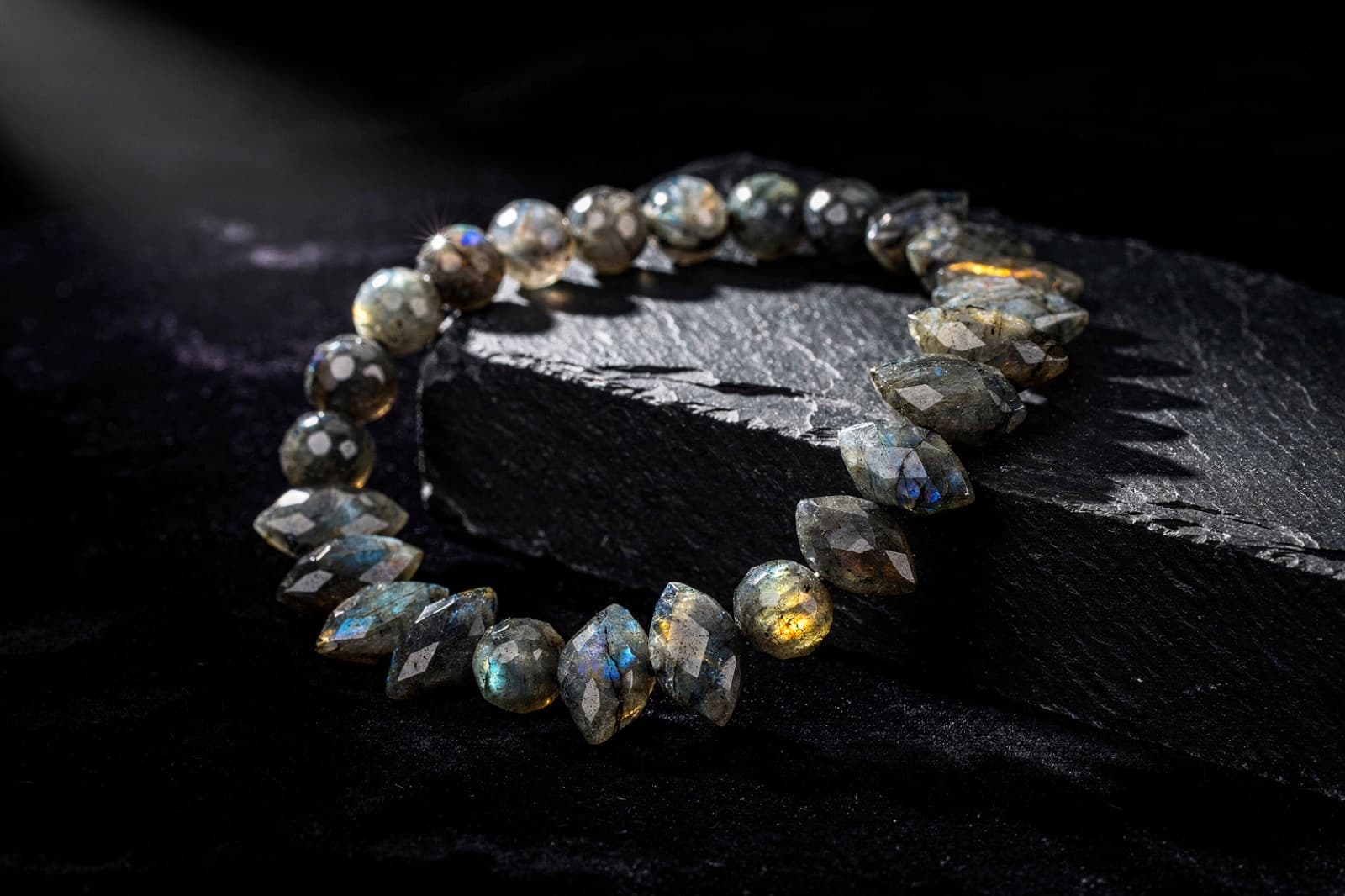
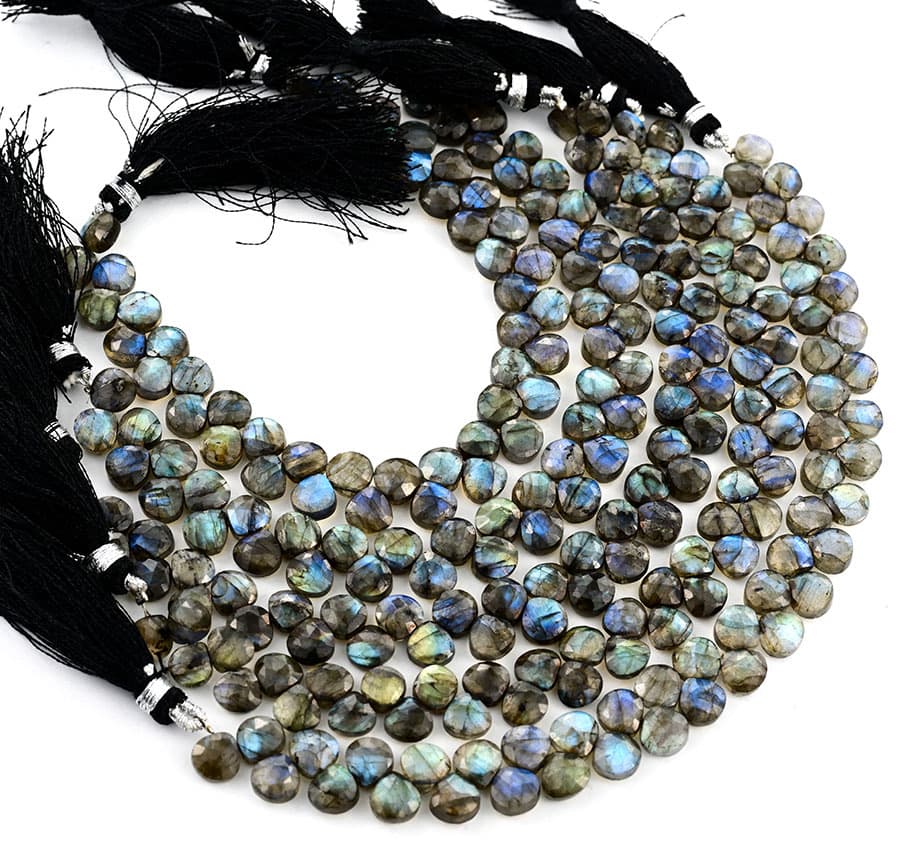
Film and illustrations are AI renders. Strand listings below show photographs of the actual material.
How to judge it
Blue over most of the bead is standard "AA"; gold, green and purple alongside blue is "AAA" at about double.
What it's like to work with
The gray-with-fire neutral for silver and boho work. Daggers and pears for earrings; nuggets and rectangles for statement necklaces.
Care
Earrings, pendants and loose necklaces; hard knocks cleave it; big nuggets chip at the edges. Warm soapy water only; no ultrasonic or steam.
No birthstone; tradition calls it a stone of transformation.
Gray until it turns, then blue across the whole face.
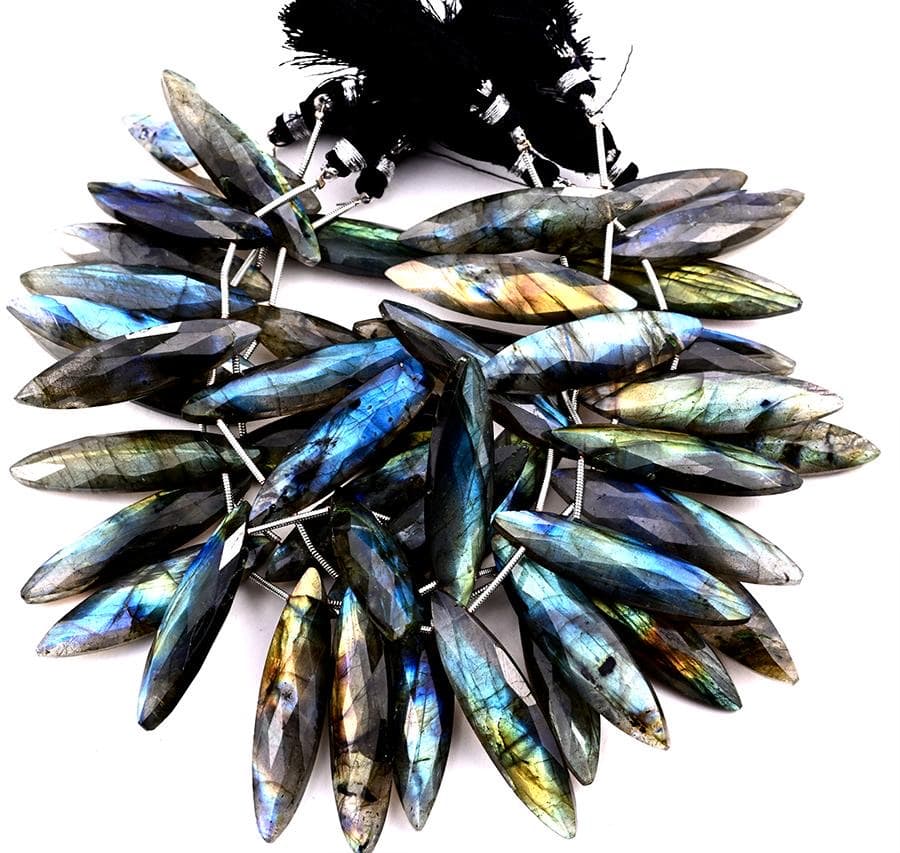
Hold a strand up and turn it slowly. One bead goes flat gray, the next throws a sheet of blue across its whole face, and a third gives you a thin edge of gold before it closes again. Faceted labradorite does this bead by bead, so no two strands look alike. The body color runs gray to near black, which is why people reach for it: a neutral that lights up when the wrist moves.
Where it comes from
Labradorite was first identified in Labrador, Canada, and takes its name from that peninsula. The geological type area is Paul's Island, near the town of Nain. It is a plagioclase feldspar, sitting between albite and anorthite, and it forms in mafic igneous rocks such as basalt, gabbro and norite. In anorthosite it can be the most abundant mineral in the rock, and it is one of the more common plagioclase varieties. It has since been reported in Poland, Norway, Finland, China, Australia, Slovakia, the United States and Madagascar. Most of the rough cut for beads today comes out of Madagascar. As a gem it is usually cut en cabochon, with a rounded convex surface. The beads on our strands are faceted instead. Our strands are cut in Jaipur, India, and chosen strand by strand in Cupertino, California.
What tradition says
The color play has a name of its own, labradorescence, borrowed from the stone that made it famous. What makes it happen is ordinary enough: light reflecting off thin twin layers inside a gray to black body. What tradition made of it is less ordinary. Because the flash appears and disappears as the bead turns, labradorite has long been called a stone of transformation, and that is how crystal tradition still describes it. The observation behind the belief is one any maker makes at the bench: the light sits inside the stone all the time, and the angle is what decides whether you can see it.
These are beliefs people have held about the stone, told as tradition. They are not claims, and not advice.
How makers use it
This is the gray-with-fire neutral, and it works hardest next to silver and in boho stringing. Faceted pears and daggers hang well from an ear wire, swinging and catching light from more angles than a still bead does. Rectangles suit statement necklaces, where the broad faces let a full sheet of blue show. Beads around 7x13mm keep to a scale that will string a whole necklace, while pieces closer to 20x37mm want to be the only thing in the design. Blue across most of the bead is the usual look; the strands with stronger flash add gold, green and purple alongside it. We list ten strands.
Looking after it
Labradorite is 6 to 6.5 on the Mohs scale with perfect cleavage, so a hard knock can split a bead and big nuggets tend to chip along their edges. Keep it to earrings, pendants and loose necklaces rather than tight bracelets. Clean with warm soapy water only, never in an ultrasonic or steam cleaner.
Sources: Labradorite: The gem plagioclase feldspar with play-of-color!, Labradorite, Labradorite, spectrolite: The gemstone Labradorite info and pictures · Minerals.net, Labradorite
Labradorite strands
All 10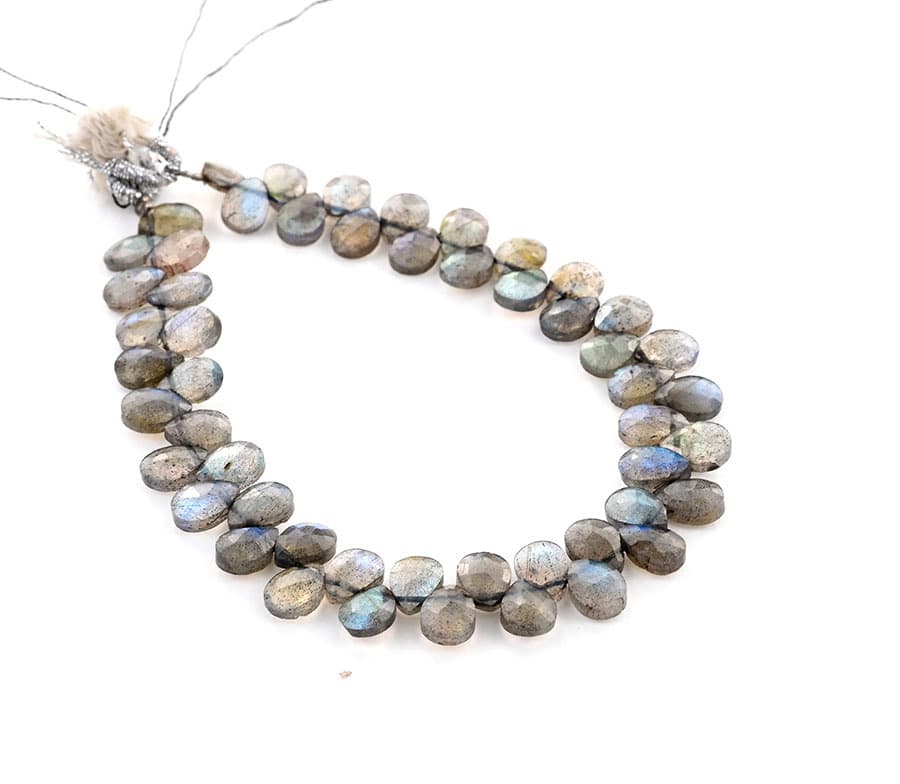
 Sold out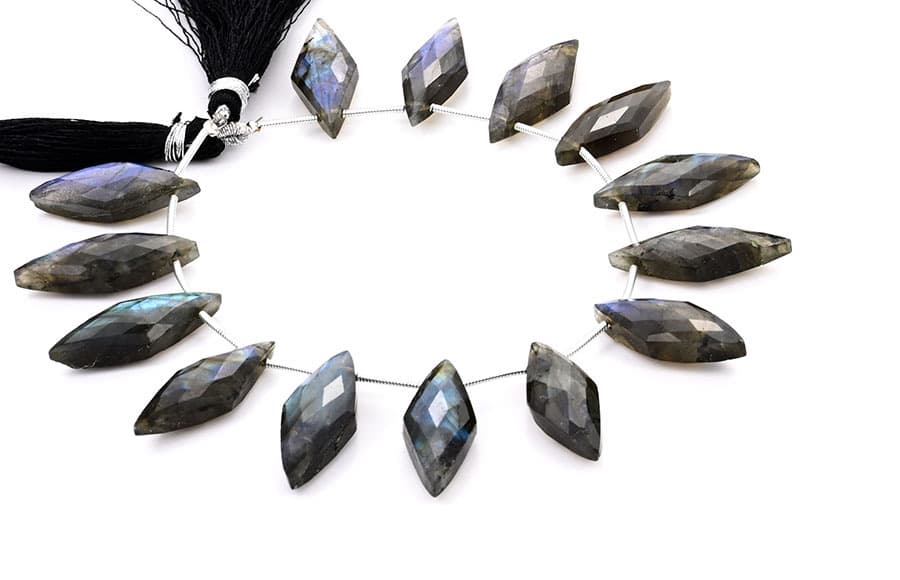
Related stones
From the blog
All posts Stone guides
What is labradorite and why does it flash
Labradorite is a plagioclase feldspar whose blue to gold flash, called labradorescence, comes from light bouncing between thin internal layers. To judge a strand, tilt it under one point light and count how many beads show face-up color. More even, face-filling flashes across more beads signals a stronger strand for stringing.
ComparisonsLabradorite vs moonstone how to tell them apart in beads
Both are feldspars. Labradorite shows directional blue to gold flashes from a dark gray body. Moonstone shows a soft blue or white glow from a milky body. What many sellers call "rainbow moonstone" is actually white labradorite. We sort by body color first, then watch how the sheen turns on and off as we tilt the strand.
 Making with beads
Should I string sapphire beads on wire or silk?
String faceted sapphire on flexible multi-strand beading cable sized to fit your bead holes, because facet edges can cut thread during wear. Use silk only for pearls and other smooth beads you want knotted between each bead. With cable and proper crimps you get strength, clean drape and dependable finishes for daily wear.