Amazonite
Blue-green microcline, a potassium feldspar (KAlSi3O8) colored by trace lead and water. Mohs 6 to 6.5, two cleavage directions. Russian material from the Ilmen Mountains shows white albite stripes in a grid or ribbon pattern, hence "Russian banded". Also Peru, Brazil.
At a glance
| Hardness (Mohs) | 6 to 6.5 |
|---|---|
| Family | Feldspar |
| Where it is mined | See description |
| Shapes we carry | Arrowheads, Diamond cuts, Half moons, Hearts, Marquise, Ovals, Pears, Pyramids, Rectangles, Tear drops, Trilliants |
| Strands listed | 32 |
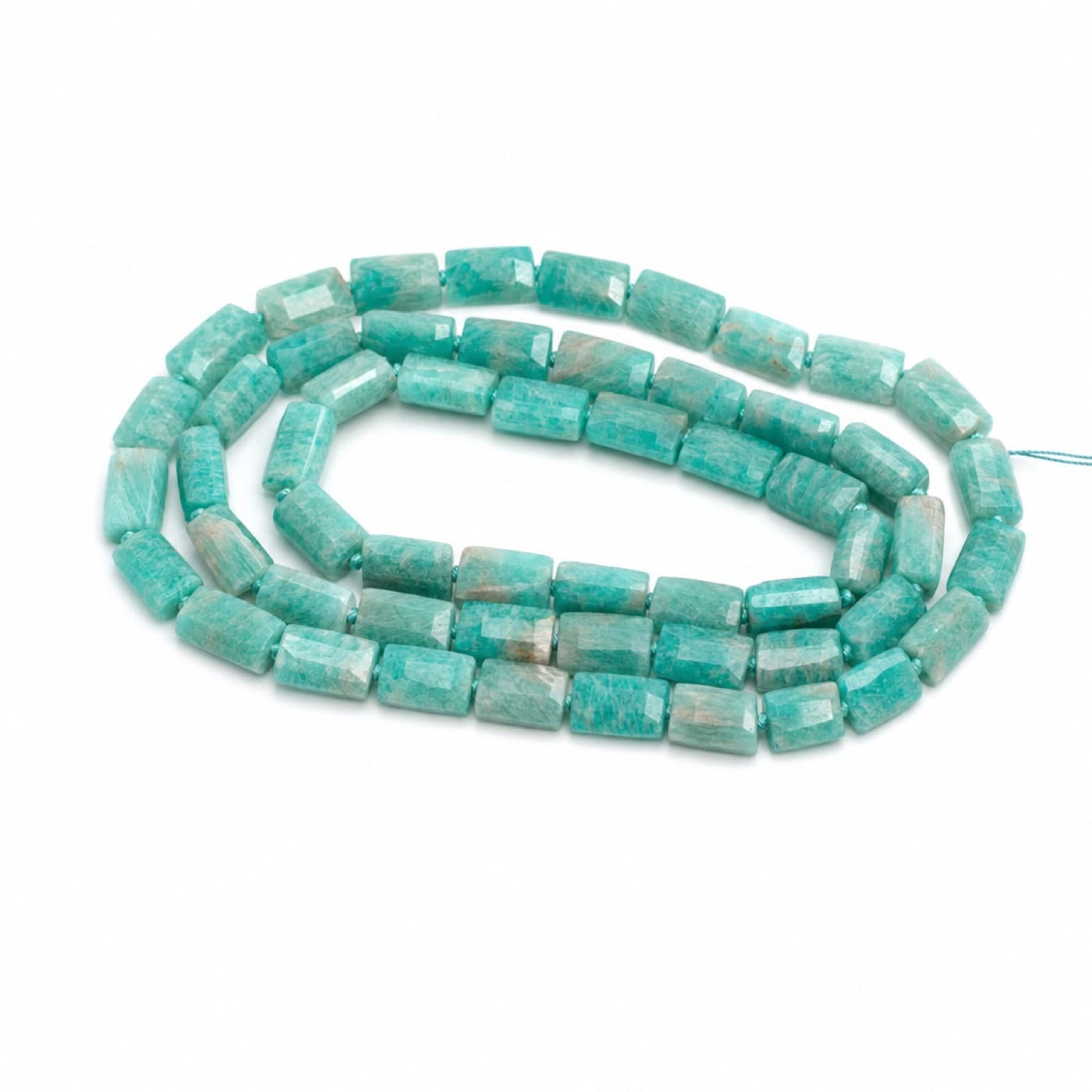
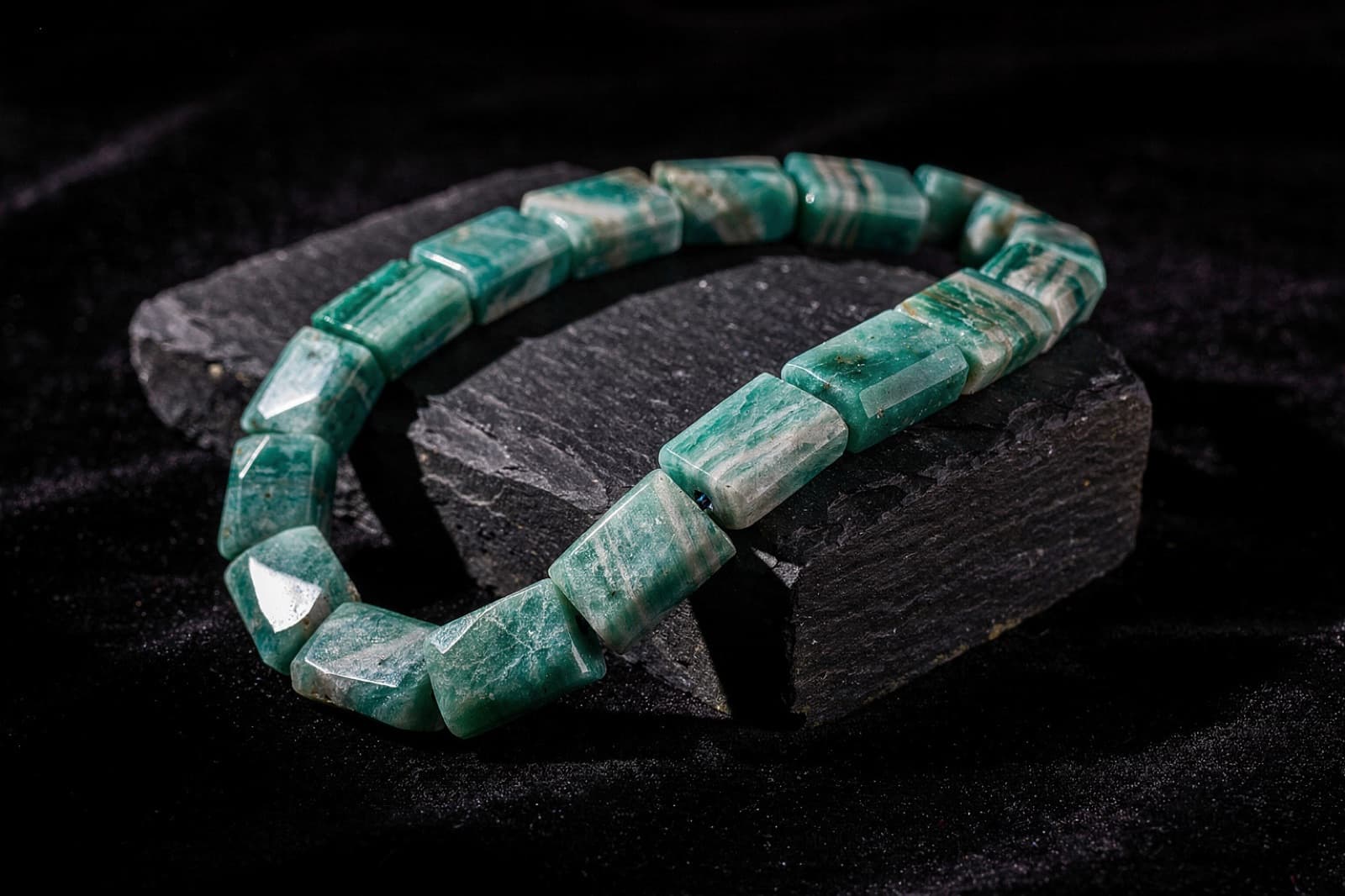
Film and illustrations are AI renders. Strand listings below show photographs of the actual material.
How to judge it
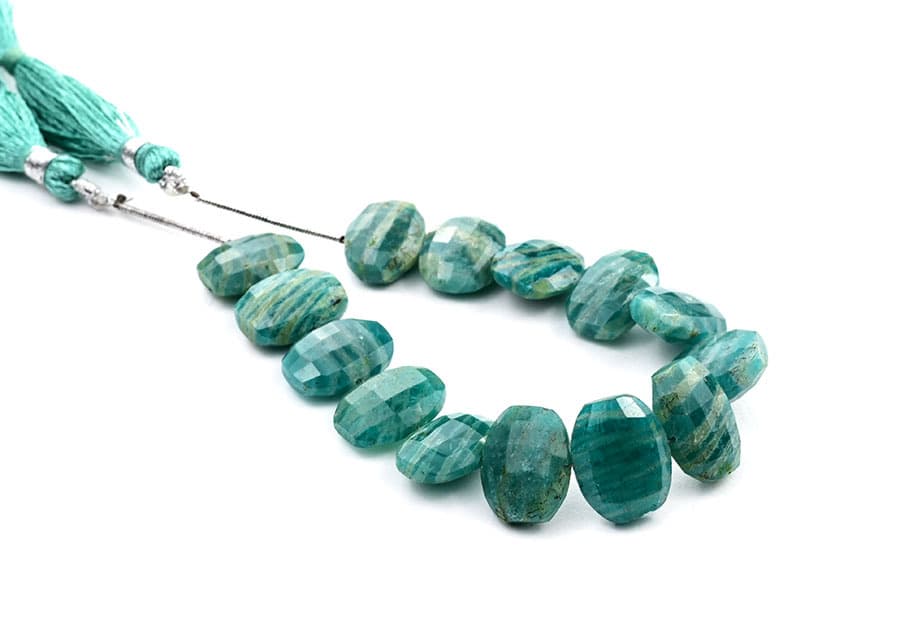
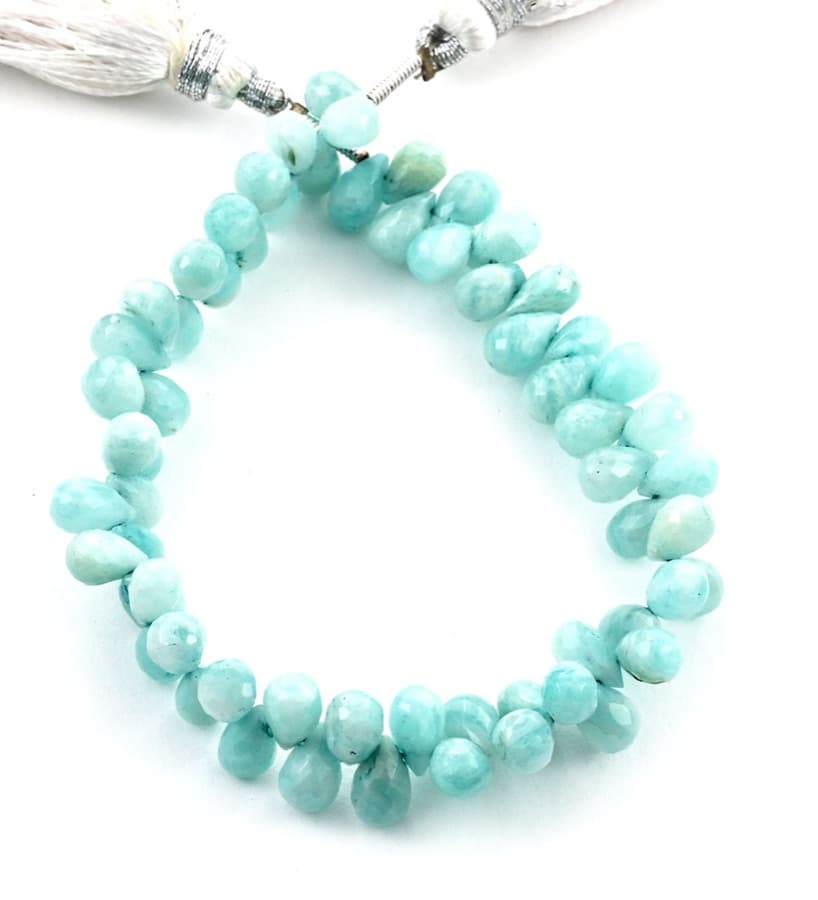
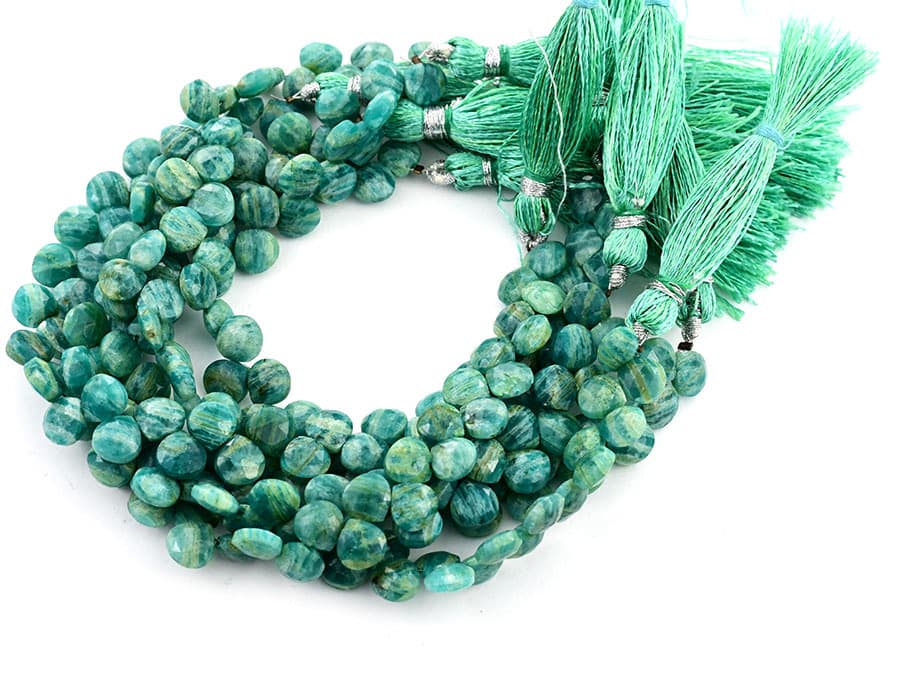
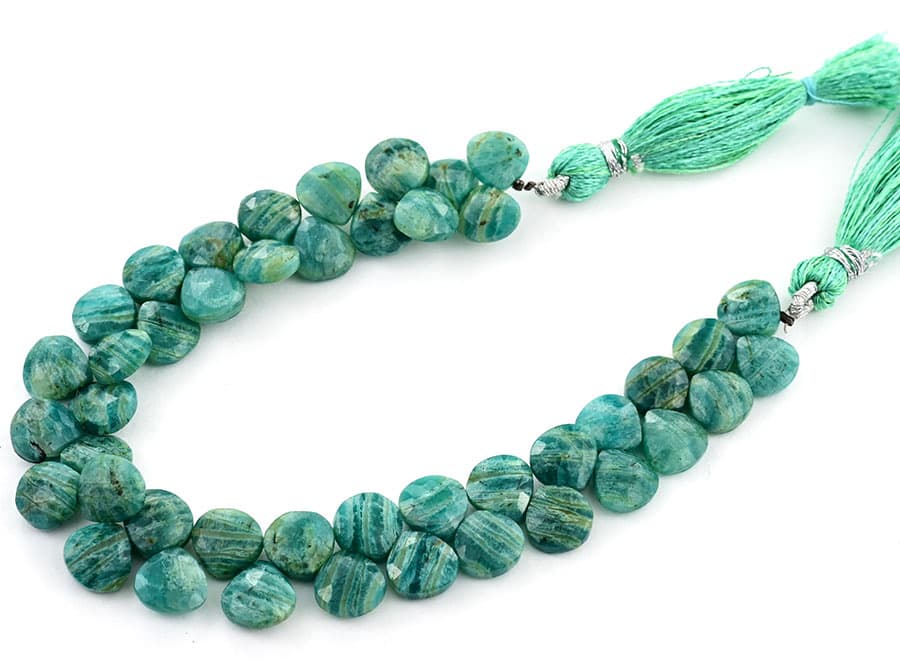
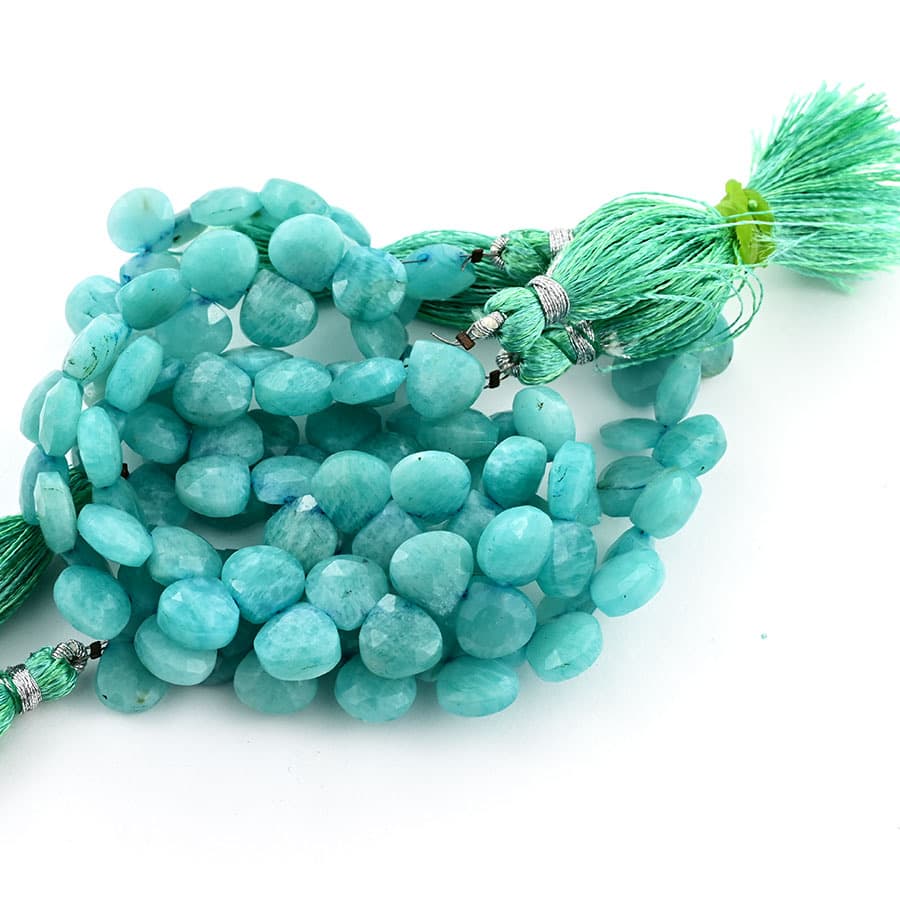
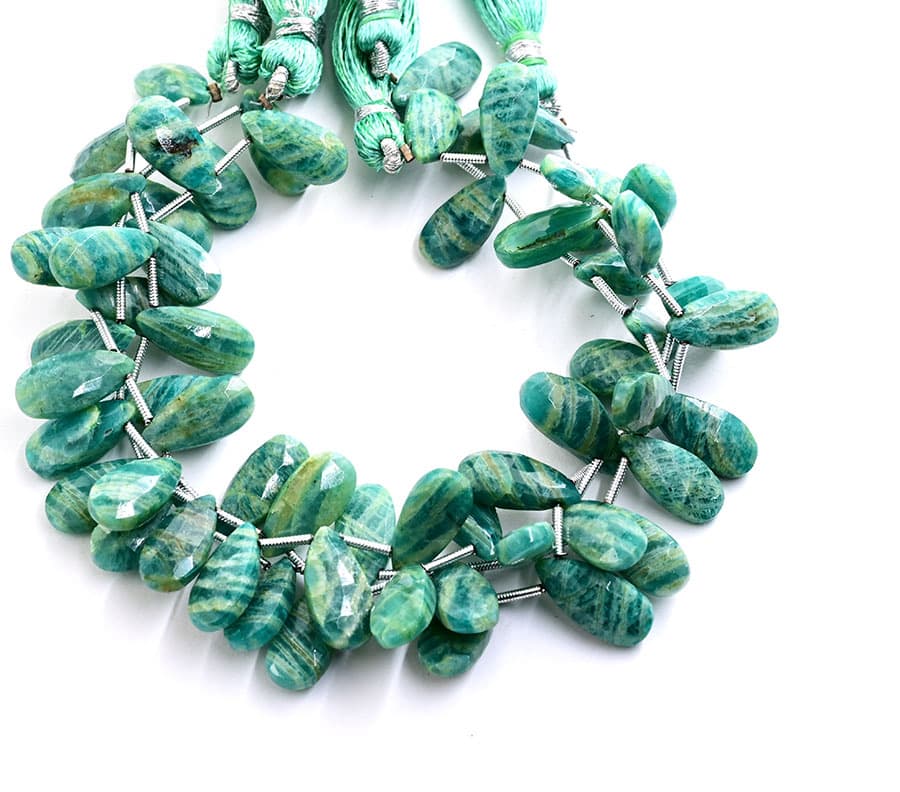
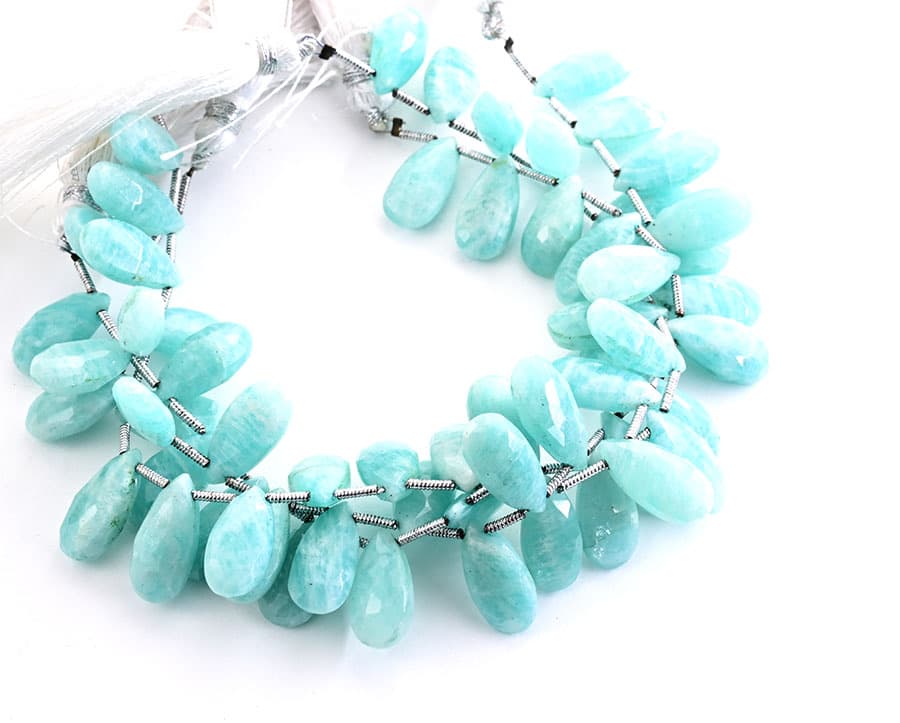
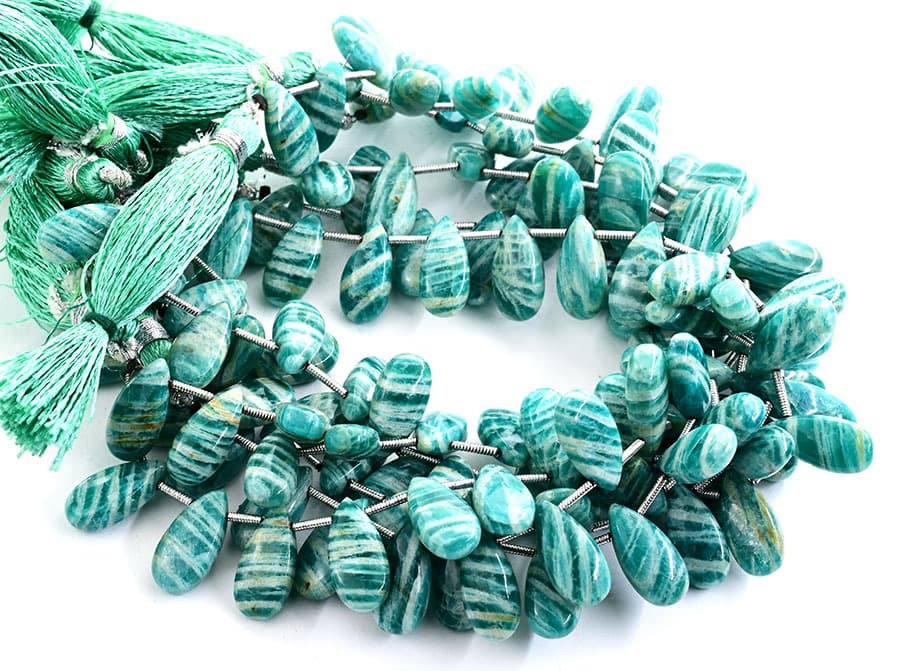
Saturated teal-blue with crisp white banding tops the Russian line; Peruvian runs paler turquoise blue. Opaque, so judge polish and facet sharpness.
What it's like to work with
Summer and coastal palettes, a cheaper "turquoise look", geometric shapes for minimalist designers. Marquise and pear for earrings.
Care
Earrings, necklaces and light bracelets; chips on hard knocks along cleavage. Warm soapy water only; no ultrasonic or steam.
No birthstone; by tradition a "hope" stone.
A hope stone the color of shallow water.
Hold a strand of amazonite up to the window and the color sits still. Blue-green, opaque, with no glow coming through from behind. The Russian beads carry white albite stripes, some in a grid, some in ribbons. Because light does not pass through the stone, what you end up looking at is the cutting: flat faces, clean edges, a low steady sheen along the polish. People reach for it when a design wants turquoise blue and a stone that stands on its own name.
Where it comes from
Amazonite is microcline, a potassium feldspar, KAlSi3O8, its color thought to come from trace lead and water in the structure. The name came from the Amazon River, where green stones were once believed to have been obtained, though no deposit has been found there and it remains uncertain whether those stones were amazonite at all. People have worn it for more than three thousand years, as archaeological finds in Middle and New Kingdom Egypt and in Mesopotamia show, and it is not named by any ancient or medieval writer. For a long stretch it was confused with jade, which the color explains. The stone comes today from the Ilmen Mountains in Russia, and from Peru and Brazil. Russian material shows the white striping and goes by the name Russian banded; plain blue is not Russian. Our strands are cut in Jaipur, India, and chosen strand by strand in Cupertino, California.
What tradition says
In crystal tradition amazonite is held to be a stone of hope, and people have long believed that is what it brings the wearer. The belief is usually left at that one word, with no list attached to it. It is handed down by word of mouth, repeated from one pair of hands to the next, and offered as belief rather than as a finding. Nothing in it is measured or proved. Makers who care about such things tend to say the word plainly when they hand a finished piece over, and then leave the rest of it to the person who wears it.
These are beliefs people have held about the stone, told as tradition. They are not claims, and not advice.
How makers use it
Marquise and pear suit earrings, since the long faces show the polish, and we stock both at 10x13mm and 10x15mm. Rectangles go to designers working geometric and plain. The color belongs to summer and coastal palettes, and it gives you turquoise blue in a necklace. We carry amazonite faceted and smooth, in marquise, pear and rectangle among other shapes, including the Russian banded, with 32 strands listed at a time and sold by the 8 inch and the 16 inch. On the Russian line, saturated teal with crisp white banding is the strongest look; Peruvian material runs paler turquoise blue.
Looking after it
Amazonite is 6 to 6.5 on the Mohs scale with two cleavage directions, so it chips on a hard knock rather than wearing down slowly. Keep it to earrings, necklaces and light bracelets. Wash with warm soapy water and a soft brush, then dry it. No ultrasonic, no steam.
Sources: Amazonite: A bluish-green gem mineral. A microcline feldspar, Amazonstone | Healing, Metaphysical & Protection | Britannica, Amazonite - Wikipedia, Amazonite: The gemstone Amazonite information and pictures · Minerals.net
Amazonite strands
All 32