Rainbow moonstone
White labradorite, a plagioclase feldspar (sodium calcium aluminum silicate), not orthoclase moonstone; the blue or multicolor sheen is light scattering off thin internal layers. Mohs 6 to 6.5, perfect cleavage. Bead rough: mostly India.
At a glance
| Hardness (Mohs) | 6 to 6.5 |
|---|---|
| Family | Feldspar |
| Where it is mined | mostly India |
| Shapes we carry | Marquise, Pears, Pyramids |
| Strands listed | 4 |
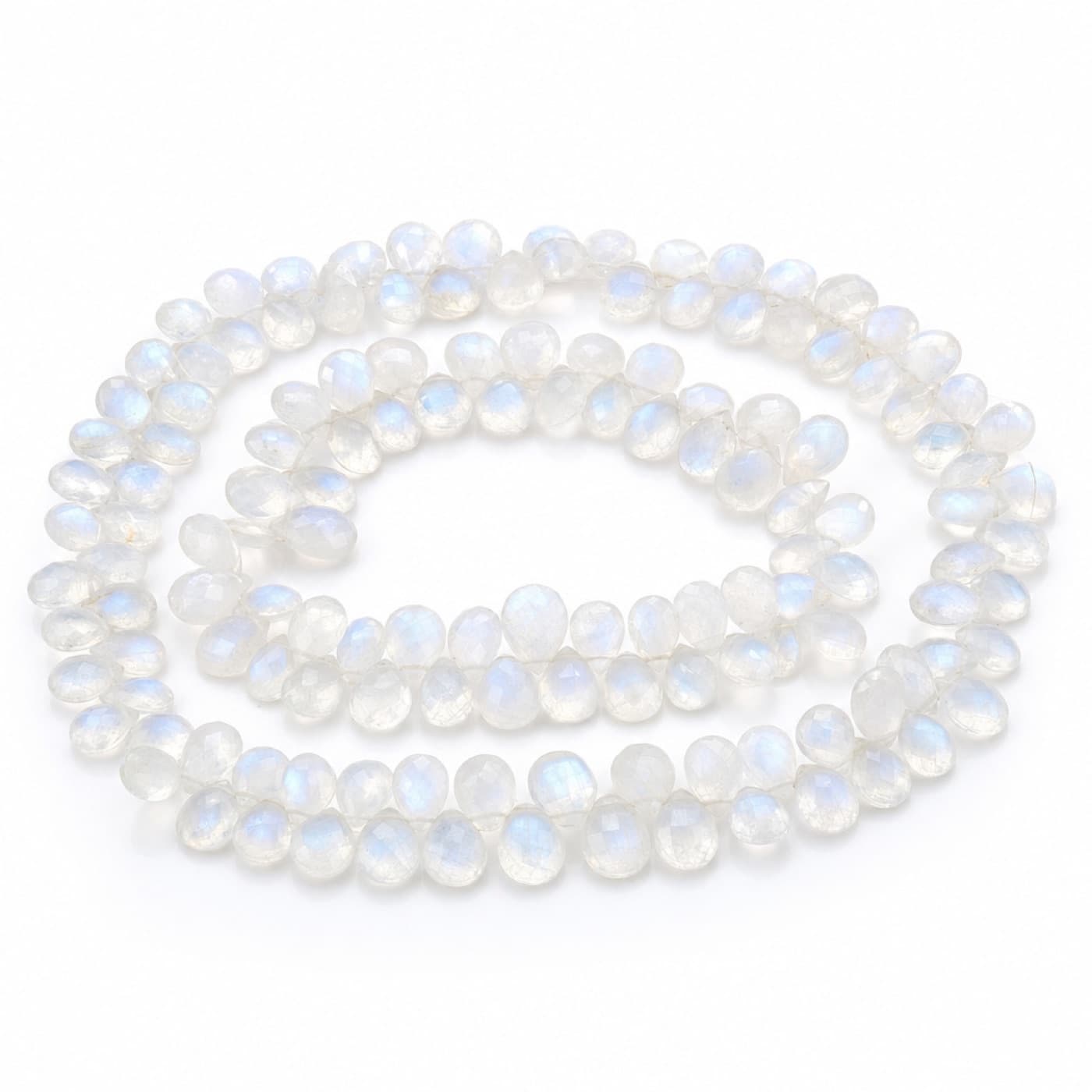
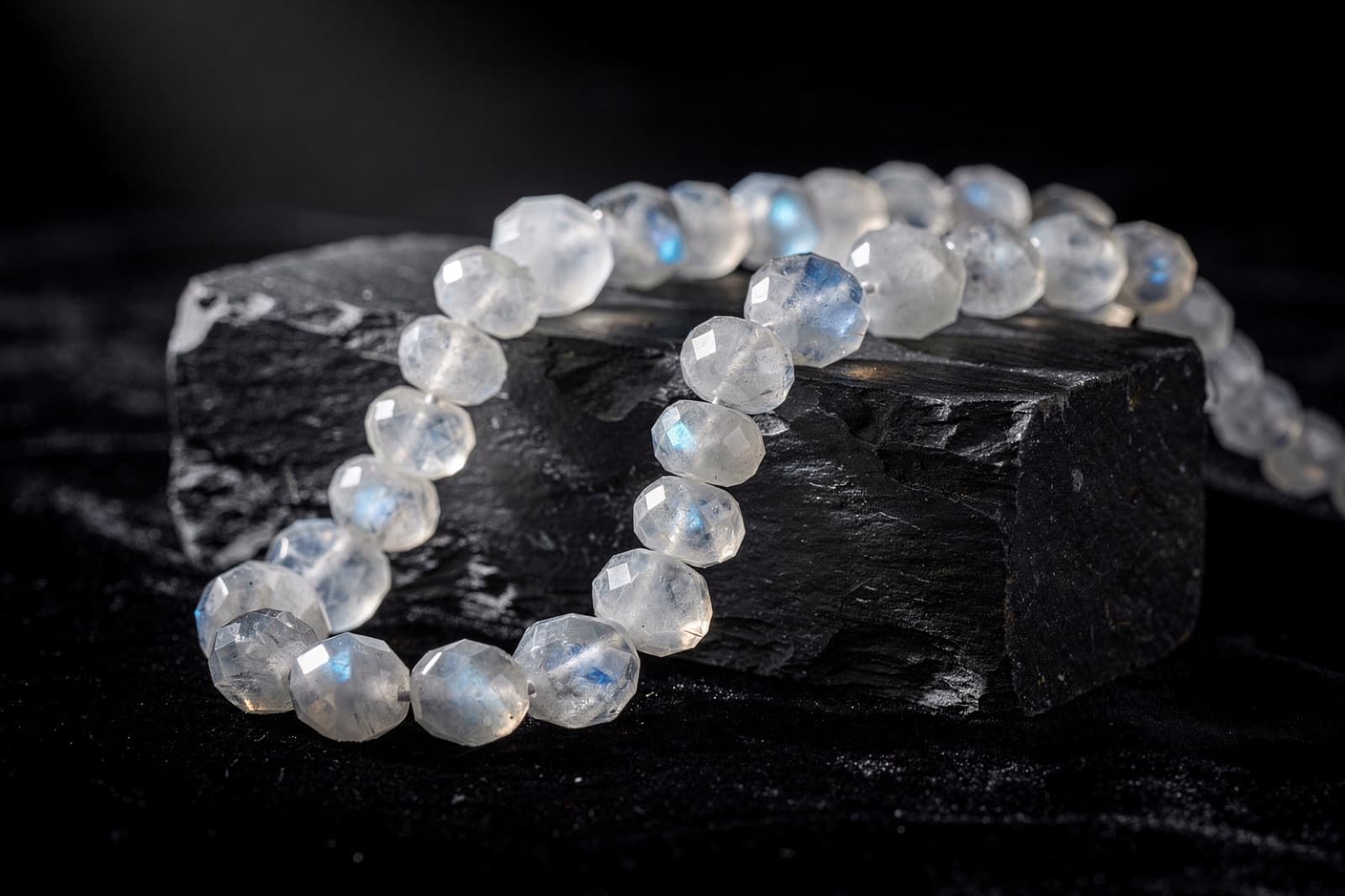
Film and illustrations are AI renders. Strand listings below show photographs of the actual material.
How to judge it
Strong blue flash across most beads is the top grade; a few blue beads and the rest chalky is the bottom. Look-alike: opalite, a milky glass that glows the same from every angle and shows bubbles; feldspar sheen switches off as you tilt.
What it's like to work with
Bridal, June-birthday, celestial and boho designers. Rondelles and briolettes move fastest; coins and cushions for statements.
Care
Earrings and necklaces, not rough-wear bracelets; hard knocks split it. Warm soapy water only; no ultrasonic or steam.
June birthstone; by tradition new beginnings.
Roll it under the light and find the blue.
On the strand it reads almost white, a row of small glassy panes with a little cloud held inside each one. Then you tilt the string toward a window and the blue arrives, bead after bead, and switches off again as you turn away. That tilt is why people reach for it. A few beads carry a flick of gold or violet along one edge. Cut with facets, the sheen breaks into short bright points instead of one soft billow.
Where it comes from
Rainbow moonstone is white labradorite, a plagioclase feldspar of sodium, calcium and aluminum silicate. Classic moonstone is a different member of the family, orthoclase, where light scattering between alternating thin layers of orthoclase and albite makes the soft floating glow called adularescence, named because it looks like the moon behind thin cloud. Nearly all commercial moonstone of that older kind comes from the Dumbara District of Sri Lanka. Labradorite scatters light off its own thin internal layers, which is why the color runs to blue and sometimes further, and the trade has long accepted it as a gem in its own right. Some buyers now prefer it to the traditional stone. The rough behind bead strands is mostly Indian. Ours are cut in Jaipur and chosen strand by strand in Cupertino, California.
What tradition says
In Hindu mythology moonstone is described as solidified moonbeams, and cultures far from one another have tied the stone to moonlight. Old legends hold that it brings good luck, and it was once believed that holding a moonstone in your mouth during a full moon would let you see what was coming. In crystal tradition, rainbow moonstone is the stone of new beginnings, carried at thresholds and turning points, and people have long believed it steadies the person wearing it. Moonstone is a June birthstone, one of the original modern birthstones set in 1912, sharing the month with pearl and alexandrite. That connection is why it turns up so often in gifts given for a birthday or a start.
These are beliefs people have held about the stone, told as tradition. They are not claims, and not advice.
How makers use it
Bridal, celestial and boho makers keep coming back to it, and the shapes that move fastest here are faceted rondelles and briolettes. Rondelles at 3 to 4mm work as spacers and as a full white line in a strung necklace, bright without shouting. Pear briolettes around 9x15mm hang well for earrings, single drops or a fringe. Coins suit a statement piece where you want the sheen read as one broad plane. On a strong strand the blue lifts across most of the beads rather than showing on two or three while the rest sit chalky. We list four strands.
Looking after it
Wear it in earrings and necklaces rather than a bracelet that takes knocks. At 6 to 6.5 on the Mohs scale, with perfect cleavage, a hard hit can split a bead along its grain. Clean with warm soapy water and a soft brush, then dry it. Keep it out of ultrasonic machines and away from steam.
Sources: Moonstone History and Lore, Is rainbow moonstone really moonstone?, What Is Moonstone Gemstone | Moonstone Stone – GIA, Moonstone: Gems with a white, silver, blue or rainbow glow
Rainbow moonstone strands
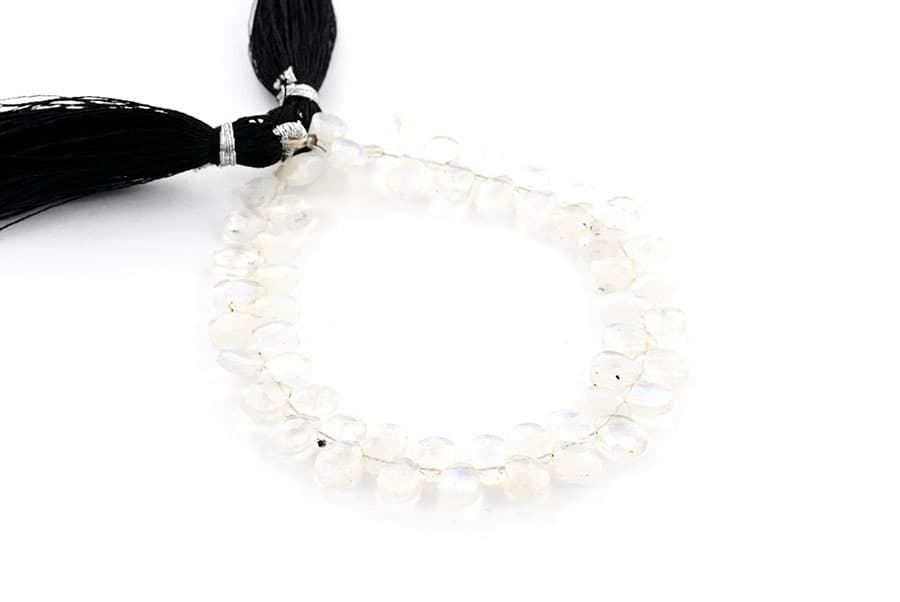 Representative photoRepresentative photo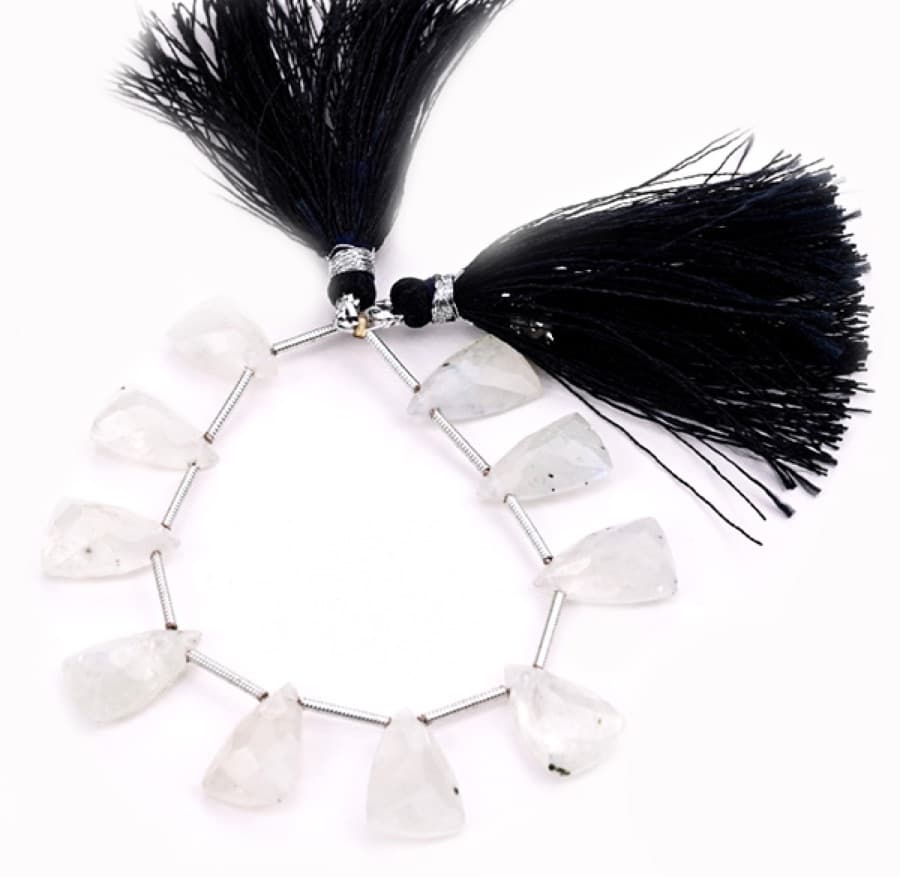
Related stones
From the blog
All posts Comparisons
Labradorite vs moonstone how to tell them apart in beads
Both are feldspars. Labradorite shows directional blue to gold flashes from a dark gray body. Moonstone shows a soft blue or white glow from a milky body. What many sellers call "rainbow moonstone" is actually white labradorite. We sort by body color first, then watch how the sheen turns on and off as we tilt the strand.
 Care and durability
Can moonstone go in water, the shower or an ultrasonic cleaner
Plain water is fine for moonstone beads, but pools and ultrasonic cleaners are not. Moonstone is Mohs 6 to 6.5 with cleavage, so internal layers can split from shocks or heat change. To clean: rinse with lukewarm water, use a tiny drop of mild soap and a soft brush or cloth, then rinse, pat dry and air dry flat.
Making with beadsHow many 6 mm or 8 mm beads for an 18 inch necklace
Plan about 66-70 of 6 mm beads or about 50-52 of 8 mm beads for an 18 inch necklace. The clasp and findings take about 1.5 inches. One 15 to 16 inch strand is usually enough for either size. String beads for the remaining length, then attach your clasp.