Sunstone
Feldspar with aventurescence, a glittery copper-red sparkle from tiny flat platelets of hematite or copper. Bead-grade sunstone is oligoclase or orthoclase feldspar from Tamil Nadu, India, and Tanzania; Oregon is a different price tier. Mohs 6 to 6.5, two cleavage directions.
At a glance
| Hardness (Mohs) | 6 to 6.5 |
|---|---|
| Family | Feldspar |
| Where it is mined | See description |
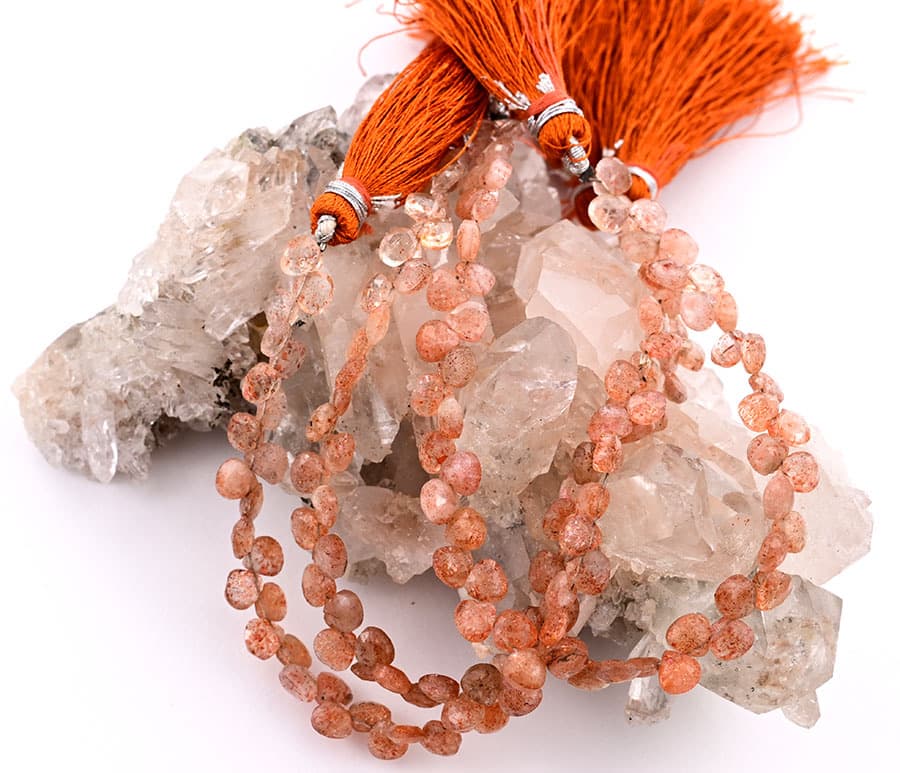
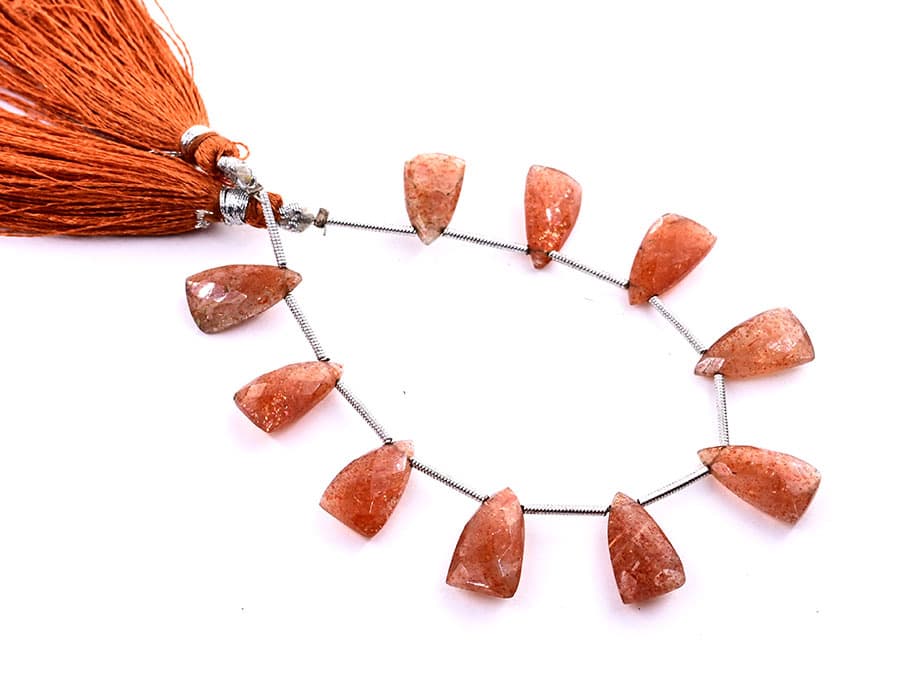
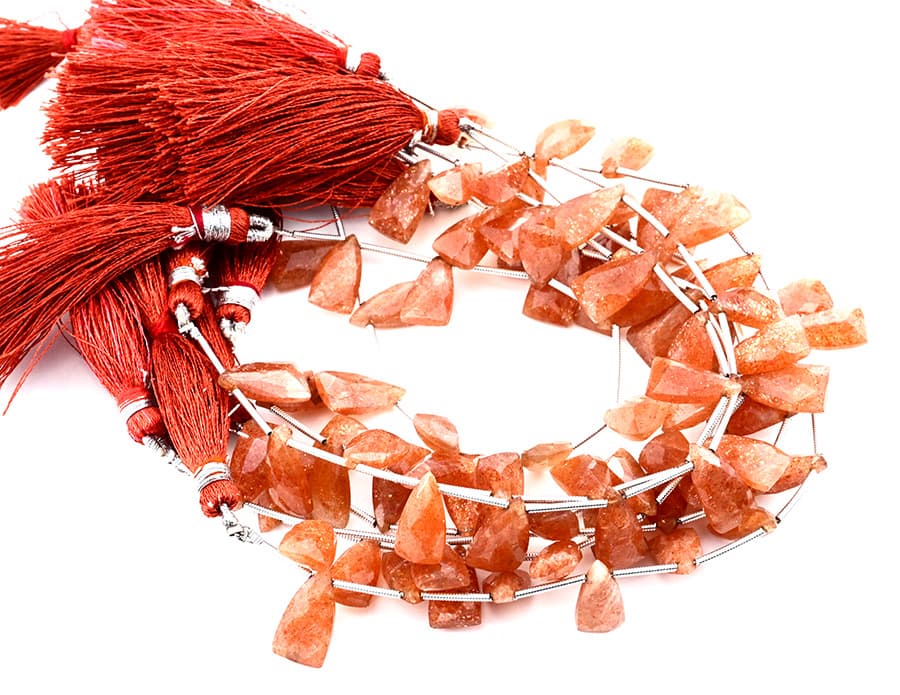
| Shapes we carry | Hearts, Pyramids |
| Strands listed | 3 |
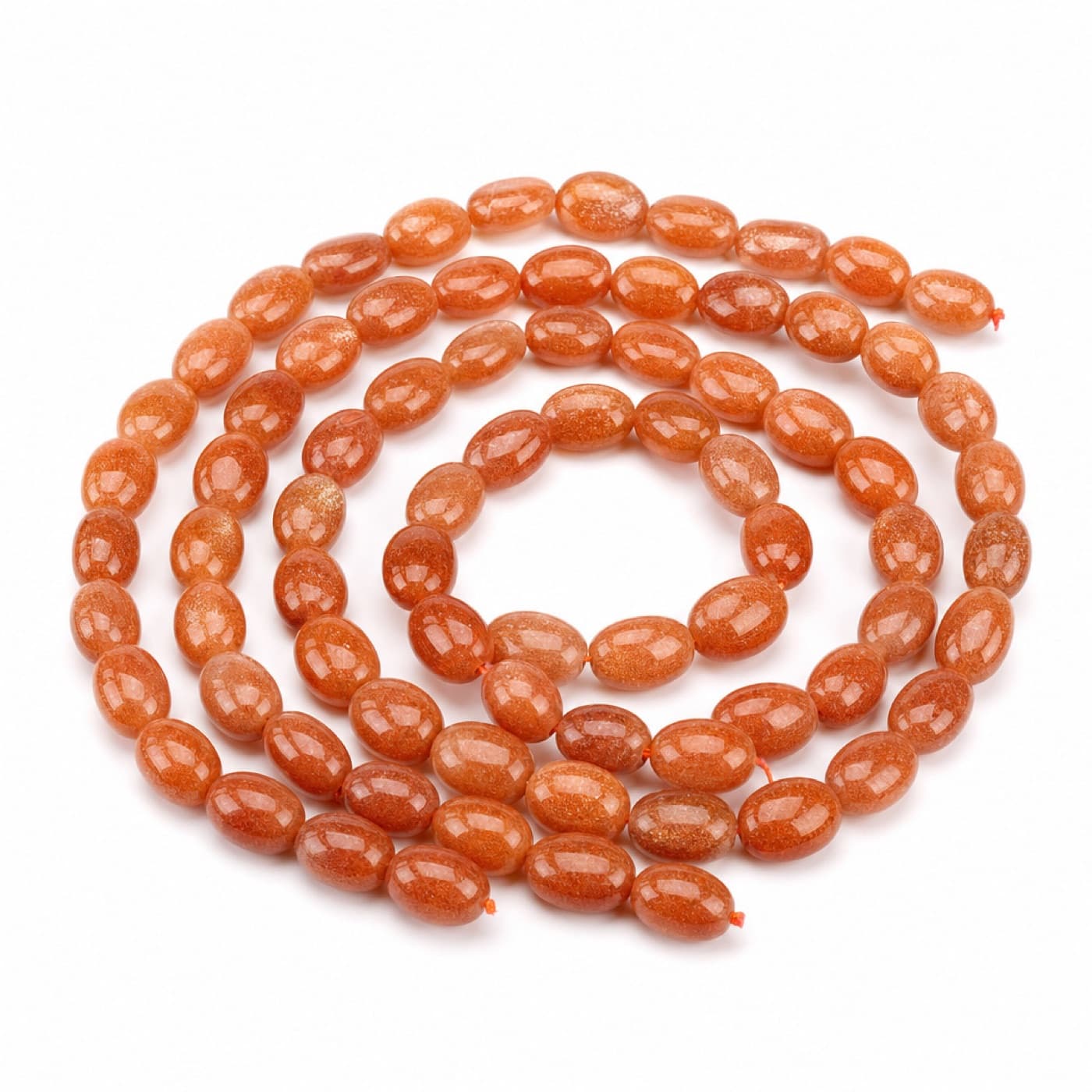
Film and illustrations are AI renders. Strand listings below show photographs of the actual material.
How to judge it
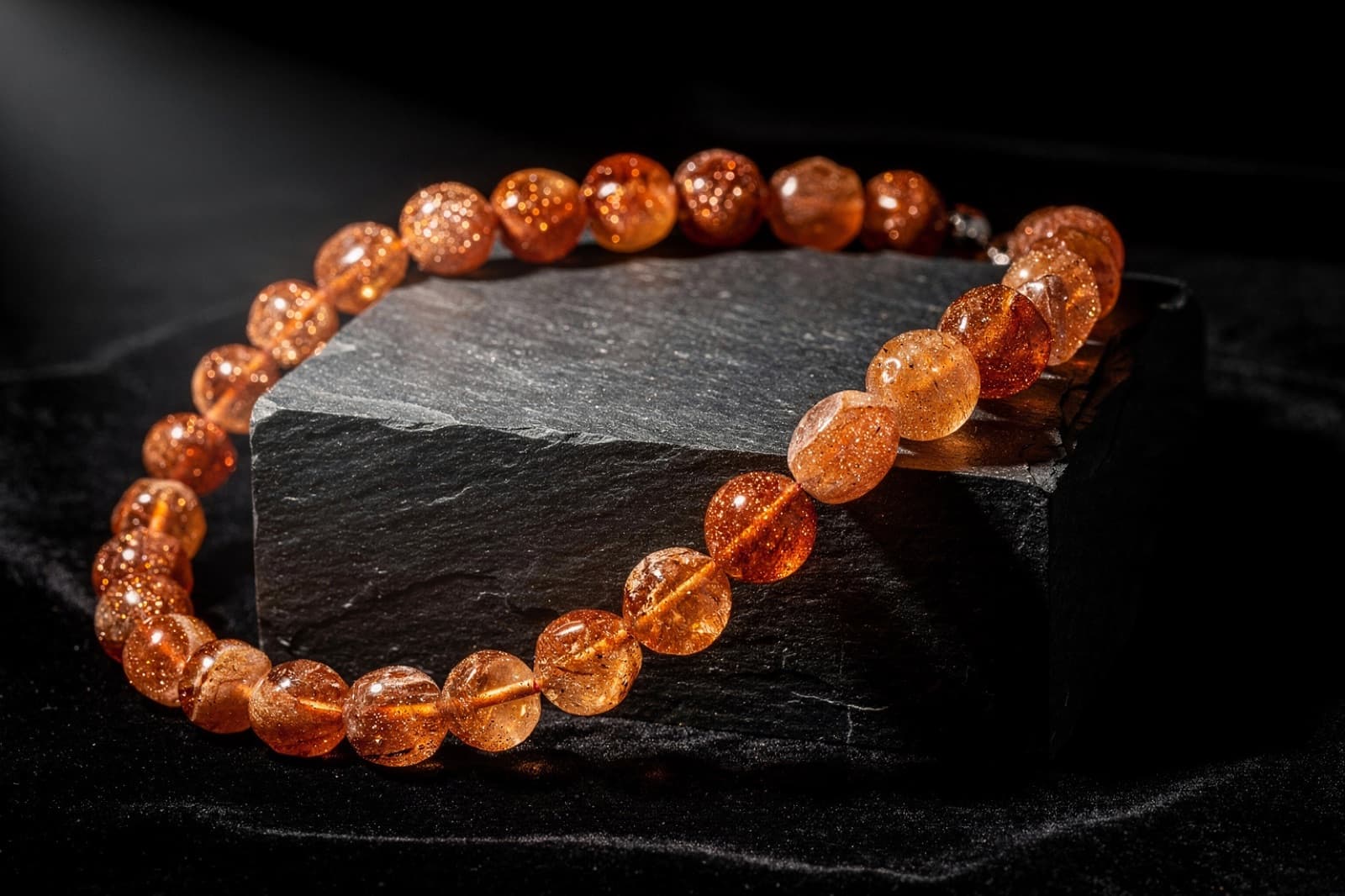
Warm orange-red body with a metallic glitter that flashes in patches as you tilt. Look-alike: goldstone, a copper-flecked glass, sparkles uniformly from every angle, shows bubbles, and comes in blue and green; sunstone never does.
What it's like to work with
Warm autumn and southwestern palettes, men's heishi bracelets, a glittering partner for labradorite. Heishi and flat nuggets stand out.
Care
Earrings and necklaces; cleavage makes it chip. Warm soapy water only; no ultrasonic or steam.
No birthstone; by tradition a stone of joy and personal power.
Coppery glints caught in feldspar
On the strand, sunstone shows warm apricot and rust with islands of metallic sparkle. Tilt it and the glitter comes in patches, not all at once. Those bright points come from tiny flat platelets of hematite or copper that grew inside the feldspar. It reads like late light across a field. Makers reach for it when a piece needs warmth with texture, or a quiet flash that appears and disappears as the wearer moves.
Where it comes from
Sunstone is a feldspar. Both orthoclase and the plagioclase species have sunstone varieties, including oligoclase. Bead-grade material comes from Tamil Nadu, India, and Tanzania. Deposits are also known at Tvedestrand, Norway; near Lake Baikal, Russia; and in the United States at Middletown, Pennsylvania, and Statesville, North Carolina. Oregon sunstone, a transparent feldspar with glittery copper inclusions, has gained attention as a product of the United States. The aventurescent effect arises from minute plate-like inclusions, commonly hematite or copper, aligned in the crystal; light reflects from them at a common angle to produce a flash. The stone is often cut en cabochon. In beads, the effect shows as moving patches along a strand. A glass imitation called goldstone sparkles uniformly from every angle and can show bubbles, sometimes in blue or green; natural sunstone never does.
What tradition says
In crystal tradition, sunstone has been linked with the warmth and power of the sun. People have long believed it brings energy, vitality, joy, and a steady sense of personal power. The glittering inclusions suggested stored sunlight to many, so it was kept for joy and personal power. Medieval sources in Iceland describe a mineral called a sunstone used to locate the sun in overcast skies, and church inventories in the 14th and 15th centuries in Iceland and Germany also mention sunstones. Today, it is kept, in crystal circles, for joy and personal power, as tradition holds.
These are beliefs people have held about the stone, told as tradition. They are not claims, and not advice.
How makers use it
We stock square heishi, flat nuggets, and faceted rondelles. The square heishi make easy men's bracelets; the flat nuggets read bold on cord or leather. Faceted 5 mm rondelles show the patchy flash as they turn, and 9 x 15 mm flat nuggets make it easy to see that effect along the strand. It settles into warm autumn and southwestern palettes, and pairs cleanly with labradorite. We have our strands cut in Jaipur, India, then choose them strand by strand in Cupertino, California. A stronger flash shows as dense coppery patches that light up as the bead turns.
Looking after it
With two cleavage directions and a Mohs hardness near 6 to 6.5, sunstone is best in earrings and necklaces. Avoid hard knocks that can chip edges. Clean with warm soapy water and a soft cloth. Skip ultrasonic and steam. Store strands apart from harder stones to keep surfaces from scuffing.
Sources: Sunstone Gemstone | Sunstone Stone – GIA Gem Encyclopedia, Sunstone - The gemstone with the aventurescent surprise!, Sunstone (medieval), Sunstone Value, Price, and Jewelry Information - International Gem Society