What is labradorite and why does it flash?
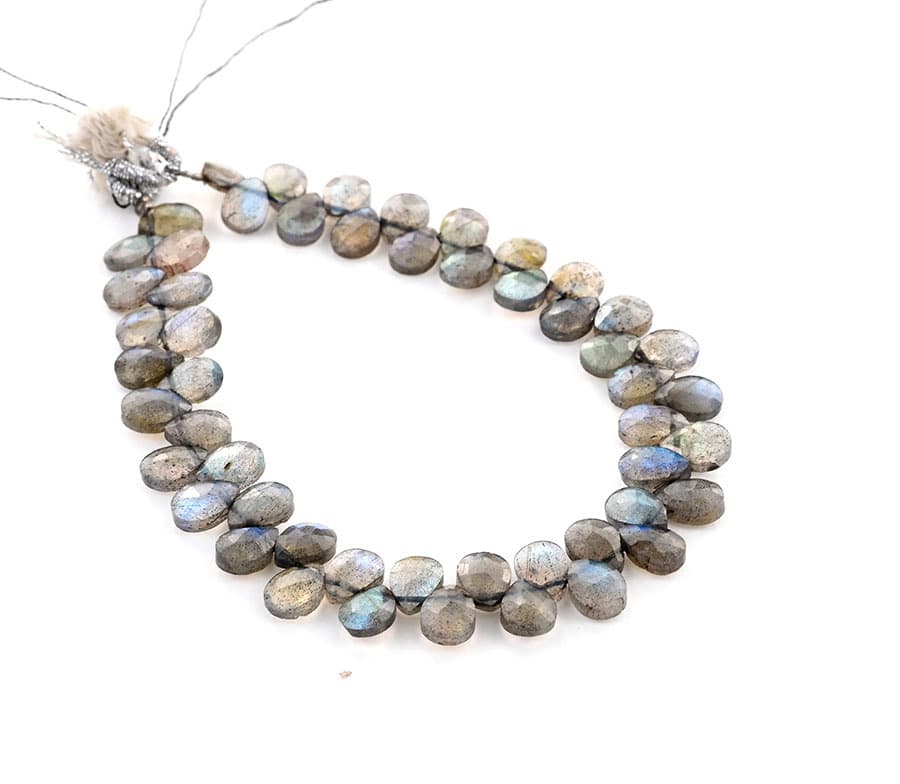
Labradorite is a plagioclase feldspar valued for iridescent color across a gray to black body. The optical effect, labradorescence, appears when light reflects and interferes between very thin internal twin layers. To judge a strand fast, tilt under one point light and count how many beads flash face-up.
For maker-focused details and care notes, see our labradorite stone guide at tandongems.vercel.app/stones/labradorite. We like it as a neutral with fire that pairs cleanly with silver and boho builds.
How do I test a strand for fire in person?
Use one small point light, like a desk lamp or phone flashlight. Hold the strand steady and tilt slowly so each bead faces the light. Log bead-by-bead flash coverage and note color spread and uniformity. Blue over most of each bead is our AA baseline; when gold, green and purple join the blue consistently, that grades as AAA at about double.
You can meet us at InterGem to test strands under controlled lighting. Our upcoming show dates are posted here: tandon-gems.vercel.app/shows.
How many 6 mm beads do I need?
Here is quick bead math using common US lengths. Allow about 1.5 inches for clasp and findings unless you are making a stretch bracelet. Knotting between beads adds about 1 mm per knot.
- 7.5 in bracelet with 6 mm: about 25 beads
- 7 in bracelet with 6 mm: about 23 beads
- 18 in necklace with 6 mm: about 70 beads
- 16 in choker with 6 mm: about 61 beads
- Stretch 7 in with 6 mm: about 29 beads
Which shapes string best in labradorite?
Rondelles are the workhorse for bracelets and full strands, spacing tight and keeping flash face-up. See shape notes here: tandongems.vercel.app/shapes/rondelle. For earrings or pendants, pears and daggers punch above their size because the long face catches light; learn pear drill options at tandongems.vercel.app/shapes/pear.
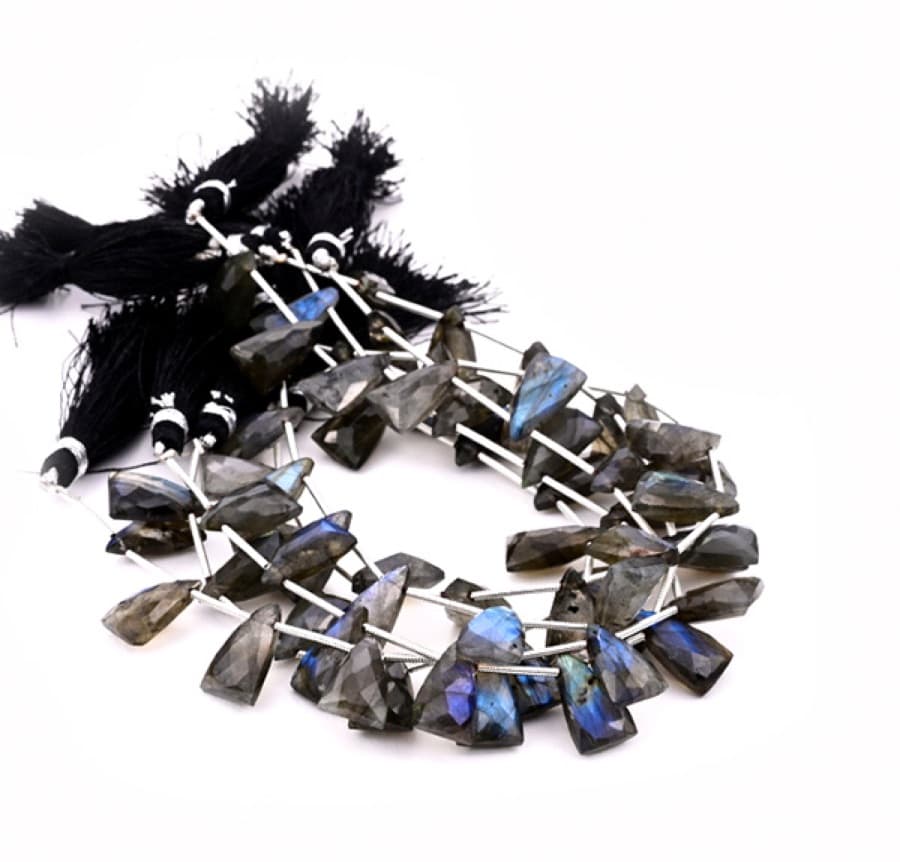
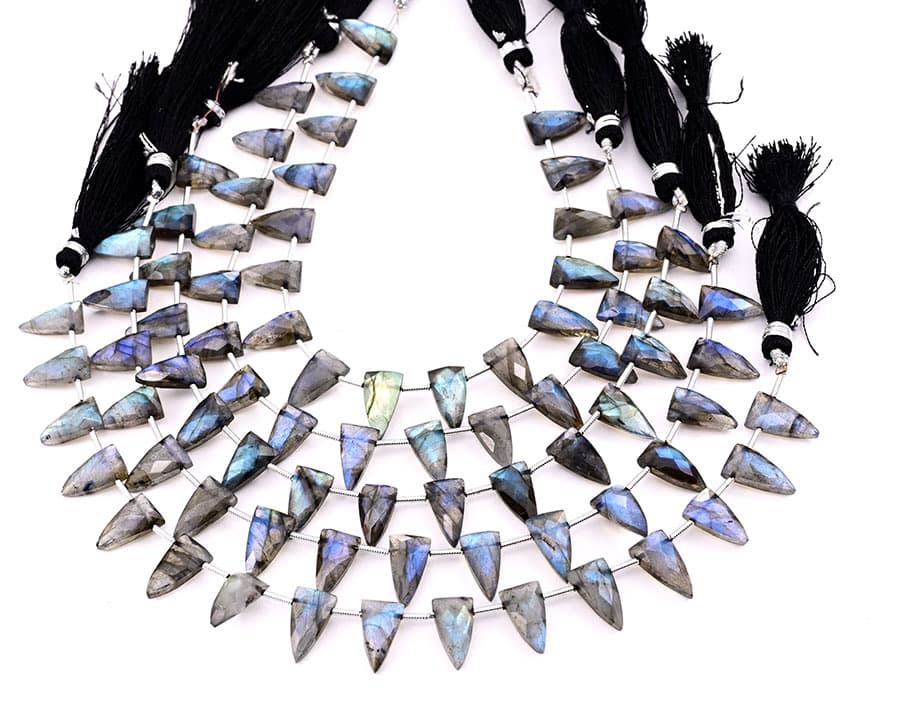
We also stock statement cuts for focal work. Our Labradorite 7x13 mm Faceted Arrowhead is sharp and directional for modern sets, and the 9x15 mm Faceted Pyramid creates bold centerpoints. Browse the exact strands: GS142 and GS109.
What should I string it on and how do I care for it?
Labradorite sits at Mohs 6 to 6.5 with perfect cleavage, so avoid hard knocks and tight crimping against stone edges. We prefer flexible beading wire for bracelets and mixed-strand necklaces, and nylon or silk for knotted necklaces that need drape. Clean with warm soapy water, then dry fully before storage. Skip ultrasonic and steam.
We recommend earrings, pendants and loose necklaces to keep impact low. Large nuggets can chip at edges if they swing into metal, so add small spacers near clasps to reduce contact.
Where does labradorite come from and what colors will I see?
Bead rough we see is mostly Madagascan, with body colors from medium gray to nearly black. The color play shows blue most often, with green, gold and purple on stronger material. Reference works describe labradorite in mafic igneous rocks and anorthosite, and they note the iridescent schiller in the best pieces.
Tradition calls it a stone of transformation. We stock it as the gray-with-fire neutral that fits silver, leather and earthy palettes.
How many beads are on a strand and will one cover my design?
Standard Jaipur strands run 13 to 16 inches. A 15 to 16 inch strand of 6 mm rondelles has about 65 to 70 beads, and 8 mm has about 48 to 52. One 13 inch strand usually covers a bracelet or choker. Two strands make a longer necklace with room for a focal or clasp spacing.