Ethiopian Welo opal, white and crystal
Hydrated silica, SiO2 with 3 to 10 percent water. Mohs 5.5 to 6.5. Mined in Wollo (Welo) province, Ethiopia, found 2008. Hydrophane: it soaks up water, turns temporarily clear, then dries back.
At a glance
| Hardness (Mohs) | 5.5 to 6.5 |
|---|---|
| Family | Opal |
| Where it is mined | Hydrophane: it soaks up water, turns temporarily clear, then dries back |
| Shapes we carry | Marquise, Nuggets, Pears |
| Strands listed | 3 |
Film and illustrations are AI renders. Strand listings below show photographs of the actual material.
How to judge it
Buy play-of-color: a good bead flashes green, orange and blue from several angles. Reject crazing (spidery cracks under a loupe). Opalite glass glows milky blue with no real flash; synthetic opal shows a too-regular "lizard skin" pattern. A water drop on Welo soaks in within a minute.
What it's like to work with
Etsy fine-jewelry makers, October birthstone sellers, boho and bridal designers. Drops for earrings and pendants are the profit item.
Care
Remove for showers, swimming and lotion; if it clouds, let it dry a few days. No ultrasonic or heat.
October birthstone; tradition ties opal to hope (tradition, not fact).
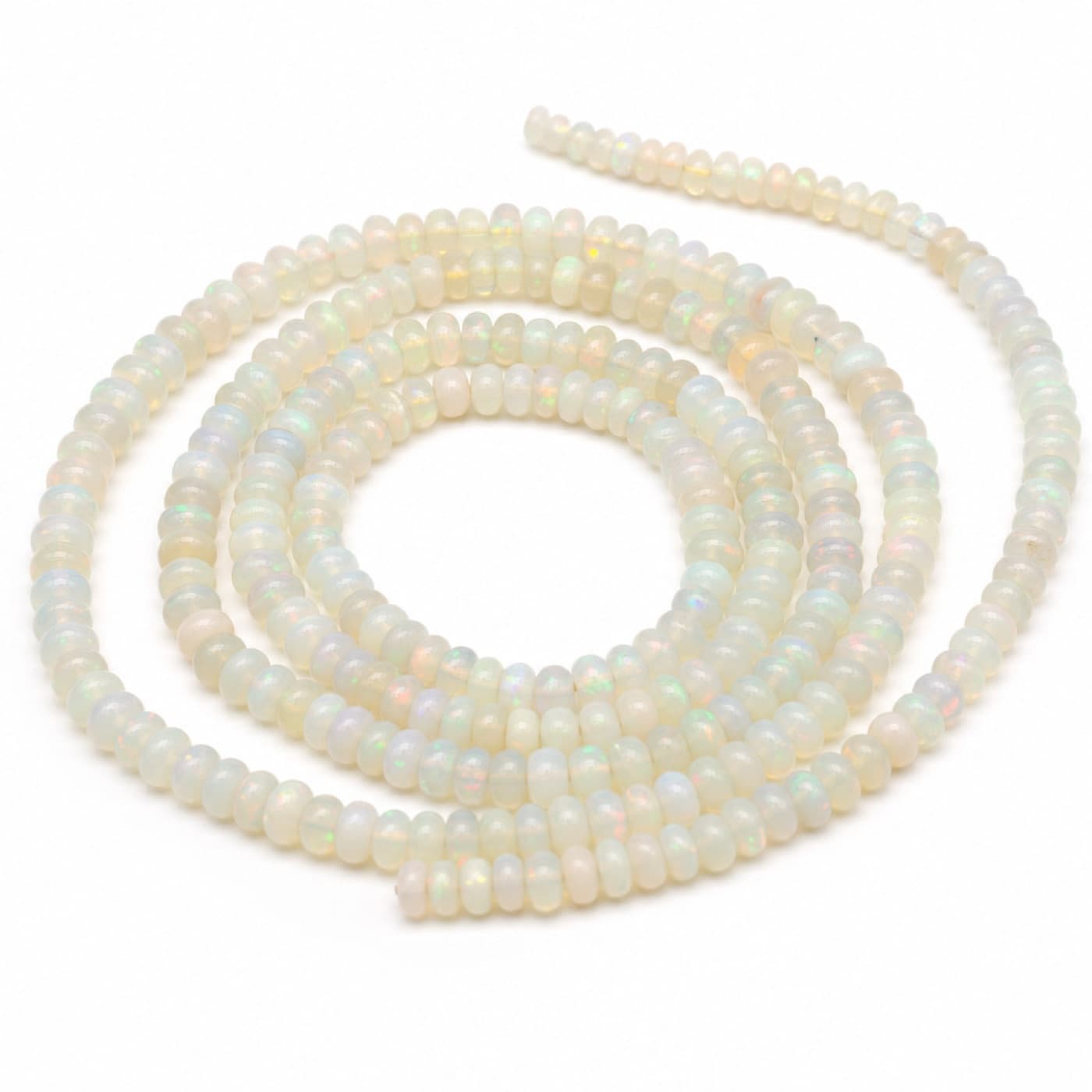
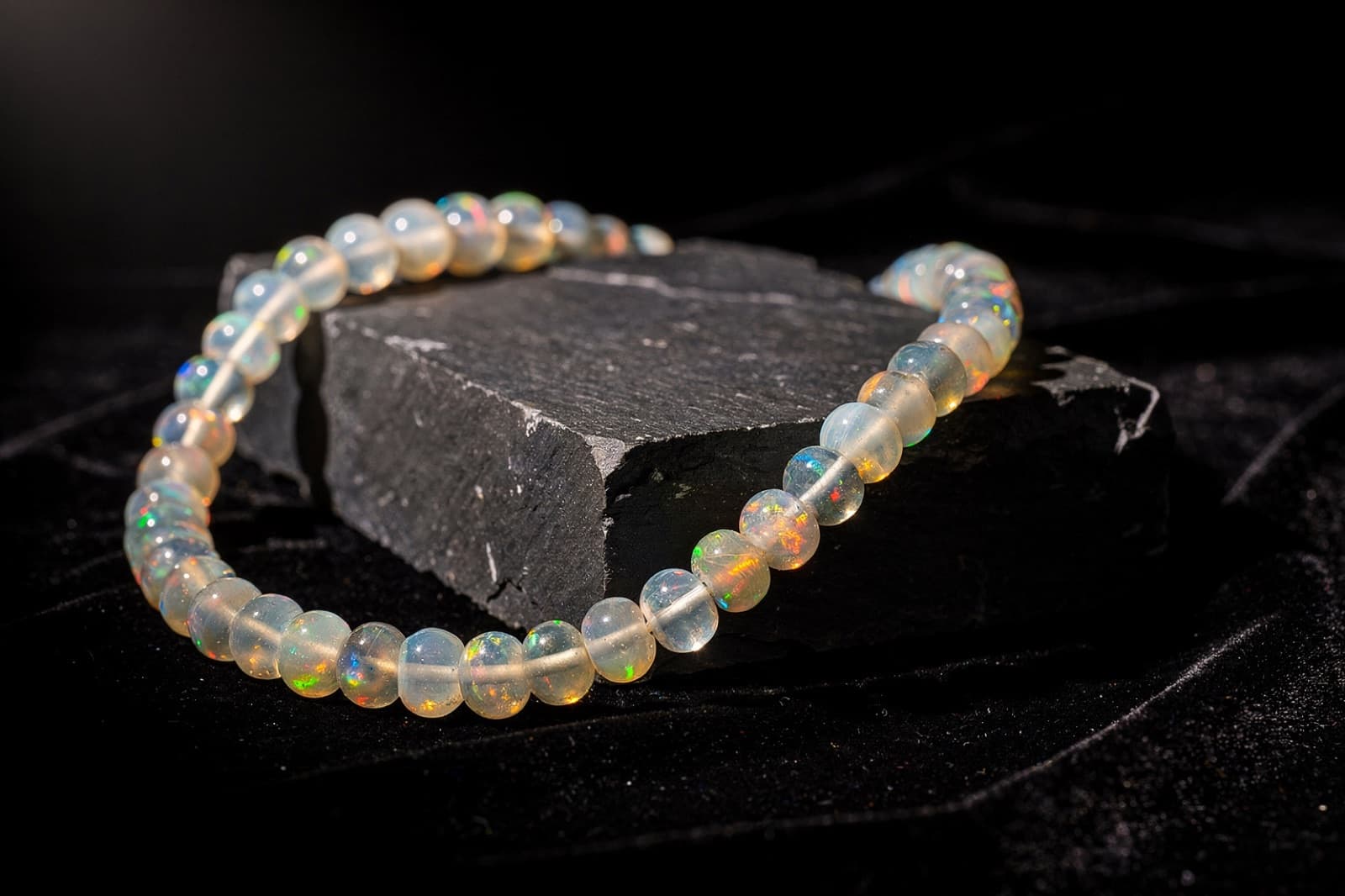
White and crystal opal, each bead flashing its own way.
Hold a strand of white Welo to a window and the beads read like frosted glass, until one turns and a patch of green lifts out of it, then orange, then blue. The crystal beads go further: bodies close to colorless, with the color floating inside, so you look through the bead and into the flash at the same time. No two match, even on one strand. Makers reach for them because each bead behaves differently in the light of a room.
Where it comes from
Opal from Ethiopia began entering the gem and jewelry market in 1994, after a small find put the country on the opal map. Material from Mezezo has been known since the mid-1990s for its brown play-of-color, called chocolate opal. The find that changed the trade came in 2008, near the village of Wegel Tena in Wollo province in the north, in volcanic rock. That deposit runs mostly white, with some brown, some fire opal, and some colorless crystal opal, and its play-of-color is often very vivid. Gemologists describe it as opal-CT, with inclusions of pyrite, barium-manganese oxides and native carbon, and some pieces show interpenetrating digit patterns. Another important discovery followed in 2013. Welo is now the opal most often seen in the trade, and beads are one of the most popular things cut from it. Ours are cut in Jaipur, India, and chosen strand by strand in Cupertino, California.
What tradition says
Opal carried meaning in ancient Rome, where it stood for love and hope, and the Roman name opalus was used as a word for precious stone in general. In 75 AD Pliny wrote that some opals hold a play of color equal to the deepest and richest colors of painters, while others seem to hold the flaming fire of burning sulphur or the bright blaze of burning oil. Later collectors gave great opals names of their own: Pandora, Light of the World, Empress. Writers have compared the stone to volcanoes, galaxies and fireworks. Opal is the October birthstone, and tradition ties it to hope.
These are beliefs people have held about the stone, told as tradition. They are not claims, and not advice.
How makers use it
Drops are the piece to start with. A pear at 7x9mm hangs well on an earring wire or a fine chain, and one bead is enough for a pendant. Nuggets keep the organic edge people want in boho and bridal work, and their uneven faces catch color from more directions. Marquise beads run long here, out to 10x40mm, which suits a single center drop rather than a repeated pattern. Pair any of them with gold fill or oxidized silver. A brighter bead flashes green, orange and blue from several angles instead of one narrow tilt. Opal is light: figure about 20 carats per 8 inches at 4mm. We list three strands.
Looking after it
Welo is hydrophane and drinks water. Take it off for showers, swimming and lotion. If a bead clouds or goes glassy, set it somewhere dry and leave it a few days to come back. Keep it away from ultrasonic cleaners and heat, and store it apart from harder stones.
Sources: Play-of-Color Opal from Wegel Tena, Wollo Province, Ethiopia | Gems & Gemology, Ethiopian Opals | Smithsonian National Museum of Natural History, Ethiopian Opals - Precious, Fire and Common Opal, Geochemical and Petrological Characterization of Gem Opals from Wegel Tena, Wollo, Ethiopia: Opal Formation in an Oligoc
Ethiopian Welo opal, white and crystal strands
Related stones
From the blog
All posts Care and durability
Which gemstone beads are hard enough for an everyday bracelet
Use Mohs 7 as the everyday-bracelet line because household dust contains quartz around 7. For daily wear, we recommend sapphire, black spinel, red Mozambique garnet, and amethyst beads. Black onyx sits on the line and needs a gentle finish. Labradorite, lapis, pyrite, turquoise, Ethiopian opal, pearls, and kyanite are better as careful or occasional bracelets.
 Stone guides
Why Ethiopian Welo opal is cheaper than Australian opal
Ethiopian Welo opal, found in 2008 in Ethiopia's Wollo province, is abundant and cut in high volume, so bead strands with real play-of-color usually cost far less than Australian material. White body opal looks opaque to milky; crystal body is transparent. Judge fire by flashes of green, orange and blue from several angles across multiple beads.
Buying guidesHow much do gemstone bead strands cost and why prices vary
Strand price is set by five things, in order: the stone species, the color grade, the bead size, the cut quality, and the strand length. In US retail, amethyst and labradorite rondelles sit in entry to mid bands. Ethiopian Welo opal small smooths run mid to upper mid. Fine sapphire, especially hand‑faceted briolettes, sits high.