Australian opal, gray body
Precious opal, SiO2 with about 6 percent water, Mohs 5.5 to 6.5, non-hydrophane and far more stable. Bead grades: Coober Pedy, Mintabie, Andamooka (light and gray bodies), Lightning Ridge (dark).
At a glance
| Hardness (Mohs) | 5.5 to 6.5 |
|---|---|
| Family | Opal |
| Where it is mined | See description |
| Shapes we carry | Ask us |
| Strands listed | 0 |
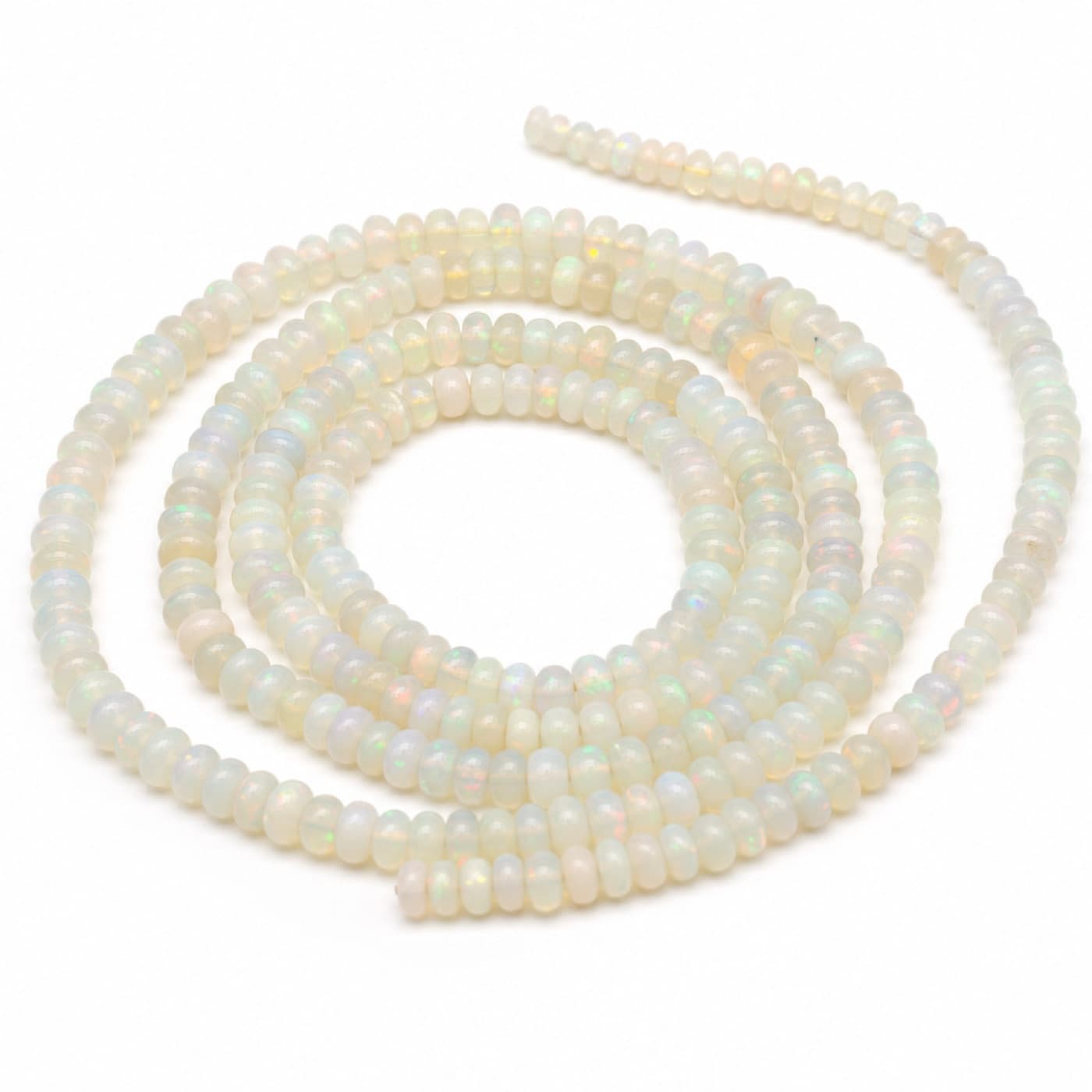
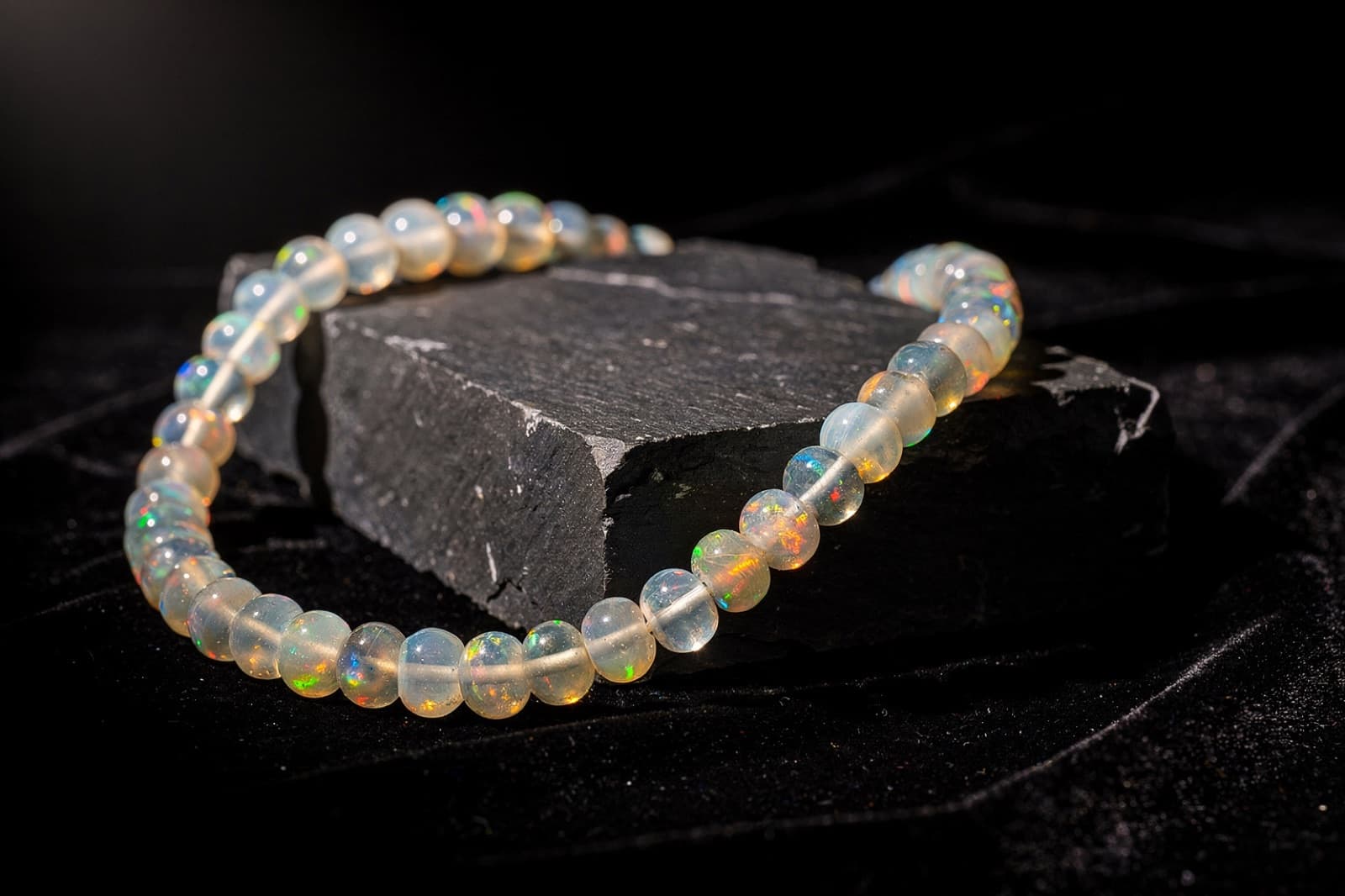
Film and illustrations are AI renders. Strand listings below show photographs of the actual material.
How to judge it
Count beads that flash versus gray potch; a good strand shows color on most beads. Check the side of each heishi disc for a straight seam or black backing, which means a doublet or triplet. A water drop sits on Australian opal instead of soaking in.
What it's like to work with
Designers who want "Australian" on the label. Heishi to boho and layered-necklace makers; faceted rondelles to wire-wrappers.
Care
The most forgiving opal. Warm water and a soft cloth; avoid ultrasonic, dry heat and sudden temperature swings.
October birthstone; Australia's national gemstone since 1993 (fact); tradition links opal to hope (tradition, not fact).
Gray ground, daylight color, no water rules to remember.
A gray body opal bead looks quiet until you turn it. The ground is the color of wet slate, and against it the play-of-color reads clearly, flashing across the surface and shifting as the light moves. Some beads carry more color than others, and a good strand is mostly the ones that do. Makers reach for the gray because the color shows in ordinary daylight, not only under a lamp. Hold a strand up to a window and the flash is there without coaxing.
Where it comes from
Opal forms from silica dissolved in water, laid down slowly by circulating groundwater. In Australia that process began about 140 million years ago, when an inland sea covered much of the continent, and the result is plain in the numbers: Australian opal accounts for about 95 percent of the world's supply. People mined opal long before that trade existed, in places such as Kenya and Hungary as far back as 4,000 BCE, and Rome knew the stone as opalus, a word it also used to mean precious stone. Australia has been the primary source since the 1880s, and the town of Coober Pedy produces more opal than anywhere else. Bead material is still spoken of by field. Coober Pedy, Mintabie and Andamooka give the light and gray bodies; Lightning Ridge gives the dark. Precious opal is silica holding about 6 percent water, which is why it behaves unlike any quartz.
What tradition says
In ancient Rome the stone stood for love and hope. In 75 AD Pliny wrote that some opals carry such a play within them that they equal the deepest and richest colors of painters, while others simulate the flaming fire of burning sulphur. Later writers compared opals to volcanoes, galaxies and fireworks, and admirers gave the great stones poetic names: Pandora, Light of the World, Empress. Crystal tradition still ties opal to hope, and people have long worn it in that spirit, as a stone of good expectation. It is the birthstone for October. Australia named opal its national gemstone in 1993.
These are beliefs people have held about the stone, told as tradition. They are not claims, and not advice.
How makers use it
Heishi discs are the workhorse here, and they go to boho and layered-necklace makers. Faceted rondelles suit wire-wrappers. Smooth ovals go out to people who want one bead to carry a pendant. We carry all three with gray body and play-of-color, sold by the 8 inch and the 16 inch strand, and an 8 inch length usually runs 20 to 30 carats. On a strong strand most beads flash rather than reading as plain gray potch, and the side of each heishi disc should be solid opal, with no straight seam or dark backing. Our strands are cut in Jaipur, India, and chosen one at a time in Cupertino, California.
Looking after it
This is the most forgiving opal, non-hydrophane and stable, with a hardness of 5.5 to 6.5. Warm water and a soft cloth are enough. Keep it away from ultrasonic cleaners, dry heat and sudden temperature swings. There are no water rules to remember, so you can wear it and forget it is on.
Sources: Opal History and Lore, Eight Opal Types Explained - International Gem Society, Opal | Properties, Types & Uses | Britannica, Australian Opals: An Introduction
Australian opal, gray body is in the stock room
We carry australian opal, gray body at shows and it is not all listed online yet. Tell us the shape and size you want and we will send photos of what is in stock.
Ask on WhatsApp