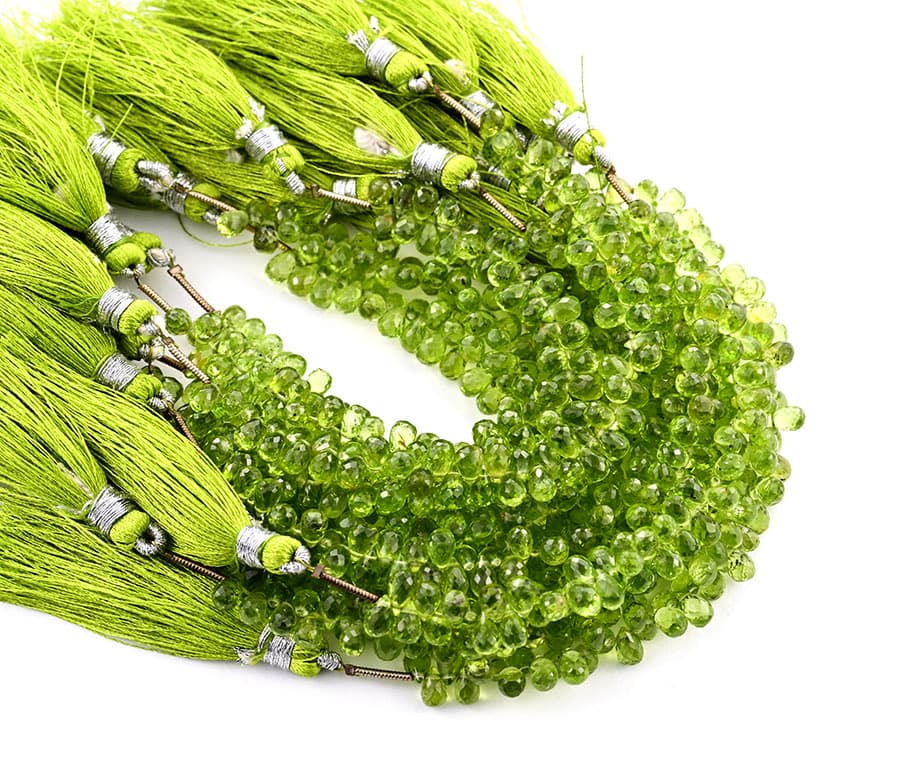
Peridot
Gem olivine (forsterite), a magnesium-iron silicate; iron gives the yellow-green. Mohs 6.5-7, no cleavage but brittle. Bead material is mostly Chinese (Hebei) and Pakistani (Kohistan); Arizona (San Carlos) supplies small sizes.
At a glance
| Hardness (Mohs) | 6.5 to 7 |
|---|---|
| Family | Olivine |
| Where it is mined | See description |
| Shapes we carry | Tear drops |
| Strands listed | 1 |
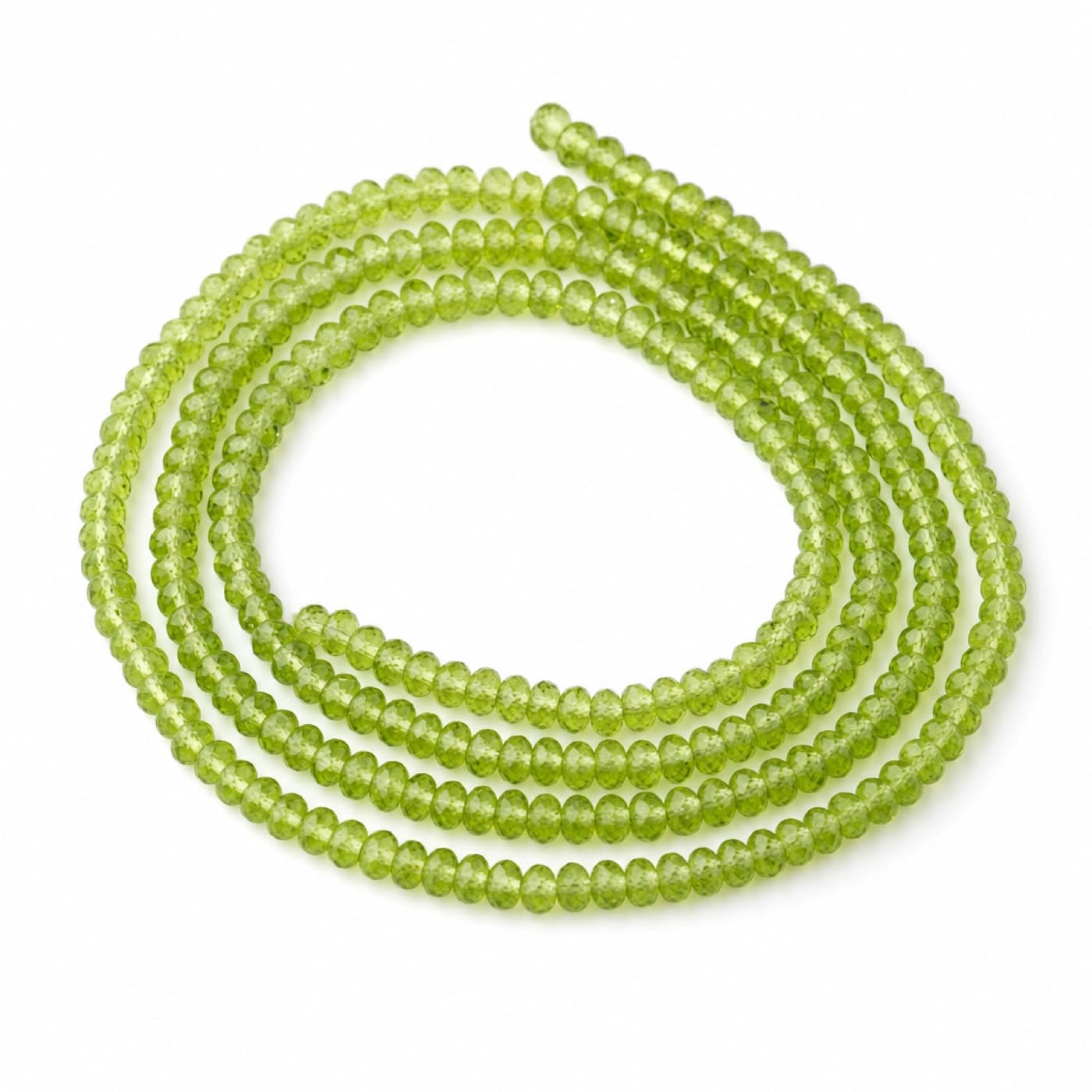
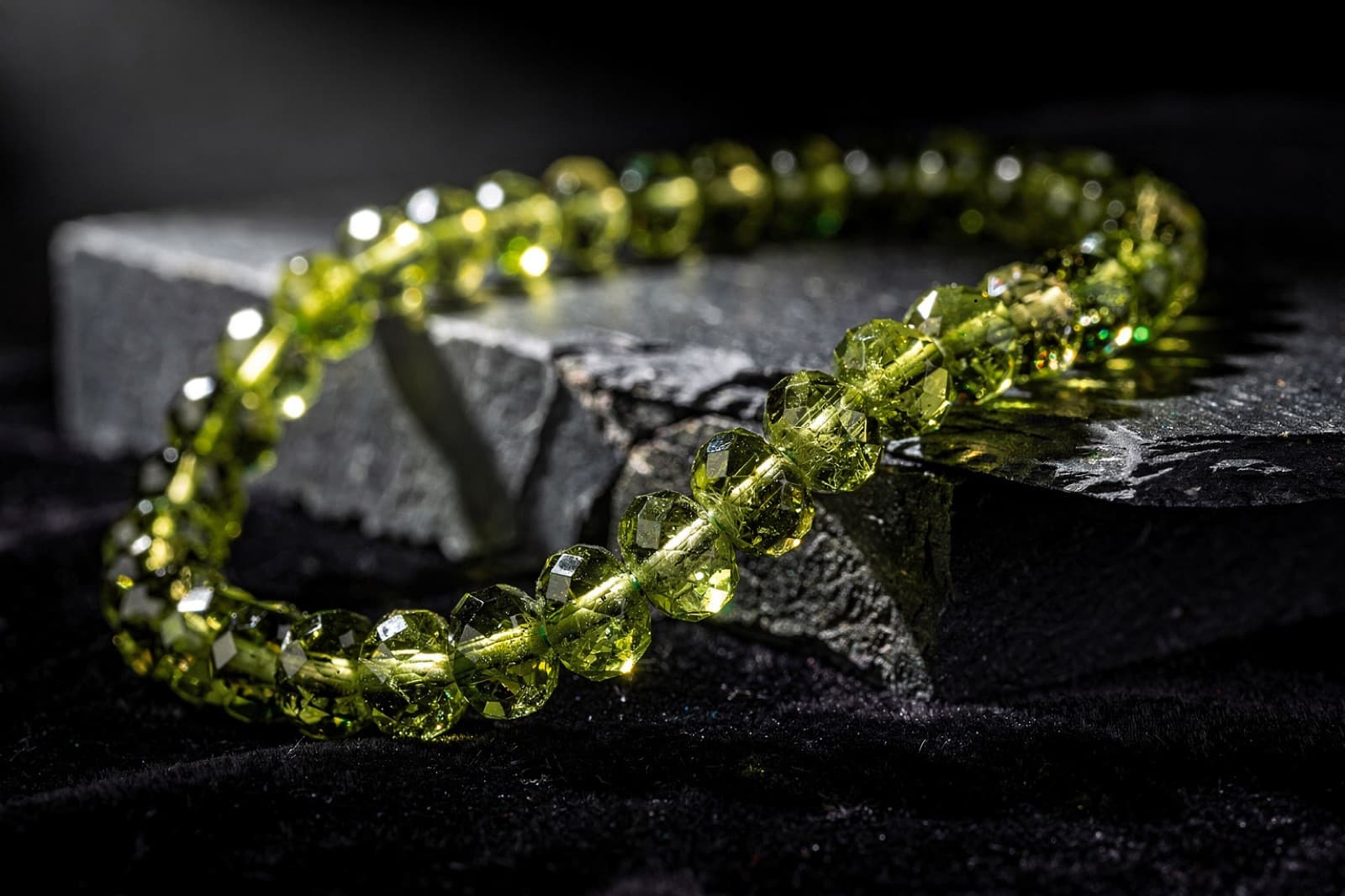
Film and illustrations are AI renders. Strand listings below show photographs of the actual material.
How to judge it
Pure to slightly yellowish green with no brown; 3mm peridot is never dark. "Lily pad" disc inclusions and tiny black specks are normal and confirm natural origin. Under a loupe peridot shows strong doubling of the far facets; glass doesn't double and shows bubbles. Check drill holes for chipping.
What it's like to work with
Mid tier. August birthstone pieces, spring greens with freshwater pearl, olive-and-gold palettes. Faceted rondelles and briolettes sell best.
Care
Fine for necklaces and earrings, bracelets with care. Soap and water only; no ultrasonic, steam or acids.
August birthstone; tradition holds it wards off nightmares (tradition, not fact).
One color only, from volcano rock to finished strand.
Hold a strand of peridot up to a window and the whole thing reads one color: green with a squeeze of yellow in it, no brown anywhere. Peridot is one of the few stones that comes in a single hue, so the beads along a strand match each other without much sorting. Look closely and you may find flat disc inclusions like small lily pads, or a scatter of black specks. Those belong there. At 3mm the color stays light and lit.
Where it comes from
Peridot is gem olivine, the magnesium-rich forsterite end of the family, and iron is what turns it green. Most of it formed deep inside the earth and rode to the surface in volcanoes; some arrived in meteorites. On Oahu, small pieces wash ashore near volcanic ground. The ancient Egyptians mined it on Zabargad, an island in the Red Sea, and that deposit supplied many of the large fine stones now in museums; a 146.10-carat peridot sits in the Natural History Museum in London. The English name is unsettled in origin, traced by some to Anglo-Norman pedoretés and by others to the Arabic faridat, meaning gemstone, with the earliest English use possibly in 1705. Bead material today comes mostly from Hebei in China and Kohistan in Pakistan, with San Carlos in Arizona supplying small sizes. Our strands are cut in Jaipur, India, and chosen strand by strand in Cupertino, California.
What tradition says
The Egyptians called peridot the gem of the sun. Some held that it kept its owner safe from the terrors of the night, and that the protection was stronger when the stone was set in gold. Others strung the gems on donkey hair and tied them around the left arm to turn away evil spirits. Legends have long tied peridot to sunlight, and with it energy and happiness for the wearer. In Hawaiian stories the green grains near the lava rock were tears of Pele, goddess of the elements, said to fall from the sky with the rain. Crystal tradition still holds that peridot wards off nightmares. It is one of the August birthstones and the gem for a fifteenth anniversary.
These are beliefs people have held about the stone, told as tradition. They are not claims, and not advice.
How makers use it
Faceted 3mm rondelles do most of the work here. Strung plain they make a light green line at the throat, and they sit well between freshwater pearls for a spring palette or against gold for an olive-and-gold one. Pear briolettes in 4x6mm hang clean as earrings, one to a wire, and they take a bail without much fuss. Ovals read longer than the rondelles and break up a plain strand. We carry faceted 3mm rondelles and ovals, plus pear briolettes on eight-inch strands, and we look over the drill holes for chipping before a strand goes on the tag.
Looking after it
Peridot sits at 6.5 to 7 on the Mohs scale and it is brittle, so it takes knocks poorly. Necklaces and earrings are easy; wear a bracelet with some care and keep it off hard surfaces. Clean with mild soap and water and a soft cloth. No ultrasonic, no steam, no acids.
Sources: Peridot History and Lore - GIA, The Folklore and Legend of Peridot | August Birthstone, Peridot Gemstone | Peridot Stone – GIA, Peridot