Freshwater cultured pearl
Nacre (mostly aragonite with conchiolin) grown by freshwater mussels on Chinese farms; China is the only commercial producer. Mohs 2.5 to 4.5. Rounds are tissue-nucleated solid nacre; "fireball" pearls are bead-nucleated baroques with a round body and flame-shaped tail.
At a glance
| Hardness (Mohs) | 2.5 to 4.5 |
|---|---|
| Family | Pearl |
| Where it is mined | See description |
| Shapes we carry | Ask us |
| Strands listed | 0 |
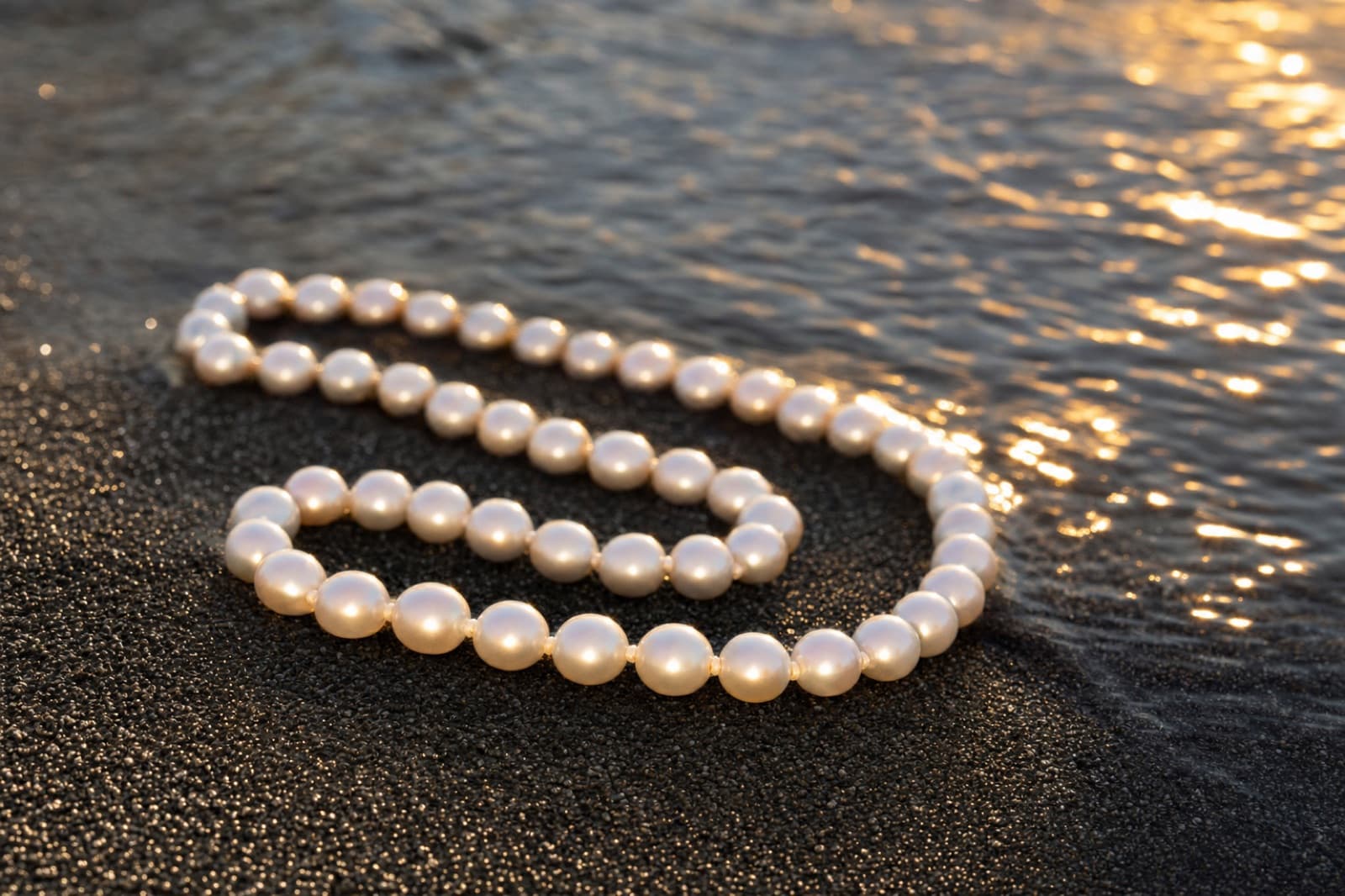
Film and illustrations are AI renders. Strand listings below show photographs of the actual material.
How to judge it
Luster is everything: sharp reflections mean thick nacre, fuzzy means thin. Fireballs want a blemish-light body and metallic tail; rounds want matched size and few pits.
What it's like to work with
Bridal and classic designers, single-fireball pendants, layering necklaces. Mid tier.
Care
Last on, first off. No perfume, acids or ultrasonic. Damp cloth.
Tradition calls pearls tears of the moon; tradition, not fact.
Grown in a mussel, judged by the light it returns.
Hold a strand of fireballs up to a window and the light comes back in a hard, narrow line. Each pearl has a round body with a tail pulled out like a flame, no two tails the same. The color reads white, with a blush of pink or mauve that shifts as the strand turns. The rounds next to them are quieter and even. Makers reach for both because nacre answers skin better than it answers a lamp.
Where it comes from
A pearl is nacre, mostly aragonite with conchiolin, laid down in layers by a mollusk. In fresh water the work is done by mussels, and today China is effectively the only commercial producer, with Japan and the United States farming on a limited scale. The idea has a long history in China, where workers were producing freshwater blister pearls in the 13th century by opening a mussel's shell, setting in small pellets of mud or small bosses of wood, bone or metal, and returning the animal to its bed for about three years. Japanese freshwater cultivation began in 1935, and Masao Fujita worked at Lake Biwa in Shiga Prefecture with the Biwa pearly mussel, Hyriopsis schlegelii. Lake Biwa supplied pearls in many colors until 1982, and from 1962 some farms moved to Lake Kasumigaura in Ibaraki Prefecture. In the United States, the Federal Trade Commission requires that farmed freshwater pearls be sold as freshwater cultured pearls.
What tradition says
Tradition calls pearls tears of the moon. That is the whole of it: an image, handed on as tradition rather than fact, that has followed pearls from one telling to the next. The comparison is easy to see on a fireball strand, where the white body carries a pink or mauve cast and the tail takes light in a thin line. Nothing in the phrase explains how a pearl forms; a mussel does that, layer by layer, in fresh water. Still, people repeat it, and it changes how a strand feels in the hand. We pass the phrase along as tradition and leave it there.
These are beliefs people have held about the stone, told as tradition. They are not claims, and not advice.
How makers use it
We carry two kinds, chosen strand by strand in Cupertino: baroque fireballs from 15 to 25mm and rounds from 8 to 10mm, white with a pink or mauve overtone. A fireball is large enough that one on a chain is a finished pendant, which is how most people use them. Rounds suit bridal work, classic single strands and layering necklaces. Luster is the thing to look at: sharp, clear reflections mean thick nacre, while a soft, fuzzy surface means less of it. On fireballs, look for a blemish-light body and a tail that reads metallic. On rounds, look for matched size and few pits.
Looking after it
Pearls are soft, between 2.5 and 4.5 on the Mohs scale, and nacre dislikes chemistry. Last on, first off. Keep perfume, hairspray and anything acidic away from the strand, and never put pearls in an ultrasonic cleaner. Wipe them with a damp cloth after wearing and let them dry before storing.
Sources: Cultured freshwater pearls, Freshwater Cultured Pearls - International Gem Society, Cultured pearl, Cultured Pearls From Lake Kasumigaura: Production And Gemological Characteristics
Freshwater cultured pearl is in the stock room
We carry freshwater cultured pearl at shows and it is not all listed online yet. Tell us the shape and size you want and we will send photos of what is in stock.
Ask on WhatsAppFrom the blog
All posts Making with beads
Should I string sapphire beads on wire or silk?
String faceted sapphire on flexible multi-strand beading cable sized to fit your bead holes, because facet edges can cut thread during wear. Use silk only for pearls and other smooth beads you want knotted between each bead. With cable and proper crimps you get strength, clean drape and dependable finishes for daily wear.
Care and durabilityWhich gemstone beads are hard enough for an everyday bracelet
Use Mohs 7 as the everyday-bracelet line because household dust contains quartz around 7. For daily wear, we recommend sapphire, black spinel, red Mozambique garnet, and amethyst beads. Black onyx sits on the line and needs a gentle finish. Labradorite, lapis, pyrite, turquoise, Ethiopian opal, pearls, and kyanite are better as careful or occasional bracelets.
For designers and shopsHow to price handmade gemstone bead jewelry
Use this rule: materials at per-bead cost plus your labor rate times hours, times two for wholesale, times two again for retail. Get per-bead cost by counting the beads on the strand and dividing the strand price by that count. If the strand is 13 inches, the method is the same: price divided by bead count equals per-bead cost.