How do I grade translucency with a flashlight?
Set one loose bead or the end bead of a strand on white paper. Hold a phone flashlight just behind it so the light enters from the back. Look for how broadly the bead lights up and how evenly the halo appears. Use the same setup for every strand so your grading stays consistent.
- High: core and rim illuminate with a soft pool of light, silhouette is faint.
- Medium-high: rim lights with a bright band, center shows a gentle shadow.
- Medium-low: rim lights, center shadow is stronger and less even.
- Low or borderline: only the thinnest edge lights, the center stays dark.
What text test should I use at the bench?
Place a bead on printed black text over white paper. View from above in diffused light. If you can still make out letter shapes through the center, grade it higher. If only the edge lets you see a hint of ink or nothing reads at all, grade it lower. We see this correlate well with the soft, milky glow described in our chalcedony guide.
Which shapes make chalcedony glow the most?
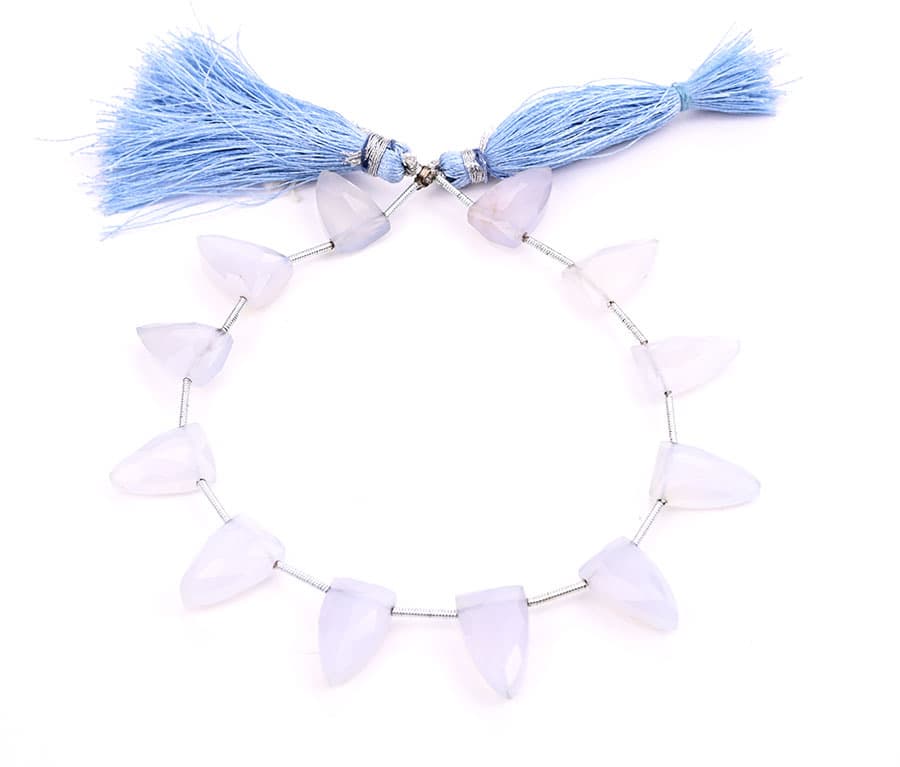
Chalcedony's light scattering loves broad, smooth surfaces. Smooth ovals and drops carry light through the body, so the glow looks deep. Faceted pears and hearts catch sparkle, but each facet can break up the pool of light. We stock it in ovals, rondelles, nuggets and faceted pears, and we also cut arrowheads, hearts, pears, rectangles and teardrops. See our Ovals page and an example chalcedony arrowhead strand.
- Ovals: generous face area, even glow. See Ovals.
- Pears and teardrops: thicker bellies glow, tips add brightness. See Pears and Tear drops.
- Rondelles: great for necklaces, moderate glow per bead. See Rondelles.
- Hearts: face forward and show a bright rim. See Hearts.
How many 6 mm beads do you need?
Plan counts before you cut. For a 7.5 in bracelet with a clasp, the beaded run is about 6 in, so 6 mm beads take about 25 per bracelet. An 18 in necklace uses about 70 of 6 mm, and a 16 in choker about 61. A 15 to 16 inch strand of 6 mm rondelles has about 65 to 70 beads, so one strand usually covers an 18 in with a clasp.
- Beads per inch: 6 mm about 4.2.
- Stretch bracelets use the full wrist length for counts.
- Standard Jaipur strands run 13 to 16 inches; faceted rondelles are often 13 inches.
- Knotting between beads adds about 1 mm per knot.
How should I string and space for that inner glow?
Light backgrounds help. Test on white thread or clear cord to avoid dulling the body color. Small spacer beads or tiny knots can open windows for light to enter and exit each bead. Keep drill holes aligned so the path of light stays consistent along the strand.
- Top-drilled pears hang point-down and show a bright rim.
- Center-drilled ovals create a continuous ribbon of glow.
- Graduated layouts put the most luminous beads front and center.
- Use clear or light spacers to keep light moving between beads.
Can chalcedony handle bracelets and daily wear?
Yes. Chalcedony is Mohs 6.5 to 7, so it is hard enough for bracelets and necklaces. Sources include Namibia, Turkey, Montana and Oregon. Some pieces show a floating interior light from microscopic inclusions, a quality we look for when we grade glow. Tradition calls chalcedony the speaker's stone, which many designers reference as folklore.
What color cues should I look for in blue and lavender?
Natural material often reads as soft cloudy blue, grayish blue or lilac, with a faint inner light rather than a flat, uniform tone. We prioritize subtle milkiness paired with good translucency because it lights up beautifully on the neck. For violet-blue types, the glow can feel slightly cooler, with a gentle bloom in the thicker areas.