Tanzanite
Blue-violet zoisite, calcium aluminum silicate, Ca2Al3(SiO4)3(OH). Mohs 6 to 7 with one direction of perfect cleavage. One source on earth: the Merelani Hills near Arusha, Tanzania.
At a glance
| Hardness (Mohs) | 6 to 7 |
|---|---|
| Family | Zoisite |
| Where it is mined | See description |
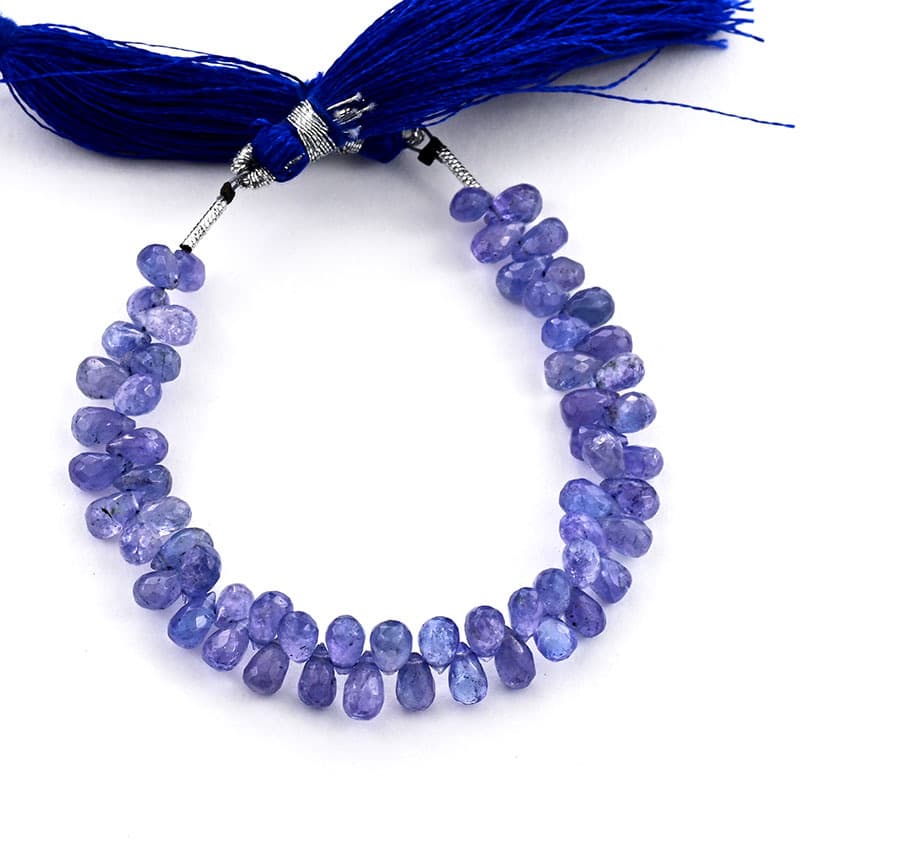
| Shapes we carry | Tear drops |
| Strands listed | 1 |
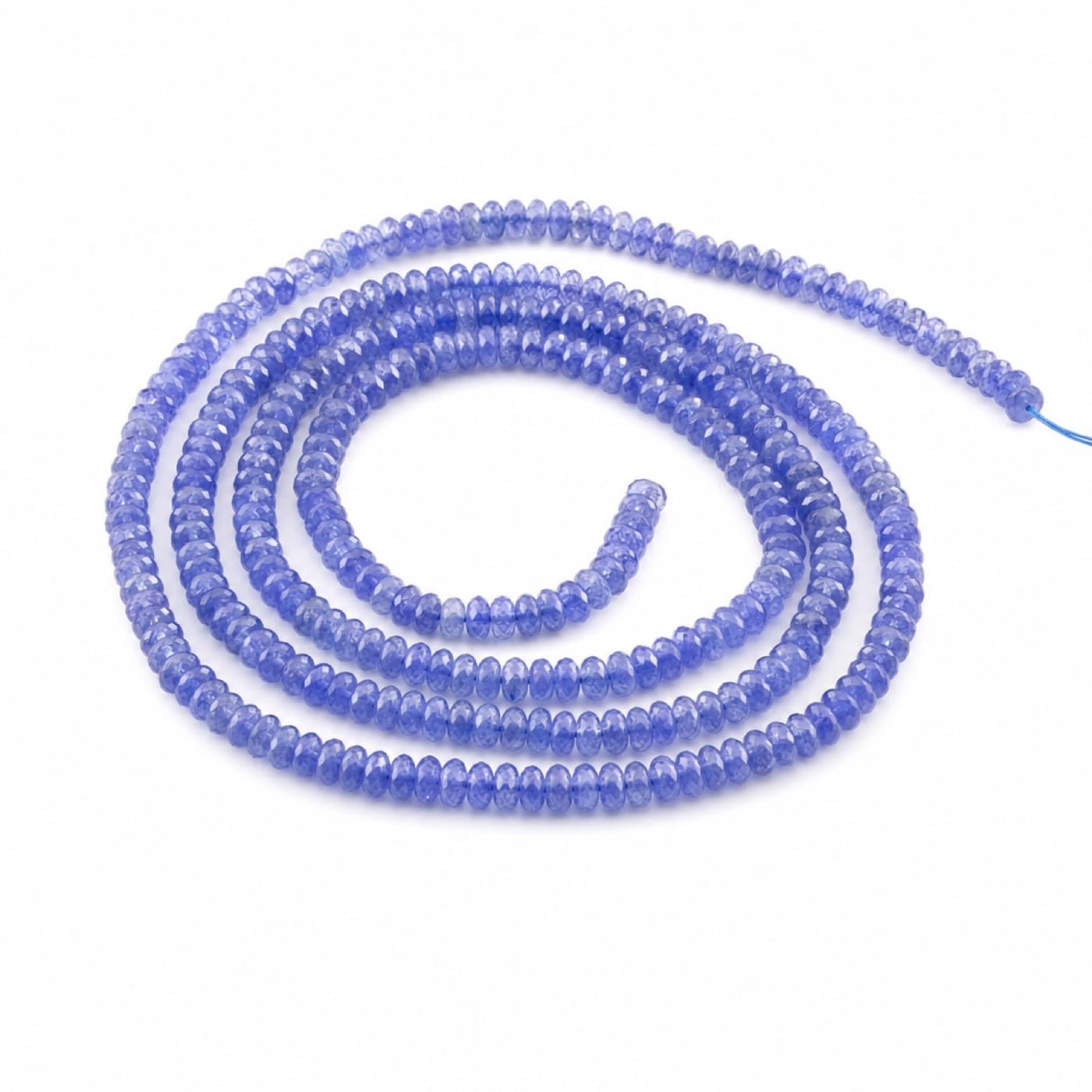
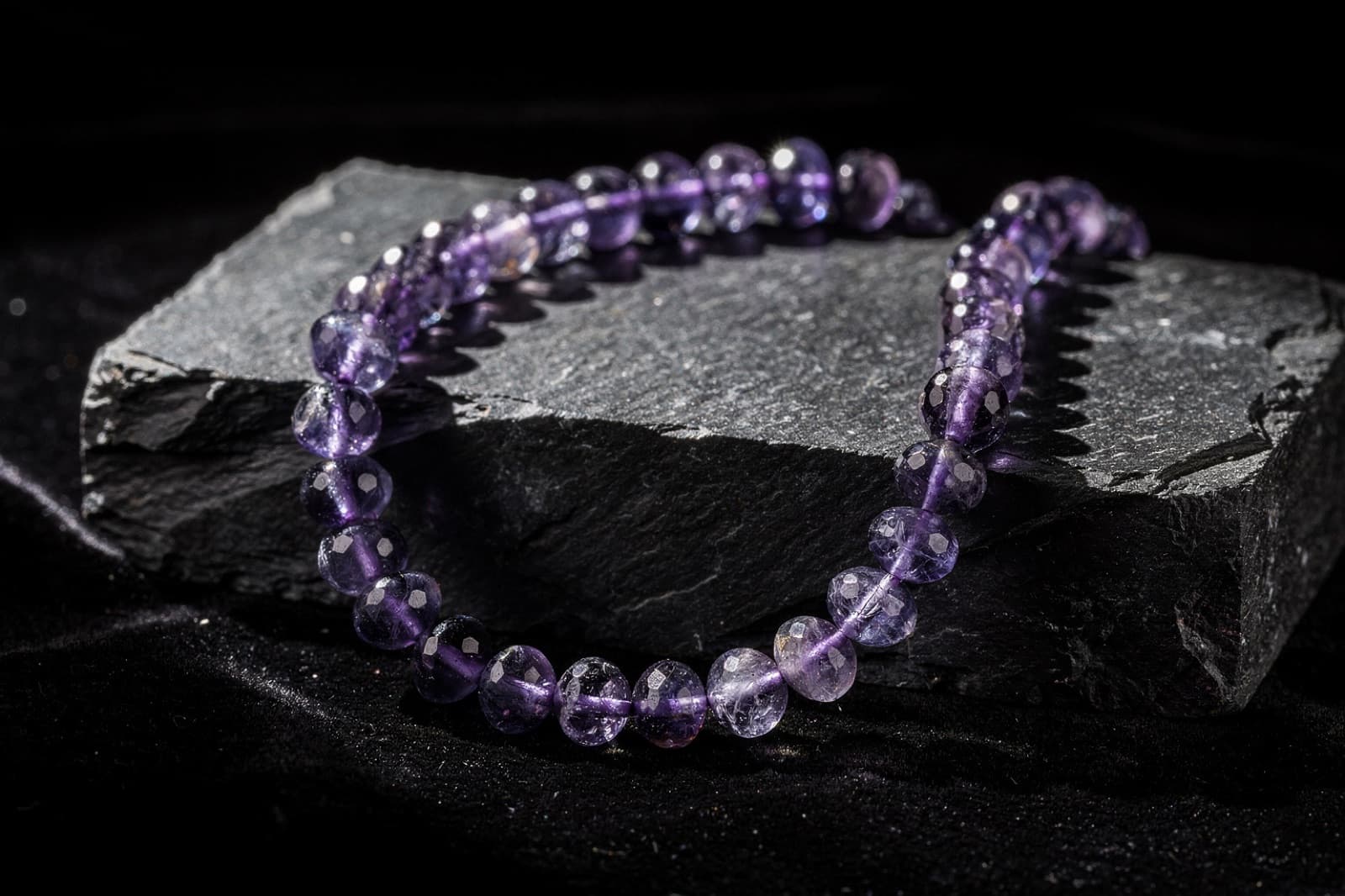
Film and illustrations are AI renders. Strand listings below show photographs of the actual material.
How to judge it
Commercial tanzanite is light lavender to grayish blue, often cloudy; saturated blue-violet with a purple flash is better. Turn a bead: tanzanite shows blue one way and violet or bronze another. Iolite is harder, lighter, grayer, and swings from violet-blue to nearly colorless.
What it's like to work with
December birthstone sellers, designers who want violet-blue that isn't amethyst, wire-wrappers using 3 to 4mm accents.
Care
Necklaces and earrings, not bracelets or rings. No ultrasonic, steam or sudden temperature change.
December birthstone (added 2002); Maasai tradition links blue with new birth (tradition, not fact).
One hill in Tanzania, blue one way and violet the next.
Held to a window, a tanzanite bead does two things at once. Turn it one way and it reads blue. Turn it again and violet rises through the facets, with a bronze cast at some angles that you catch only when the strand swings. Along a strand the color runs uneven. One bead pale lavender, the next deeper. That unevenness is part of the appeal, and makers reach for it when they want a violet-blue that will not be mistaken for amethyst.
Where it comes from
Tanzanite is blue-violet zoisite, a calcium aluminum silicate. It comes from one place on earth: the Merelani Hills near Arusha in northern Tanzania, within sight of Mount Kilimanjaro. The common account of the discovery has Maasai herders finding transparent blue crystals weathering out of the ground in 1967 while they tended livestock. They told a prospector named Manuel d'Souza. He registered four mining claims and believed for a time that he had found a new sapphire deposit. Careful gemological study identified the crystals instead as a transparent variety of zoisite. Tiffany & Co. introduced the material to the trade as tanzanite, after the country, rather than selling it as blue zoisite. A 122.70-carat stone sits in the Smithsonian National Museum of Natural History. Our strands are cut in Jaipur, India. We pick them strand by strand here in Cupertino, California.
What tradition says
Tanzanite is a recent arrival, so it carries none of the layered legend that older stones gathered over centuries. What it has instead is custom. Young custom. It was added to the December birthstone list in 2002, and jewelers who mark birth months have used it that way ever since, which makes it a frequent gift for a December birthday. Maasai tradition links the color blue with new birth, and people who sell and give the stone often repeat that association when they speak about it. In crystal tradition the stone is linked with calm, and it is said to steady a wearer facing something new. All of this is belief, passed along with the stone rather than proven by it.
These are beliefs people have held about the stone, told as tradition. They are not claims, and not advice.
How makers use it
Faceted rondelles in 3 to 4mm are the workhorse. They sit between metal spacers as accents, and they take a wire wrap cleanly. Small beads also stretch a little material across a long necklace. At 4mm, figure roughly 35 carats in an 8 inch strand. Plan before you cut wire. Teardrops at 3x5mm hang as earring pairs, or as a single center drop on a fine chain, which is how most December birthday pieces get made here. A stronger strand shows saturated blue-violet with a clear purple flash when turned. A weaker one stays light and cloudy, closer to gray-blue.
Looking after it
Tanzanite is Mohs 6 to 7 and has one direction of perfect cleavage, so a sharp knock can split a bead. Keep it to necklaces and earrings rather than bracelets or rings. Wipe with a soft damp cloth. Skip the ultrasonic cleaner and steam, and keep the beads away from sudden changes in temperature.
Sources: Tanzanite History and Lore - GIA, What Is Tanzanite Gemstone | Tanzanite Stone – GIA, Tanzanite: What you need to know about color, rarity, value, Tanzanite History - December Birthstones - American Gem Society