Tourmaline
Complex boron silicate; elbaite is the species behind pink, green and watermelon. Mohs 7 to 7.5, no cleavage, strongly pleochroic. Bead grades: Afghanistan, Nigeria, Brazil, Mozambique, Madagascar.
At a glance
| Hardness (Mohs) | 7 to 7.5 |
|---|---|
| Family | Tourmaline |
| Where it is mined | See description |
| Shapes we carry | Hearts, Nuggets, Pears, Pyramids, Rondelles, Tear drops |
| Strands listed | 12 |
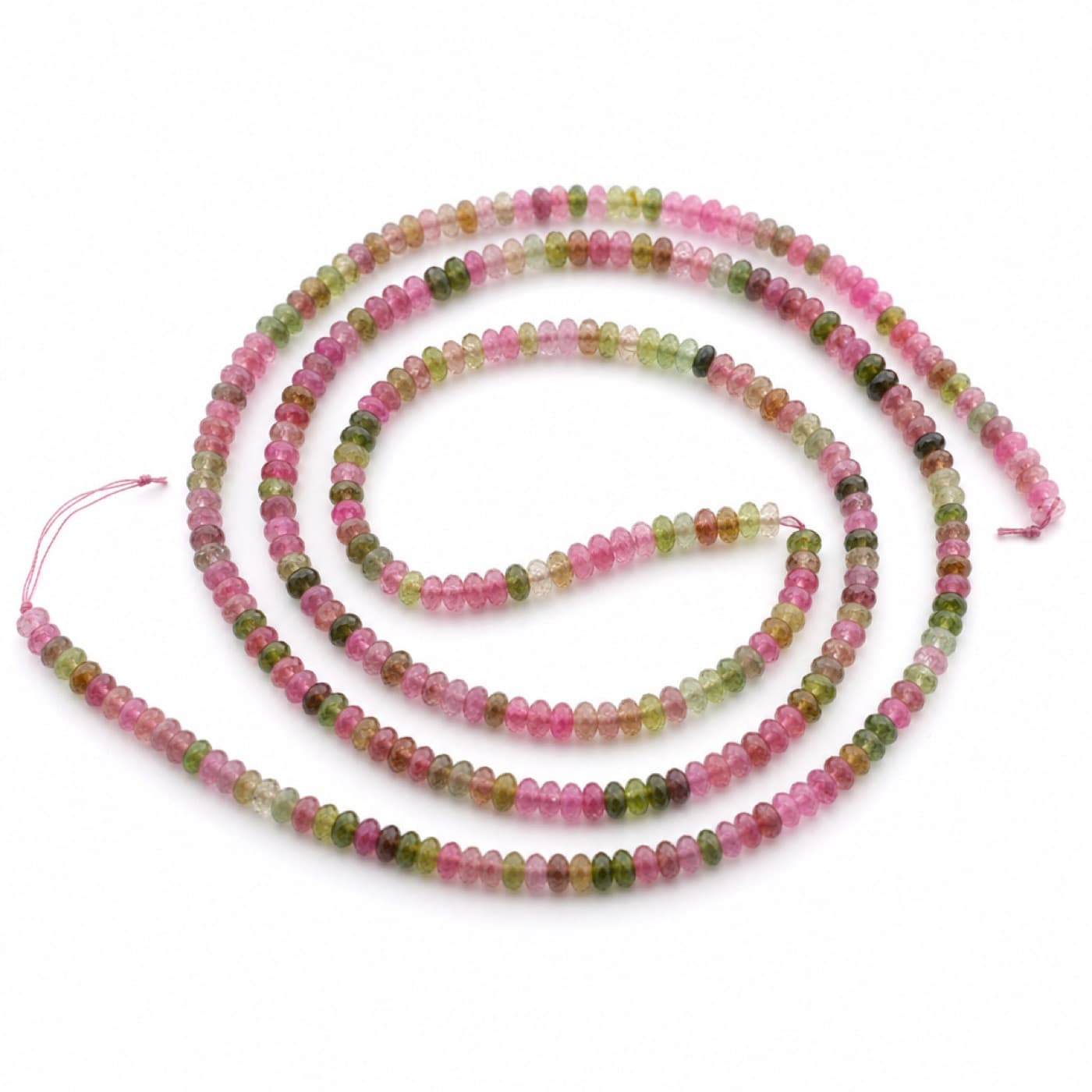
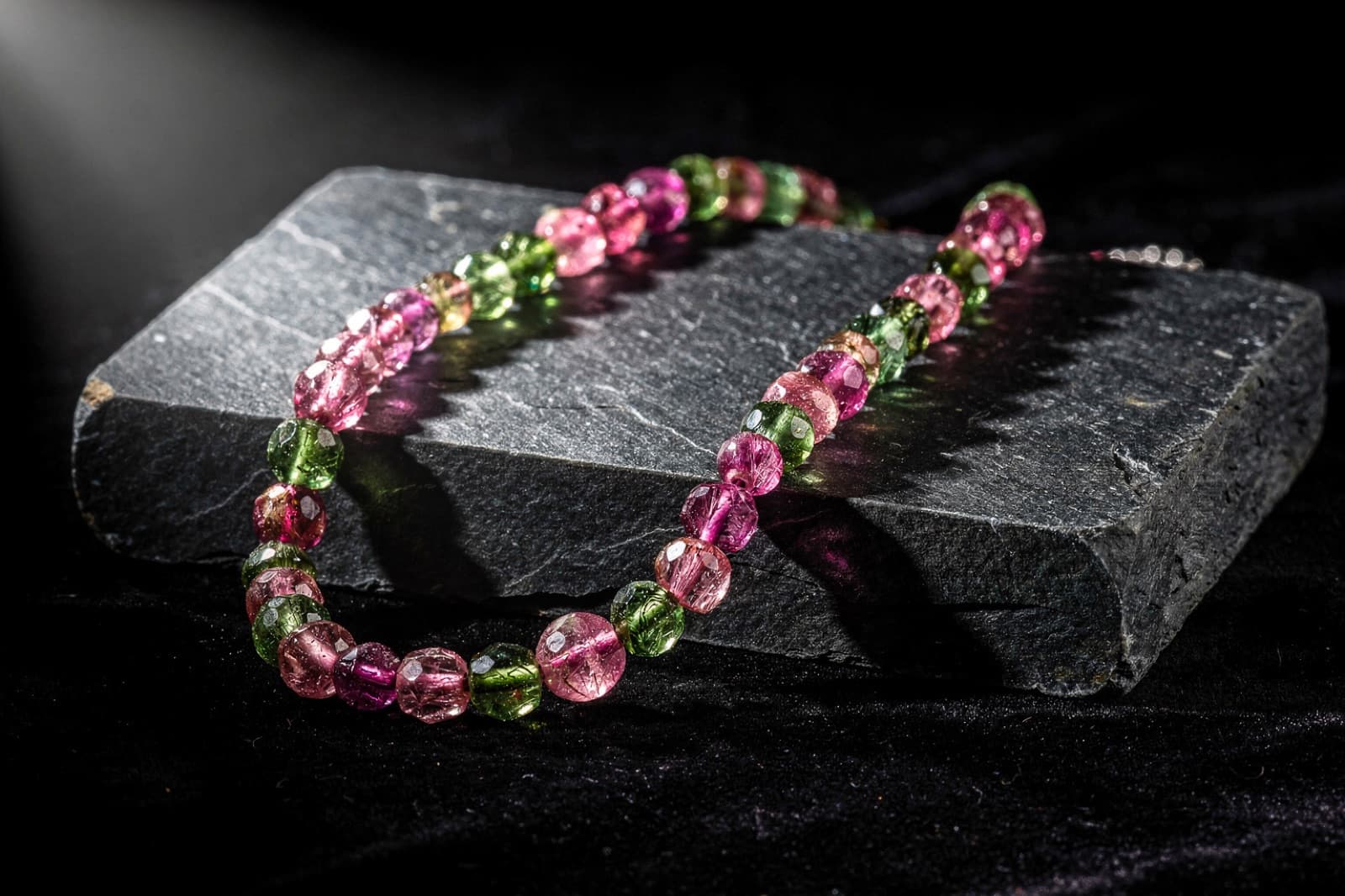
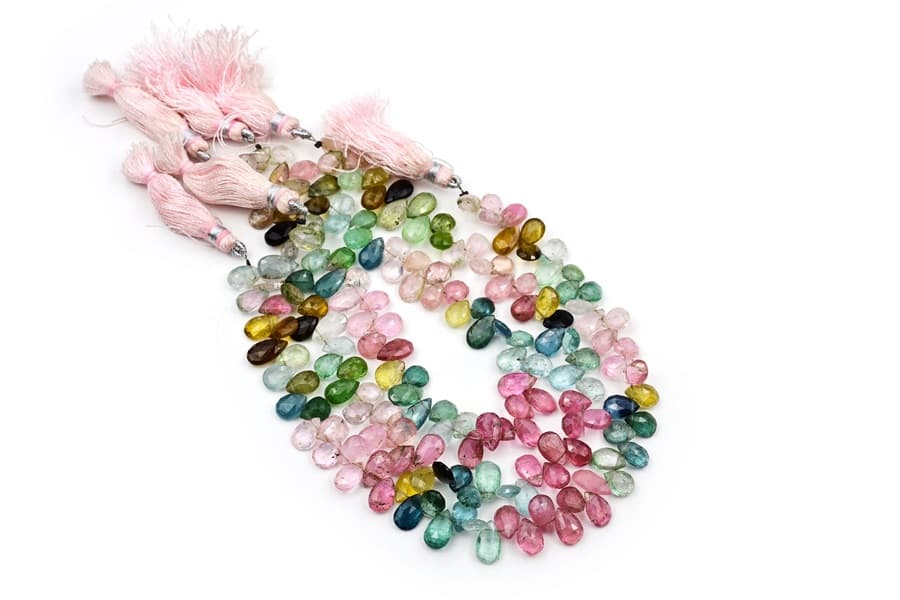
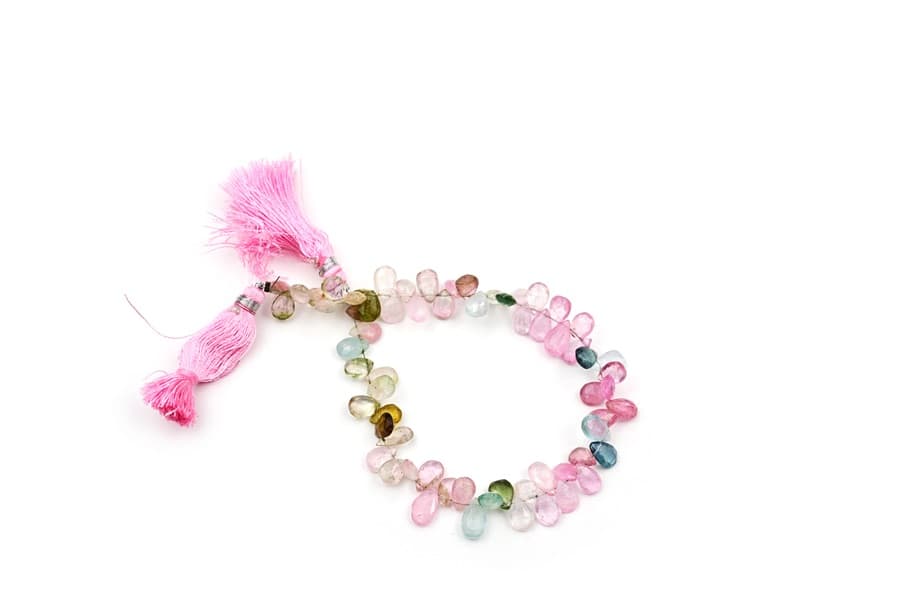
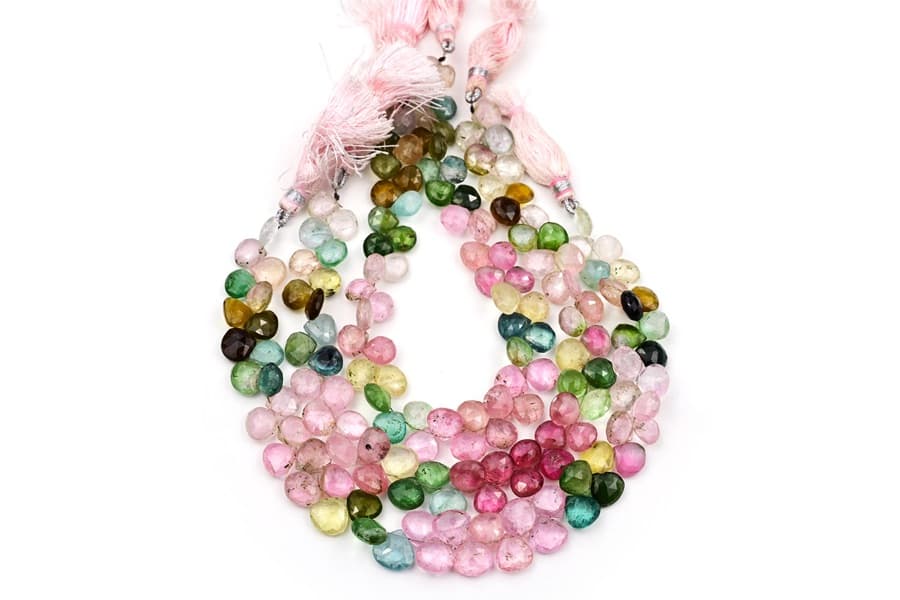
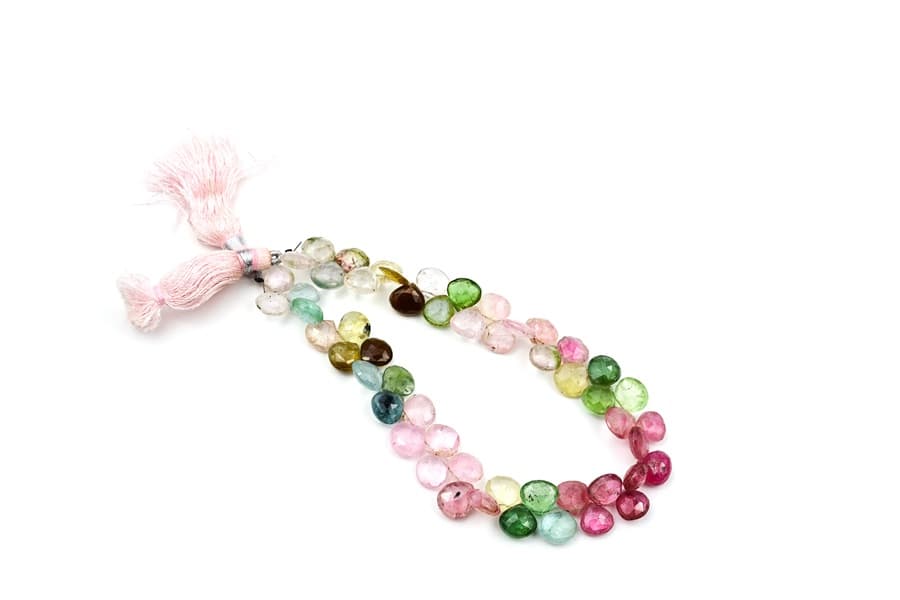
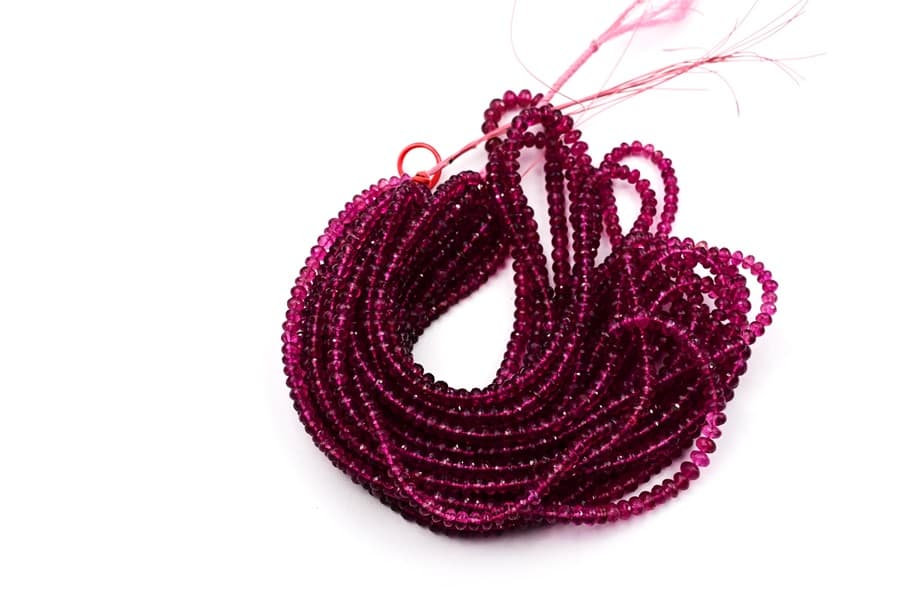
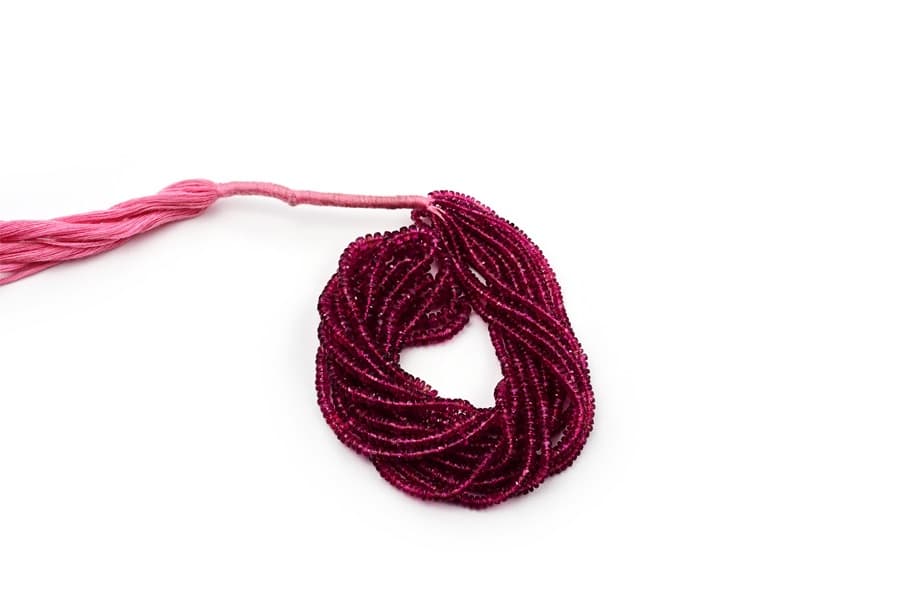
Film and illustrations are AI renders. Strand listings below show photographs of the actual material.
How to judge it
A good multi strand has clean pinks, greens and blues with few muddy brown-olive beads. Tourmaline is darker along the crystal's length than across it, and facet edges double under a loupe. Real watermelon slices show a rounded-triangular outline and a pink core grading to green rind.
What it's like to work with
Designers wanting color variety, October birthstone sellers, wire-wrappers. Multi rondelles are volume; slices and briolettes are high-ticket focals.
Care
Fine for daily wear including bracelets; skip ultrasonic and steam on included beads and slices.
October birthstone (with opal); Egyptian legend has it passing through a rainbow (tradition, not fact).
Eleven colors, one mineral, one strand.
A multi tourmaline strand reads like a paint box. Pink beside mint, then a deep sea blue, then a green so saturated it looks wet. Turn the strand in the light and the tones shift, because tourmaline is darker along the length of the crystal than across it, so a bead can hold two moods depending on how it was oriented at the wheel. Watermelon beads show the family trait plainly: a pink core grading out to a green rind. People reach for it when one color is not enough.
Where it comes from
The name comes from the Sinhalese toramalli, stone with mixed colors. Dutch merchants used the word for the water-worn pebbles miners found in the gem gravels of Ceylon, now Sri Lanka, and the Dutch East India Company carried those Ceylonese stones to Europe in quantity to satisfy a demand for gems and curiosities. Meanwhile, somewhere in Brazil in the 1500s, a Spanish conquistador washed the dirt off a green crystal and took it for emerald. The 1554 expedition of Francisco Spinoza is credited with that so-called Brazilian emerald, and the confusion lasted until scientists recognized tourmaline as a distinct mineral species in the 1800s. The old mistake still lingers in trade names for green alkali tourmaline. Our bead grades come from Afghanistan, Nigeria, Brazil, Mozambique and Madagascar. The strands are cut in Jaipur, India, and we choose them one by one in Cupertino, California.
What tradition says
October has two birthstones, opal and tourmaline, and tourmaline is also the gem of the eighth anniversary. An Egyptian legend, carried as tradition rather than fact, has the stone passing through a rainbow. Ancient mystics are said to have believed that a gem with a shade for every mood could inspire artistic expression, and crystal folklore still treats a multi strand as a stone for creative work. Because tourmaline comes in more colors and color combinations than any other mineral group, people have long picked a bead by its hue and let that choice carry meaning. All of it is belief, passed along with the beads themselves.
These are beliefs people have held about the stone, told as tradition. They are not claims, and not advice.
How makers use it
Faceted multi rondelles at 3mm and 4mm are the workhorse. Knotted on silk or strung plain, they put eleven colors in a necklace without any one bead shouting. At 3mm, count on roughly 17 carats in an 8 inch strand, useful when you are planning a run of bracelets. Watermelon slices work as focals, and wire-wrappers like them because the pink core and green rind already do the design work. Crystal sticks are the mineral as it grew, good beside a clasp or strung short and plain. We list twelve strands, including watermelon along with single-color pink and green.
Looking after it
Tourmaline sits at 7 to 7.5 on the Mohs scale and has no cleavage, so it takes daily wear well, bracelets included. Clean with warm water, mild soap and a soft brush. Keep included beads and slices out of ultrasonic and steam cleaners, and store strands away from harder stones.
Sources: Tourmaline History and Lore, What Is Tourmaline Gemstone | Tourmaline Stone – GIA, Tourmaline: Earth's most colorful mineral and gemstone, October Birthstones | Opal & Tourmaline Birthstone Information | GIA
Tourmaline strands
All 12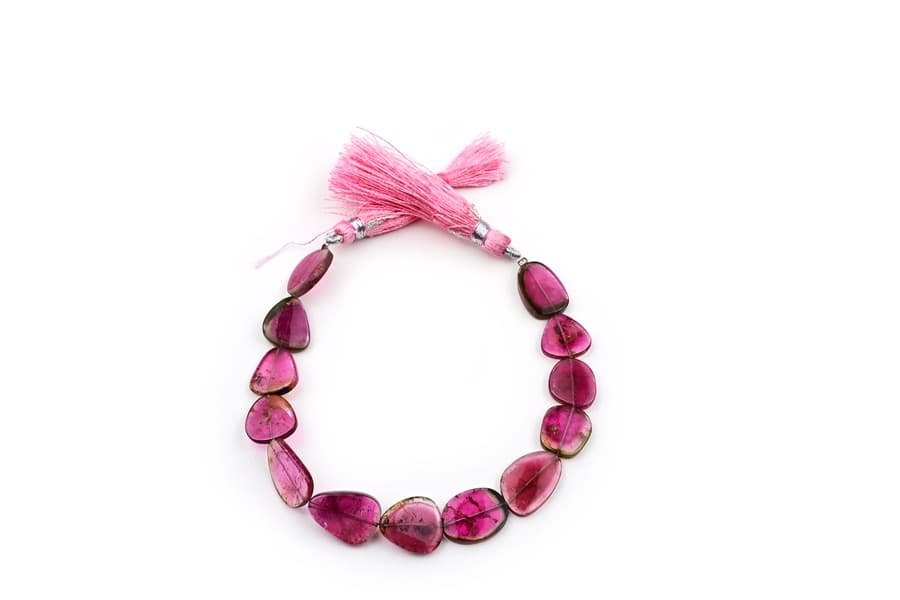 New
New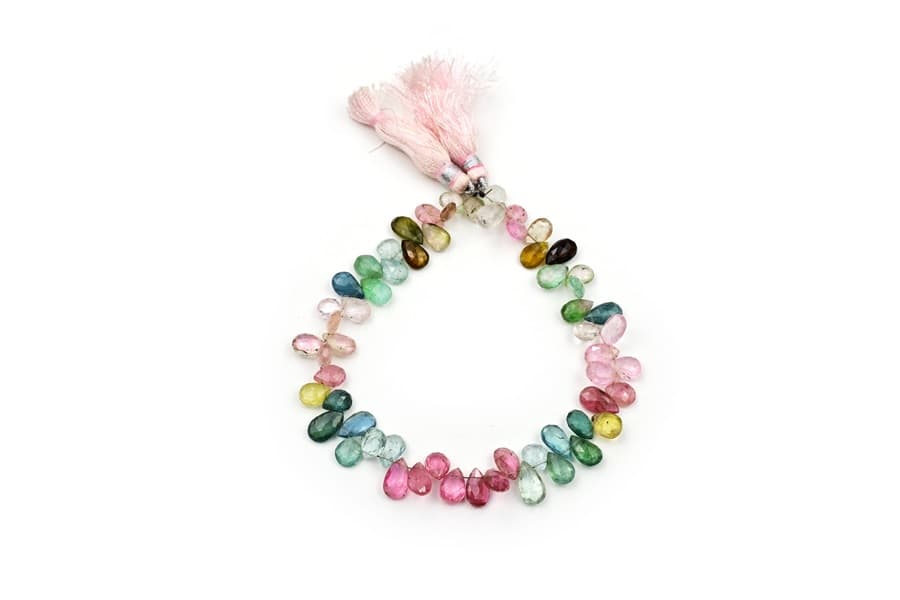
From the blog
All posts For designers and shops
How do I allocate a strand's cost to earring pairs and leftover beads?
Treat the strand's cost as cost per usable bead. Cull any beads you would not sell, then divide strand cost by the usable bead count. Assign each earring pair the cost of two beads, and reduce the strand's remaining cost by that amount. Price finished items by multiplying material cost two to three times, then add labor at your hourly rate.
 Buying guides
What size bails or jump rings fit pyramid and trilliant gemstone beads?
Measure the drill height, the center of the hole to the nearest edge. Pick a jump ring whose inner diameter is about twice that distance so it swings freely. For example, a .5 mm drill height needs roughly a 1 mm ID. Choose the thickest wire that passes the hole smoothly.