Rhodochrosite
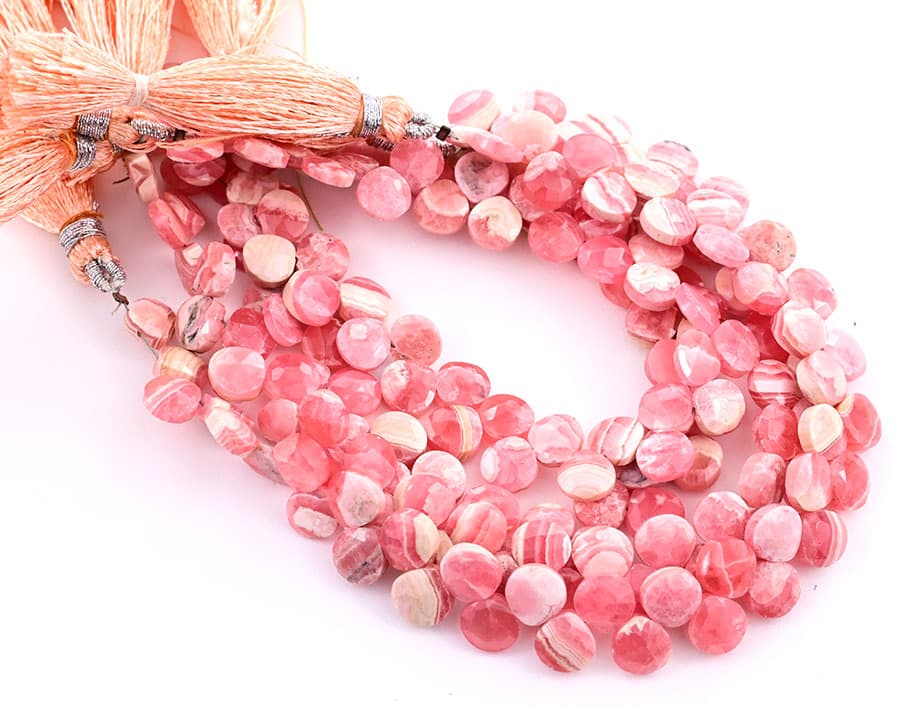
Manganese carbonate. Mohs 3.5-4, perfect cleavage in three directions. Banded pink-and-cream bead material comes from the Capillitas mine, Catamarca, Argentina, where it formed as stalactites in old copper-silver workings, hence "Inca Rose."
At a glance
| Hardness (Mohs) | 3.5 to 4 |
|---|---|
| Family | Rhodochrosite |
| Where it is mined | See description |
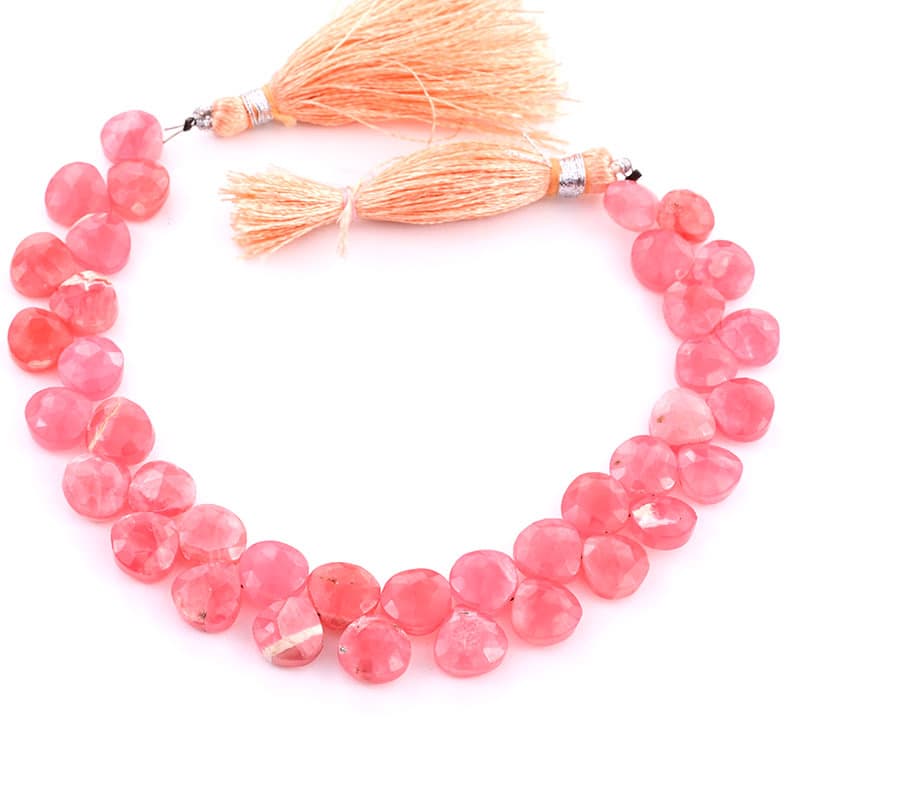
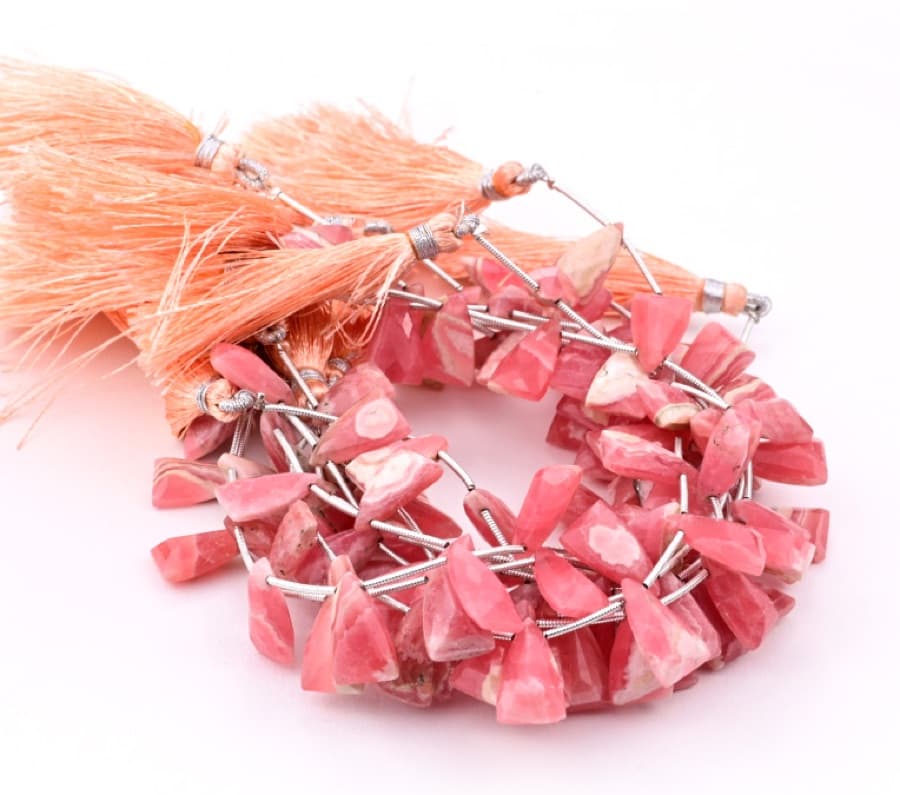
| Shapes we carry | Hearts, Pyramids |
| Strands listed | 4 |
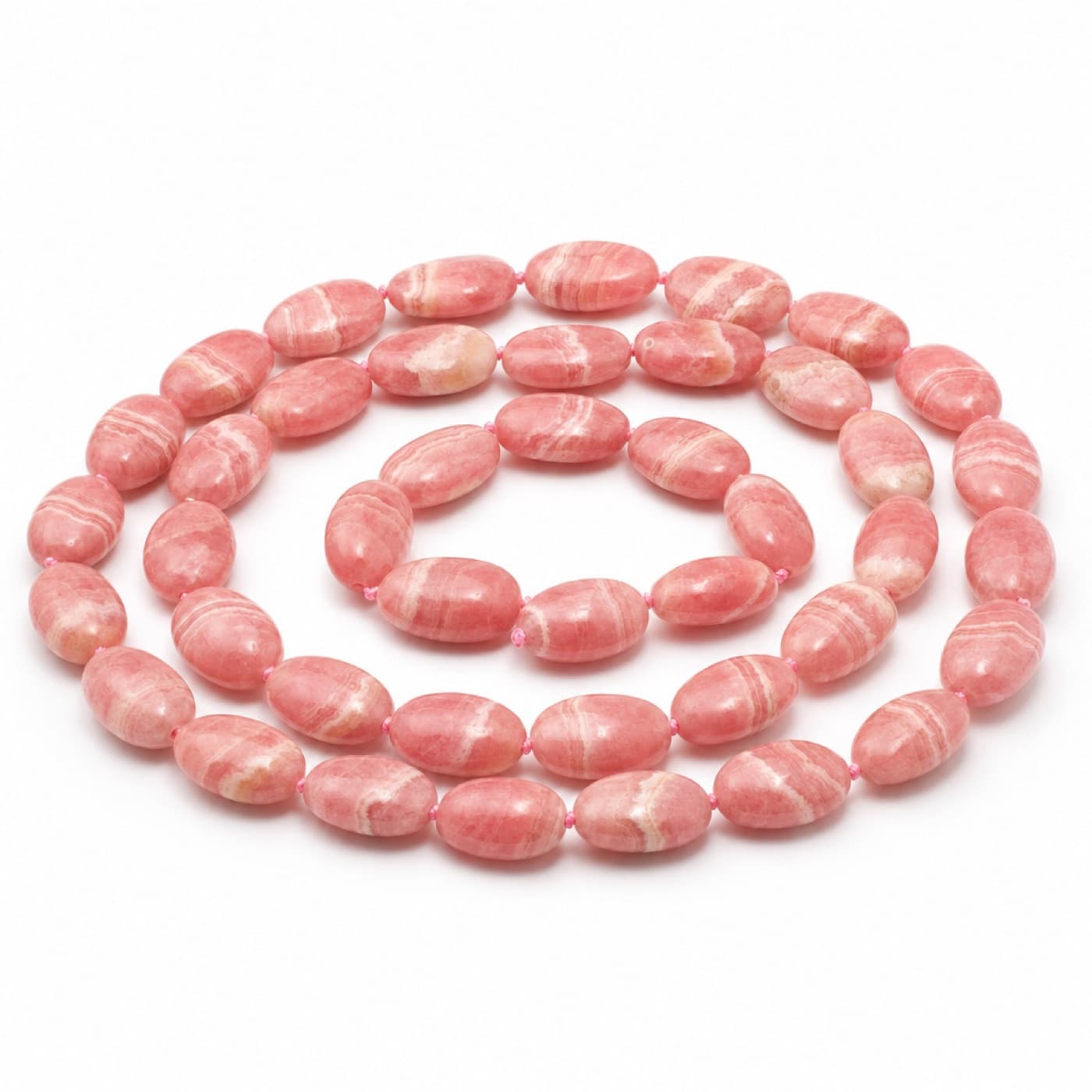
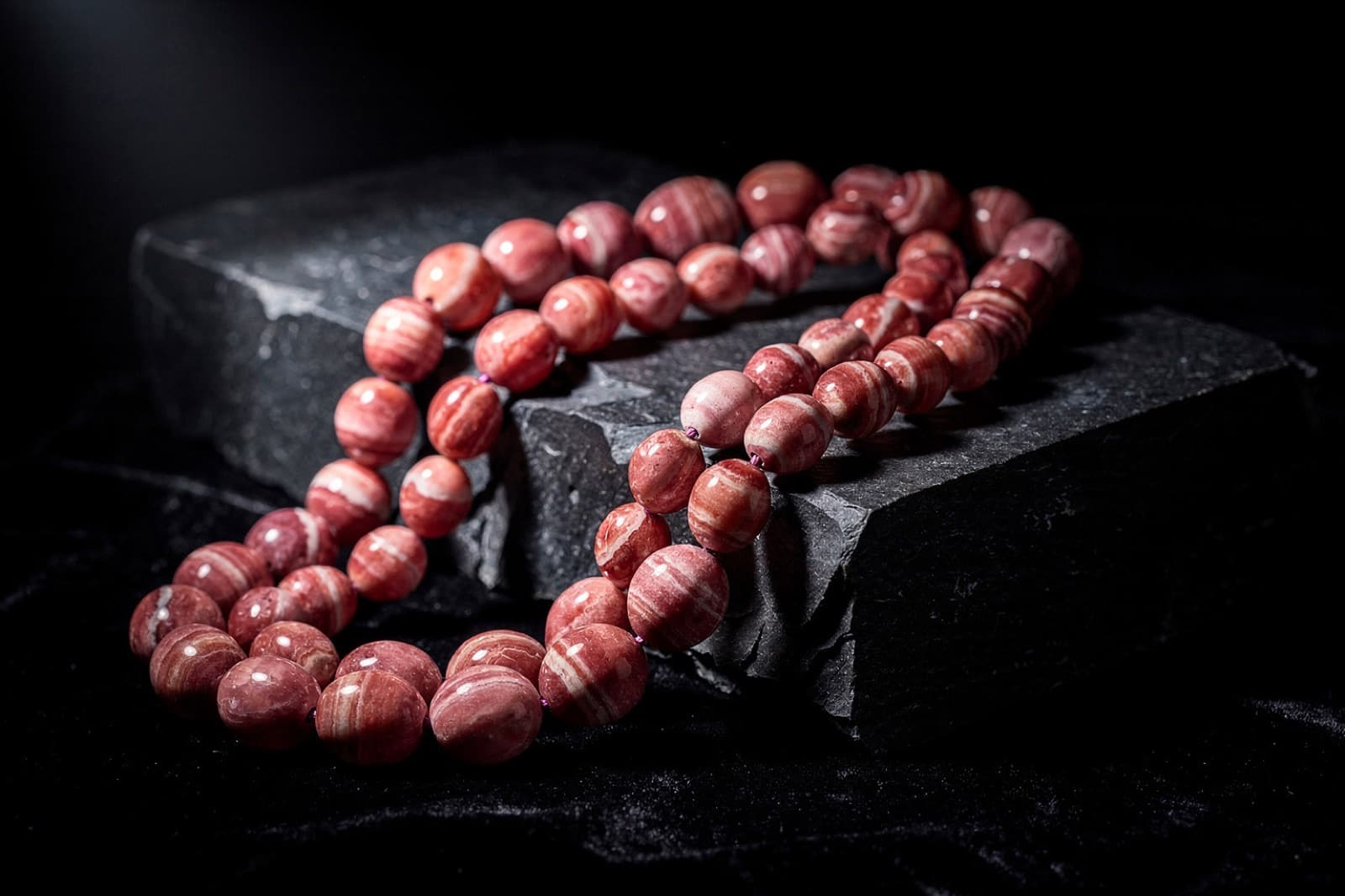
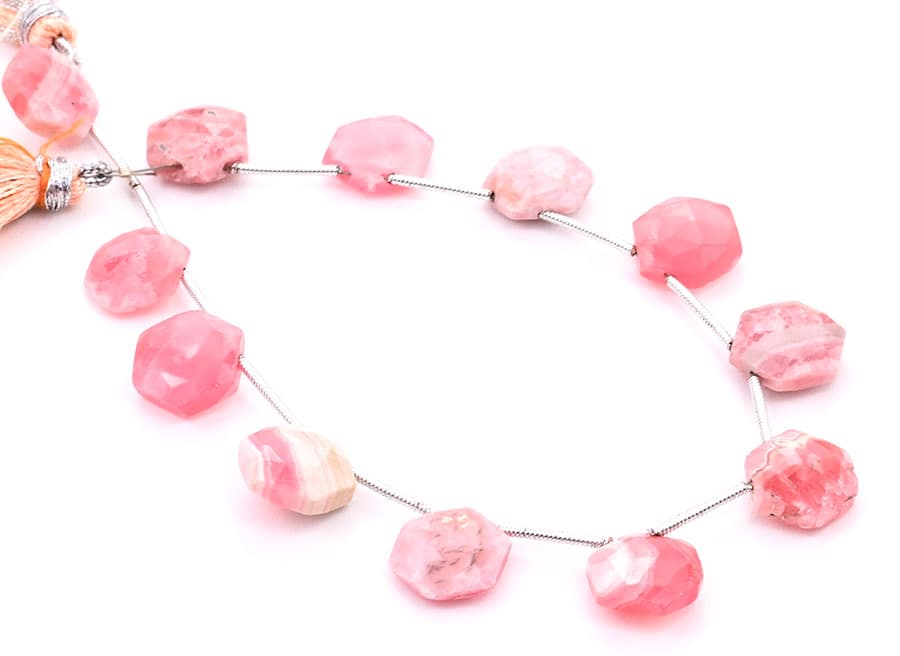
Film and illustrations are AI renders. Strand listings below show photographs of the actual material.
How to judge it
Strong rose to raspberry bands alternating with cream or white, sharp and concentric, with translucency at the edges. Pale, mostly cream beads are the low grade. A drop of vinegar at the drill hole fizzes on rhodochrosite and calcite, not agate or rhodonite; rinse at once.
What it's like to work with
Mid tier. Pink palettes, single-focal necklaces. Large ovals show the bands; small rondelles don't.
Care
Necklaces and earrings only. Perfume, sweat and any acid etch it. Damp cloth and dry; no soaking, ultrasonic or heat.
No birthstone month; tradition calls it a stone of compassion (tradition, not fact).
Growth rings from an old silver mine, in rose and cream.
Pink and cream in alternating bands, each one following the curve of the last. On a strand of large ovals the pattern shifts bead to bead: some cut across the rings like a sliced onion, others catch them lengthwise as soft stripes. Hold one to a window and the edges go translucent, the rose deepening toward raspberry where the band is thickest. Makers reach for it because no two beads repeat, and because that pink is a mineral color.
Where it comes from
Rhodochrosite is manganese carbonate, and it turns up in only a small number of places where other manganese minerals are present. Notable occurrences include Cavnic in Romania and Butte, Montana, and Leadville, Colorado. The banded material used for beads comes from the Capillitas mine in Catamarca Province, Argentina, a locality worked by the Incas and long known for fine rhodochrosite stalactites. Those stalactites grew in old copper and silver workings, drip by drip, and the bands in a finished bead are their growth rings. The Argentine name, Inca Rose, stayed with the stone, which is now Argentina's national stone. Colorado's Sweet Home mine tells a different story: established as a silver mine in 1872 in the Alma Mining District at about 3,300 meters, it saw miners throw most of the rhodochrosite away, because it interfered with the amalgamation process then used for silver ore.
What tradition says
In crystal tradition, rhodochrosite is called a stone of compassion, and the folklore around it stays in that register: kindness rather than power or luck. People who keep stones for their meanings group it with the pink stones for that reason. The Argentine name, Inca Rose, carries its own affection in the stories told about the Capillitas mine and the Incas who worked it, and Argentina has since made rhodochrosite its national stone, which gives the pink a second kind of meaning there. All of this is belief and custom rather than fact, passed along with the stone from one owner to the next.
These are beliefs people have held about the stone, told as tradition. They are not claims, and not advice.
How makers use it
Banded rhodochrosite wants room to show its rings, so we favor smooth ovals in the 15 to 20mm range, one as the focal point of a necklace with plain metal or small pale beads on either side. Small rondelles lose the pattern entirely. Faceted hearts suit earrings and short pendants, where the pink reads clearly against silver. Kept in a pink palette, a single oval carries a whole necklace without competition. A stronger strand shows sharp, concentric rose to raspberry bands against cream, with light passing through at the bead edges; pale, mostly cream beads are the weaker end. Our strands are cut in Jaipur, India, and chosen strand by strand in Cupertino, California.
Looking after it
This is a soft stone with easy cleavage, so keep it to necklaces and earrings rather than rings or bracelets. Perfume, sweat and anything acid will etch the surface. Wipe the beads with a damp cloth and dry them at once. No soaking, no ultrasonic cleaner, no heat.
Sources: Sweet Home Mine Rhodochrosite from 1888, Rhodochrosite: Manganese ore, gemstone, mineral specimen, Rhodochrosite: The gemstone rhodochrositeinformation and pictures · Minerals.net, Rhodochrosite