Kunzite
Pink to lilac spodumene, lithium aluminum silicate, LiAlSi2O6, colored by manganese. Mohs 6.5 to 7 with perfect cleavage in two directions. Bead-grade rough: Afghanistan, Pakistan, Brazil, Madagascar.
At a glance
| Hardness (Mohs) | 6.5 to 7 |
|---|---|
| Family | Spodumene |
| Where it is mined | Afghanistan, Pakistan, Brazil, Madagascar |
| Shapes we carry | Ask us |
| Strands listed | 0 |
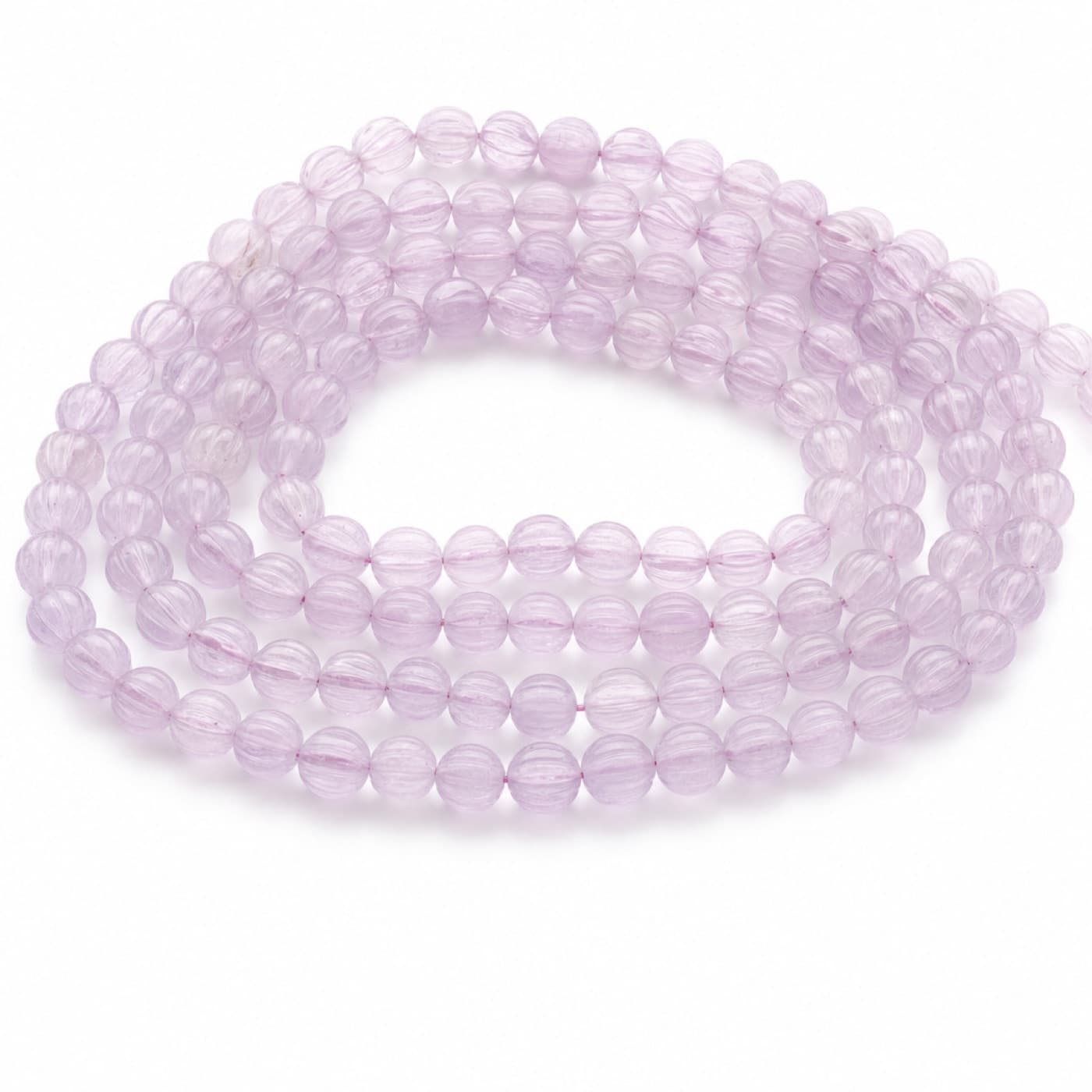
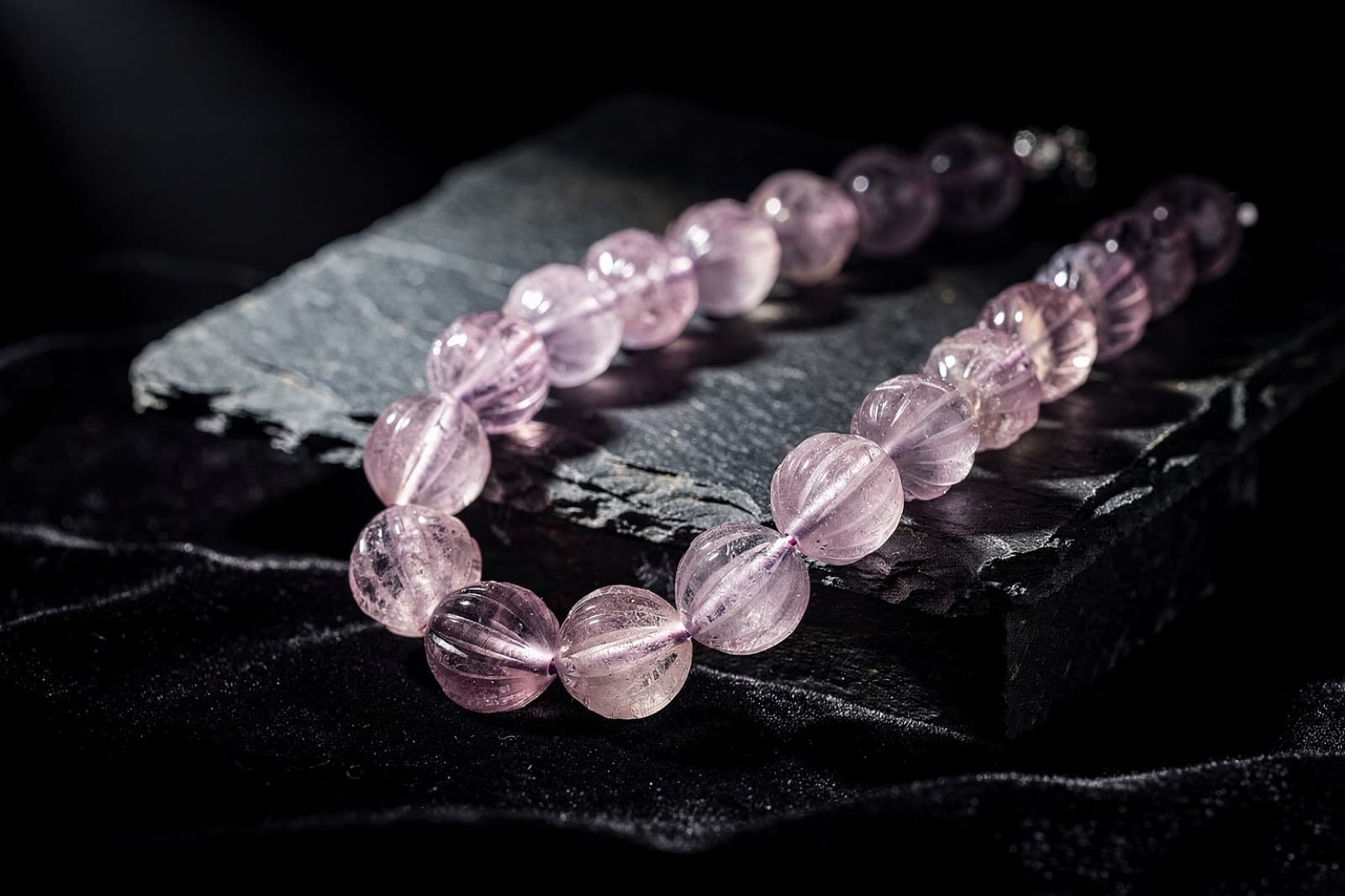
Film and illustrations are AI renders. Strand listings below show photographs of the actual material.
How to judge it
Kunzite is pale, so bigger beads show more color; 4mm rondelles look like glass. Turn a bead and it shifts pink, violet and near colorless. Rose quartz is cloudier with no color shift. Reject beads with cleavage planes reaching the drill hole.
What it's like to work with
Bridal and blush-palette designers, statement makers who want big pale beads. Melons as focal runs; tubes for bar pendants.
Care
Not a beach or windowsill stone; no ultrasonic, steam, hot water, halogen lamps or bracelets.
No birthstone; modern crystal lore calls it a stone of emotional healing (tradition, not fact).
Pink that needs ten millimeters to show itself.
On the strand it reads pale pink with a violet undertone, closer to the inside of a shell than to candy. Turn one bead in daylight and the color moves: pink, then lilac, then nearly colorless. The color is thin, which is why size matters here. A 4mm rondelle reads as glass, while a 10mm melon holds enough pink to carry a necklace on its own. Makers reach for it when they want scale, big soft-colored beads that still look like gemstone.
Where it comes from
Kunzite is the pink to lilac variety of spodumene, a lithium aluminum silicate that takes its color from traces of manganese. Spodumene itself was first described in 1800 from Uto, in Sodermanland, Sweden, by the Brazilian naturalist Jose Bonifacio de Andrada e Silva, who named it from the Greek word for burnt to ashes after the dull gray look of material refined for industry. The pink kind came much later. It was found in the pegmatites of Pala, in San Diego County, California, in 1902, and recognized as a distinct variety of spodumene by the American gemologist George Frederick Kunz, whose name it carries. San Diego County is still an important source. Bead-grade rough now comes from Afghanistan, Pakistan, Brazil and Madagascar. Our strands are cut in Jaipur, India, and chosen strand by strand in Cupertino, California.
What tradition says
Some kunzite pales after long hours in bright light, drifting toward colorless, and that habit gave it the nickname evening stone. Certain traditions count it as an alternate birthstone for February. In modern crystal folklore it is described as a stone of emotional healing, and people who keep such stones tend to file it with the soft and quiet ones rather than the guardians. It is said to suit anyone going through a tender stretch. All of this is belief and custom, carried hand to hand and repeated because people like thinking that way, not a claim about what the stone does for anyone.
These are beliefs people have held about the stone, told as tradition. They are not claims, and not advice.
How makers use it
This is a stone for blush palettes and bridal work, where pale pink needs to hold its own next to white metal and pearl. Because the color is soft, size carries it: carved melons at 8 and 10mm give a focal run real presence, while tubes suit bar pendants and short vertical drops. Smooth nuggets work as spacers between richer stones. A stronger strand shows the color shift plainly as you rotate a bead; a weaker one stays one flat tint. We carry melons, nuggets, tubes and ovals, and melons come in heavy, so plan clasps and knots for the weight.
Looking after it
Keep it out of direct sun and off windowsills, since the color can fade with long exposure. No ultrasonic, no steam, no hot water, no sitting under halogen lamps. Cleavage runs perfectly in two directions at 6.5 to 7 hardness, so skip bracelets and store the strand away from light.
Sources: Kunzite Gemstone | Kunzite Stone - GIA, Kunzite spodumene: The pink gemstone Kunzite information and pictures · Minerals.net, Spodumene (var. kunzite) | Smithsonian National Museum of Natural History, Spodumene (var. kunzite) | Smithsonian National Museum of Natural History
Kunzite is in the stock room
We carry kunzite at shows and it is not all listed online yet. Tell us the shape and size you want and we will send photos of what is in stock.
Ask on WhatsApp