Fluorite
Calcium fluoride. Mohs 4, perfect cleavage in four directions. Banded "rainbow" bead material comes almost entirely from China.
At a glance
| Hardness (Mohs) | 4 |
|---|---|
| Family | Fluorite |
| Where it is mined | See description |
| Shapes we carry | Ask us |
| Strands listed | 0 |
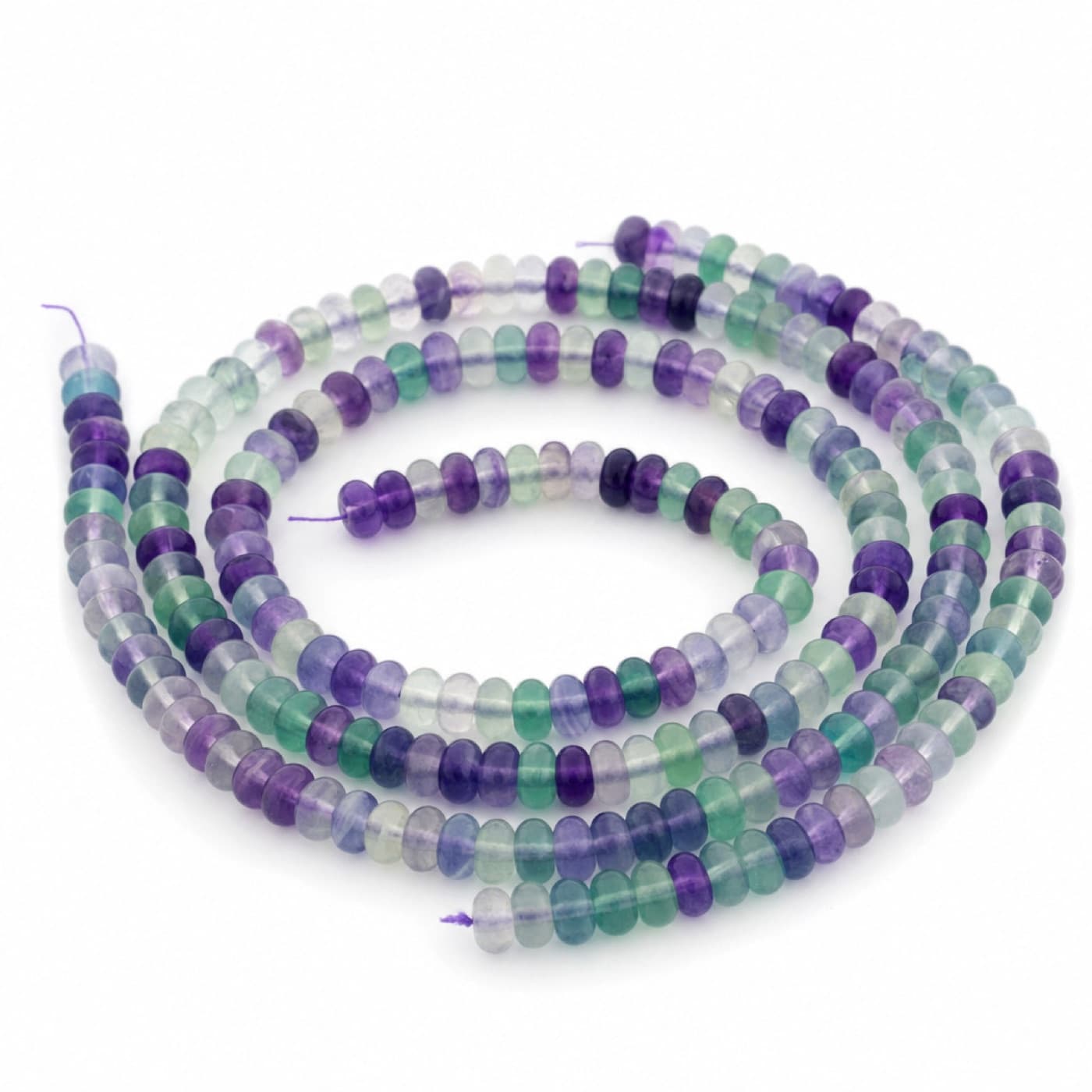
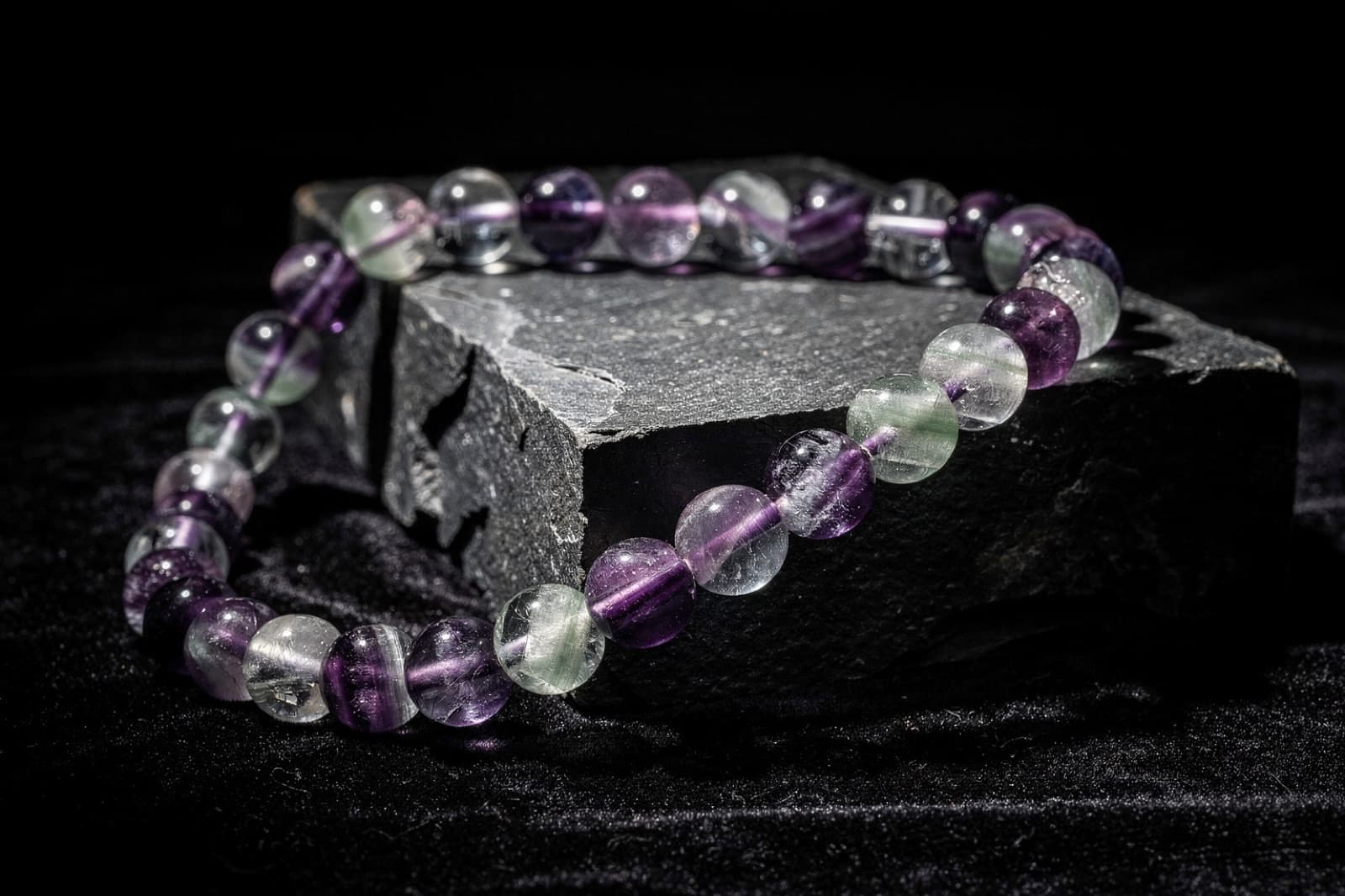
Film and illustrations are AI renders. Strand listings below show photographs of the actual material.
How to judge it
Saturated bands with sharp color changes and good transparency; gray or mostly colorless beads are the low end. Faceted tubes should have crisp facet junctions; a rushed polish rounds them. Check drill holes for flat or stepped chips, early cleavage.
What it's like to work with
Entry tier. Candy palettes, crystal-shop buyers, gift lines. Rondelles and heishi sell best.
Care
Mohs 4 in plain terms: a steel pin, a key or house dust (quartz, Mohs 7) will scratch it, and a knock on a table edge can split a bead along a cleavage plane. Earrings and necklaces only; never bracelets or rings. Cool soapy water; no ultrasonic, heat or acids.
No birthstone month; tradition calls it the "genius stone" for focus (tradition, not fact).
Every bead is a different slice through the color bands.
Hold a strand of banded fluorite up to a window and the beads read like slices of a layered cake: green giving way to violet, violet to water clear, sometimes a seam of colorless stone between. No two beads repeat, because each one is cut through a different part of the color banding. The surface takes a glassy polish that looks wet. People reach for it because it is cheerful without being loud, and because the colors are the stone's own.
Where it comes from
Fluorite is calcium fluoride, deposited in veins by hydrothermal processes and found in the fractures and cavities of some limestones and dolomites. It is common in many parts of the world, and miners call it fluorspar. The name comes from the Latin fluere, to flow, for its use as a flux in iron smelting; it was first printed under that sense in 1530, in Georgius Agricola's Bermannus. In 1852 George Gabriel Stokes named fluorescence after the mineral, some specimens of which glow under ultraviolet light. As a decorative stone it has a long English chapter: for over 1,500 years artisans worked Blue John, the Derbyshire variety banded in white, blue, violet and reddish brown, into vases and bowls. Those deposits are nearly exhausted, and a similar banded material has since been found in China, which is where almost all rainbow bead fluorite now comes from. Our strands are cut in Jaipur, India, and chosen in Cupertino, California.
What tradition says
Crystal tradition calls fluorite the genius stone. People who keep a piece on a desk, or wear it while studying, have long believed it sharpens focus and sorts a crowded mind into order. That is belief rather than fact, but it is a persistent one, and it shapes how the stone is sold and given. It reaches crystal shops as often as jewelry benches. The banding invites its own reading, since a single bead can carry several colors at once, and people tend to speak of the stone in terms of attention and clear thinking. Whatever a wearer makes of that, the colors are reason enough to keep a strand nearby.
These are beliefs people have held about the stone, told as tradition. They are not claims, and not advice.
How makers use it
This is a good first colored strand. Smooth rondelles in the 6 to 8mm range are the workhorse, easy to knot or string on beading wire for a simple necklace where the color changes do the work. Faceted tubes catch more light, and crisp facet junctions are worth looking for, since a rushed polish rounds them off. Heishi lies flat and reads almost like a painted line at the throat. We carry all three in banded multicolor. The best strands show saturated bands with sharp changes between them and enough transparency to see into the bead; gray or mostly colorless beads look flat next to them. Keep it to earrings and necklaces.
Looking after it
Fluorite is Mohs 4 with perfect cleavage in four directions. House dust will scratch it, so will a key or a steel pin, and a knock against a table edge can split a bead. Wash in cool soapy water only. No ultrasonic, no heat, no acids. Treat it like glass and it will last.
Sources: Fluorite gemstone information, Fluorite: The gemstone fluorite information and pictures · Minerals.net, Fluorite Value, Price, and Jewelry Information - Gem Society, Fluorite and Fluorspar: Mineral uses and properties
Fluorite is in the stock room
We carry fluorite at shows and it is not all listed online yet. Tell us the shape and size you want and we will send photos of what is in stock.
Ask on WhatsApp