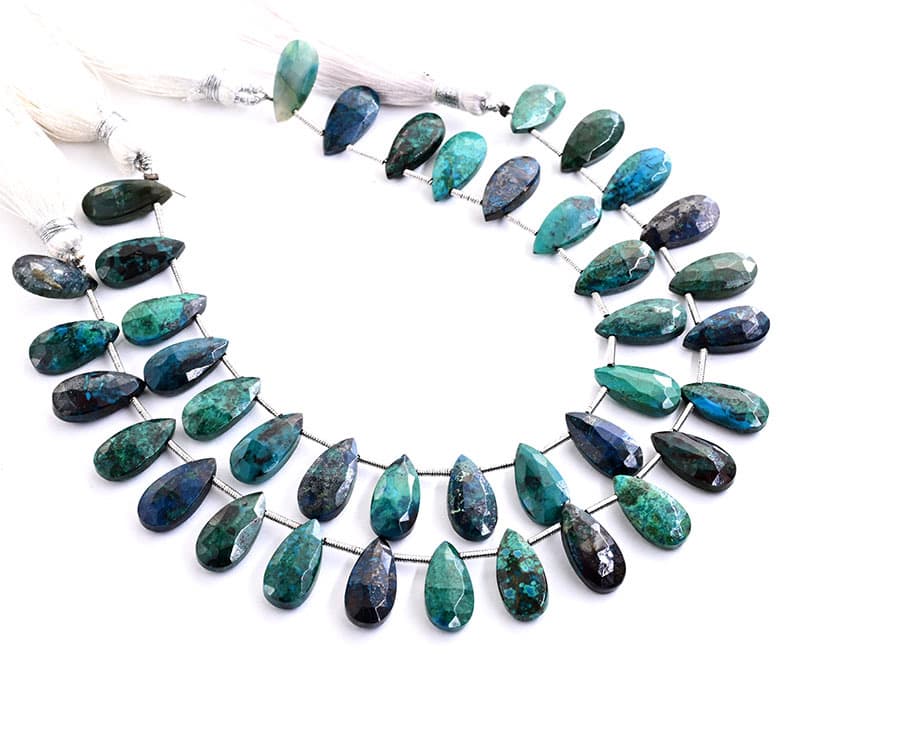
Chrysocolla and shattuckite
Two blue-green copper silicates that grow together. Chrysocolla is Mohs 2.5-3.5 alone but up to 7 locked in chalcedony or quartz, the bead-grade form, from Peru, DR Congo and Arizona. Shattuckite (Mohs about 3.5) was named for Bisbee's Shattuck mine; most now comes from the Kaokoveld, Namibia.
At a glance
| Hardness (Mohs) | 2.5 to 3.5 |
|---|---|
| Family | Chrysocolla |
| Where it is mined | See description |
| Shapes we carry | Pears |
| Strands listed | 1 |
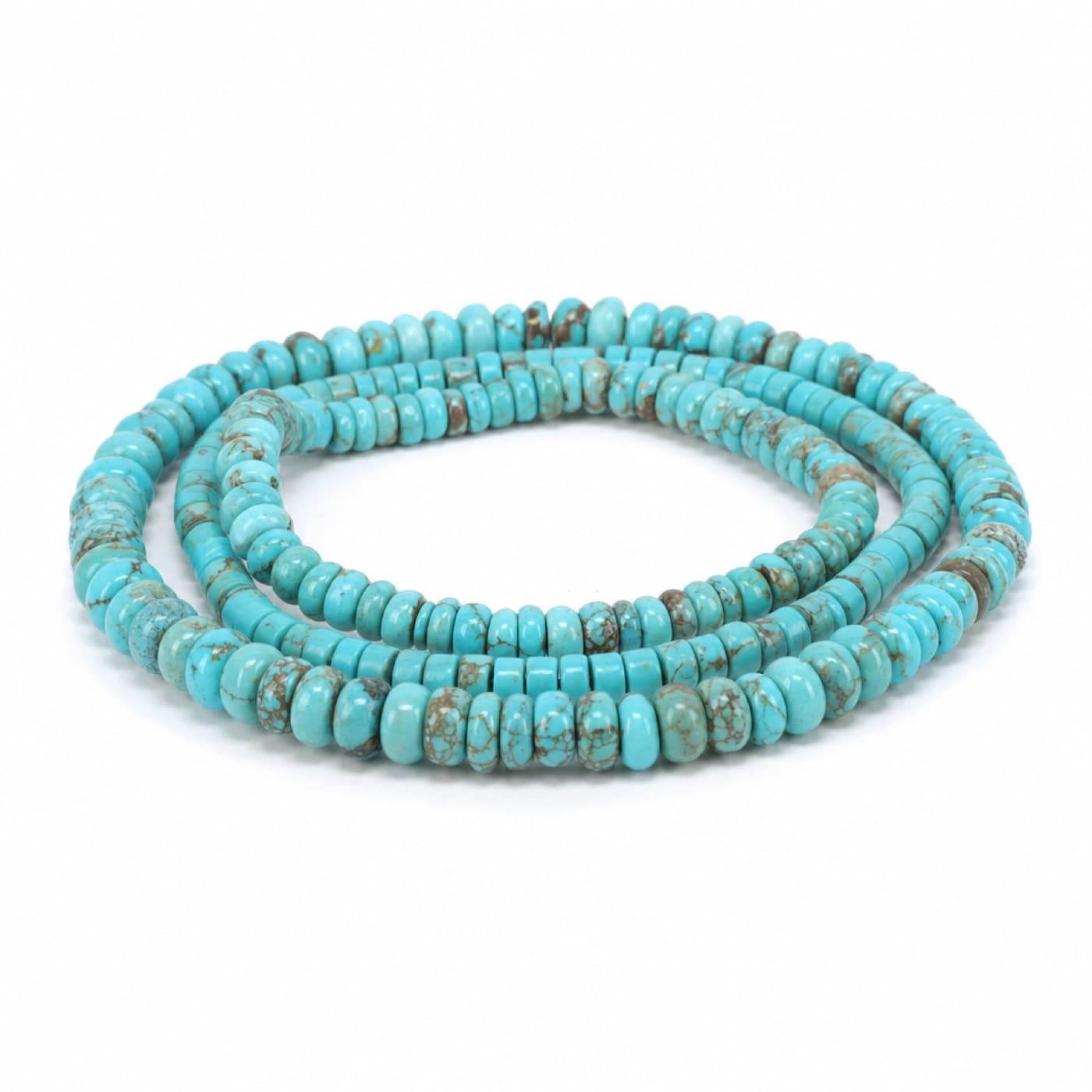
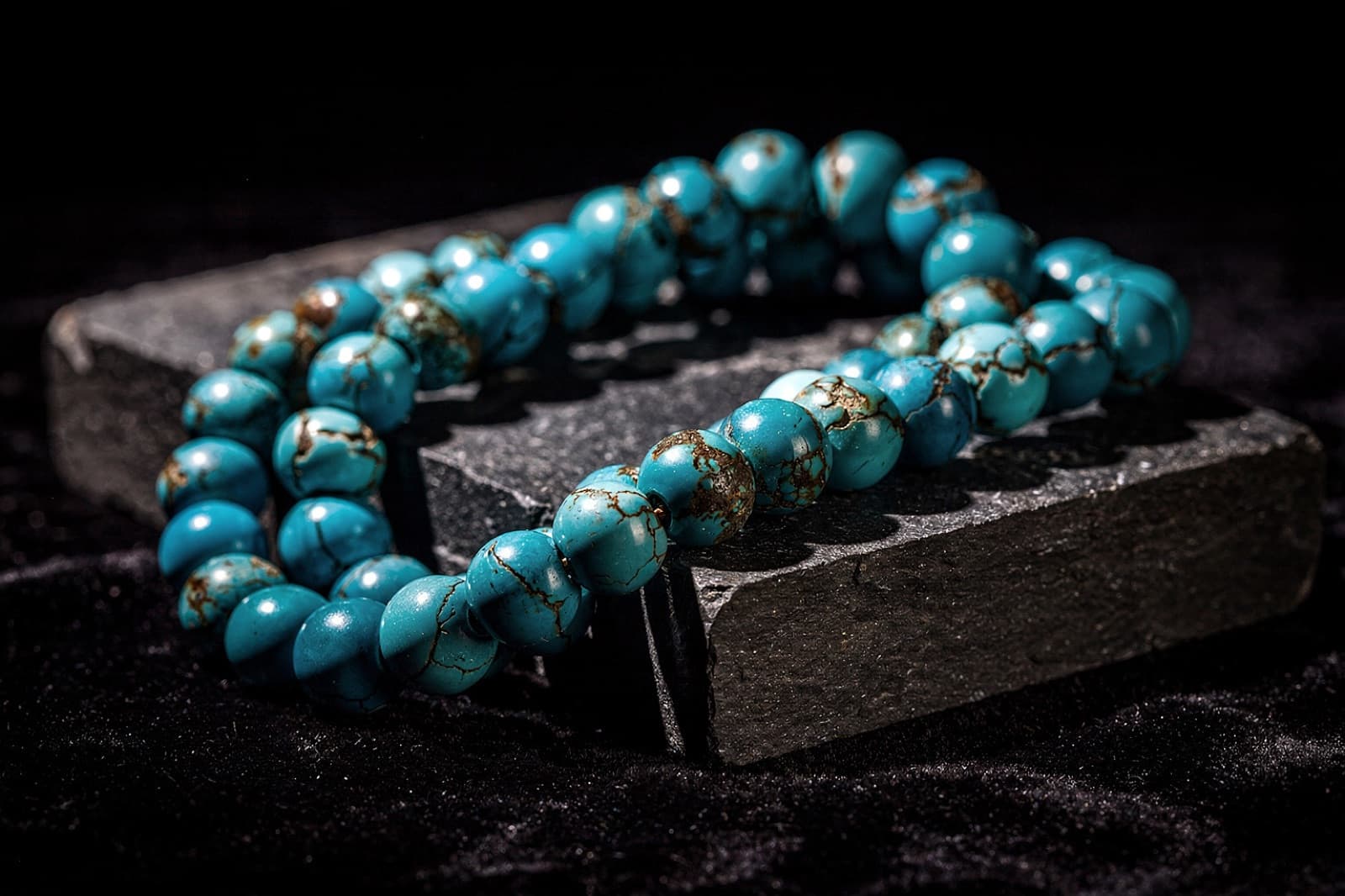
Film and illustrations are AI renders. Strand listings below show photographs of the actual material.
How to judge it
Chrysocolla is robin's-egg to sky blue-green with a waxy to glassy finish; shattuckite is deeper, near-royal blue in fibrous patches, often with black or green. The usual confusion is azurite-malachite, a carbonate: azurite is deep navy, malachite green in concentric bands. Vinegar on a hidden spot fizzes on azurite-malachite, not on the silicates.
What it's like to work with
Mid tier. Southwest palettes as a turquoise alternative. Nuggets and ovals sell best.
Care
Necklaces and earrings. Damp cloth; no ultrasonic, acids or perfume.
No birthstone month; tradition calls it a stone of communication (tradition, not fact).
Copper blue locked in quartz, cut in Jaipur.
On the strand, two blues take turns. Chrysocolla runs robin's-egg to sky, blue-green, waxy where the polish sits and glassy where the quartz took over. Shattuckite comes in deeper. Near-royal, in fibrous patches that read almost navy in low light, often edged with black or green. People reach for it because it looks like turquoise and wears harder: copper color locked into quartz. Hold a strand up. The pale beads glow while the dark ones hold their weight.
Where it comes from
Chrysocolla forms where water carrying dissolved silica works on copper ore near the surface, so it turns up in the upper parts of copper veins in dry country. Alone it is soft. Mixed with silica as a gel and hardened into chalcedony or quartz, it reaches up to 7 on the Mohs scale, and that harder form is the one cut into beads. Ours traces back to Peru, the Democratic Republic of the Congo and Arizona. Shattuckite was first found in 1915 in the copper mines of Bisbee, Arizona, at the Shattuck mine, which gave the mineral its name. Most of what reaches the market now comes from the Kaokoveld in Namibia. The name chrysocolla is older. Theophrastus and other ancient writers applied it to materials used in soldering gold, from the Greek words for gold and glue. Our strands are cut in Jaipur and picked out one at a time in Cupertino, California.
What tradition says
In crystal tradition these copper silicates are called stones of communication. People have long believed that keeping one close makes words easier to find, and that it favors plain speech over the polished kind. The belief travels with the beads. A strand gets strung for someone who has something to explain, or worn by a person who wants to be understood the first time and not the third. None of that is a claim about the body. It is what has been said about the stone for a long while, repeated among people who work with color and rock, and handed along with the strand itself.
These are beliefs people have held about the stone, told as tradition. They are not claims, and not advice.
How makers use it
Makers reach for these beads most often in Southwest palettes, where the blue-green sits next to turquoise without repeating it. Smooth ovals and nuggets move fastest. Both take a bezel or a simple knotted line, and both look right against silver or brass. We list one strand of faceted pears at 7x15mm, small enough to hang as a single drop from an ear wire. A strong strand shows clear separation between pale sky and deep near-royal blue rather than one muddy tone. The lookalike is azurite-malachite, a carbonate: a drop of vinegar on a hidden spot fizzes there and does nothing here.
Looking after it
Keep it to necklaces and earrings, where the beads stay clear of knocks. Wipe with a damp cloth and dry them. Skip the ultrasonic cleaner and anything acidic. Perfume and hairspray should go on before the strand does, so put the piece on last and take it off first.
Sources: Chrysocolla, Shattuckite, Chrysocolla | Healing, Metaphysical, Properties | Britannica, Shattuckite gemstone information